Choosing between the many types of fences is easier when you stop asking, “Which fence looks best?” and start asking, “Which fence fits this project?”
Wood, vinyl, composite, chain link, aluminum, steel, and masonry all solve different problems. The right choice depends on privacy, security, maintenance, climate, installation conditions, local requirements, and long-term cost.
For contractors, distributors, and project buyers, there is another consideration: can the supplier deliver the right specifications consistently at project scale?
This guide compares the major fence materials and styles, explains where each works best, and shares several practical lessons we have learned from real fencing inquiries and project purchasing at JZH Fence.
Overview of the Different Types of Fences
You can classify most fences in two ways: by material and by purpose.
Common fence materials include wood, vinyl/PVC, WPC or composite, chain link, aluminum, steel, wrought-iron-style steel, wire, and masonry.
By application, fences are usually divided into privacy fencing, residential boundary fencing, pool fencing, commercial security fencing, agricultural fencing, temporary fencing, and decorative fencing.
For most projects, you should compare six factors before choosing:
- Privacy – How much visibility does the fence block?
- Security – How difficult is it to climb, cut, bend, or pass through?
- Initial cost – What are the panels, posts, gates, accessories, freight, and installation likely to cost?
- Maintenance – Will the fence require staining, painting, rust treatment, or only occasional cleaning?
- Compliance – Are there local requirements for height, gaps, gates, setbacks, or pool barriers?
- Supply capability – Can the supplier maintain specifications, finishing, accessories, packaging, and delivery across a large or repeat order?
The sixth factor becomes especially important when you are purchasing hundreds of panels rather than installing one backyard fence.
Wood Fences: Classic Privacy and Flexible Design
Wood remains one of the most recognizable fence materials. It provides a warm, natural appearance and can be cut, painted, stained, repaired, or modified on site more easily than most factory-finished fencing systems.
Common styles include solid privacy panels, board-on-board fences, stockade fences, traditional picket fences, and modern horizontal slat fencing.
A solid privacy fence places boards closely together to block direct views. A board-on-board fence uses overlapping or staggered boards, which can create privacy while allowing some airflow depending on the design.
Wood works particularly well where appearance and on-site customization matter more than low maintenance.
Its main weakness is moisture exposure.
The USDA Forest Service notes that wood decay and termite resistance depend heavily on species, treatment, moisture exposure, and construction details. For wood posts exposed to soil or high decay risk, properly treated material is particularly important. See USDA Forest Service guidance on protecting wood fences.
You should therefore consider wood carefully for humid, wet, or coastal environments. Posts, rails, end grain, fasteners, and drainage details often determine how well the system performs over time.
Best suited to: residential privacy, gardens, traditional architecture, front yards, and projects where natural appearance is the priority.
Main trade-off: attractive and highly customizable, but usually more maintenance-intensive than aluminum, vinyl, or composite fencing.
Vinyl and PVC Fences: Low-Maintenance Residential Options
Vinyl and PVC fencing are popular alternatives when you want the look of a clean painted fence without repeated painting or staining.
Typical styles include:
- Full privacy panels
- Semi-private panels
- Picket fencing
- Ranch rail fencing
- Decorative residential panels
The material does not rot like untreated timber and can normally be cleaned with water and mild detergent.
That makes vinyl attractive for residential boundaries and property managers who want predictable routine maintenance.
However, product quality matters.
Panel rigidity, internal reinforcement, post structure, UV formulation, profile thickness, and connection design can affect long-term performance. Very cold conditions can also make some vinyl products more susceptible to impact damage.
Another consideration is appearance flexibility. Once the color and profile are selected, changing the finish is less practical than repainting wood.
Best suited to: residential privacy fencing, garden boundaries, suburban developments, and low-maintenance properties.
Main trade-off: very low routine maintenance, but less structural and finish flexibility than metal fencing.
Composite and WPC Fences: Durable Privacy With a Wood-Look Finish
Composite fencing combines polymer and wood-based material to create panels that provide the visual warmth of timber with less routine treatment.
For many modern privacy projects, it sits between traditional timber and metal fencing.
Common designs include vertical privacy panels, horizontal boards, and WPC infill installed between powder-coated aluminum posts.
One important detail for professional buyers is that not all WPC fence boards are constructed the same way.
JZH Fence currently distinguishes between traditional WPC fence and co-extrusion WPC fence.
Traditional WPC generally has the core composite material exposed at the surface. A co-extrusion WPC board adds a protective outer layer around the core, which can improve surface protection, stain resistance, cleaning performance, and resistance to outdoor exposure depending on the formulation.
You can see the construction differences in our guide to traditional and co-extrusion WPC fence quality checks.
Composite fencing is especially useful when privacy and low maintenance are more important than an open-view fence design.
If you are importing complete panels rather than only boards, remember to compare the entire system: boards, posts, rails, caps, reinforcement, brackets, gates, packaging, and installation method.
Our composite fence panels import guide explains what professional buyers should check before placing a larger WPC order.
Best suited to: residential privacy, multifamily developments, hotels, resorts, courtyards, and commercial projects that want wood-like aesthetics with lower routine maintenance.
Main trade-off: higher product weight and usually a higher initial cost than basic timber, but less recurring surface treatment.
Chain Link Fences: Economical Enclosure for Large Areas
When you need to fence a long perimeter without creating a solid visual barrier, chain link remains one of the most practical options.
A typical system consists of chain link mesh, line posts, terminal posts, rails, tension components, fittings, gates, and optional security accessories.
Galvanized mesh provides basic corrosion protection, while coated systems can offer a darker, cleaner appearance for parks, schools, commercial properties, or sports facilities.
The biggest advantage is efficiency.
Chain link can cover warehouses, logistics yards, sports fields, construction sites, farms, and long property boundaries with relatively simple components.
Its main weakness is obvious: standard chain link provides little privacy.
If privacy becomes important later, you may add slats, screening material, or landscaping instead of replacing the complete fence.
For applications where security matters more than privacy, chain link can also form part of a more sophisticated perimeter system. U.S. Department of Energy physical-protection specifications, for example, illustrate how chain link fencing can be combined with additional security features in higher-risk facilities.
JZH Fence supplies chain link as part of its broader commercial and security fence systems, including posts, gates, fittings, and other perimeter options.
Best suited to: large boundaries, sports facilities, industrial yards, warehouses, construction areas, pet containment, and cost-controlled commercial projects.
Main trade-off: economical and practical, but offers less privacy and architectural value than solid or decorative fencing.
Metal Fences: Aluminum, Steel, and Wrought-Iron-Style Fencing
“Metal fence” is a broad category.
An aluminum tubular fence and a heavy steel security fence may both be black metal fences, but they solve very different problems.
Aluminum Fence
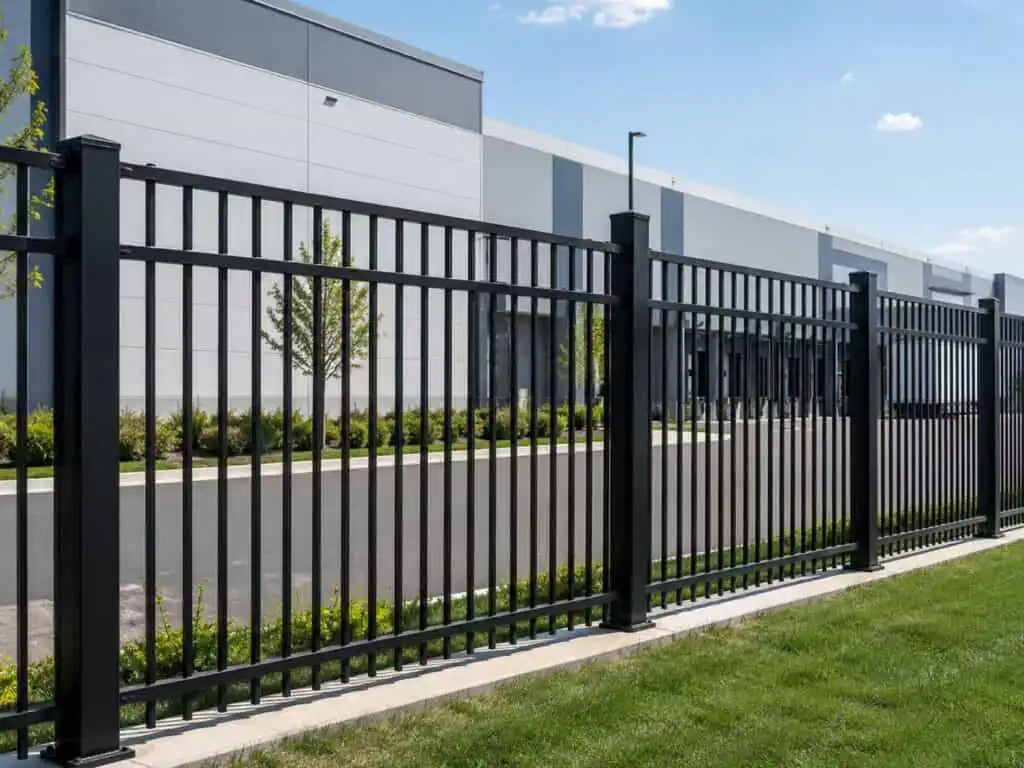
Aluminum is widely selected where you want low maintenance, corrosion resistance, lighter handling, and a clean architectural appearance.
Common styles include:
- Aluminum tubular fence
- Aluminum privacy fence
- Aluminum blade fence
- Pool fence
- Horizontal slat fence
- Garrison/tubular-style systems
JZH Fence uses aluminum fencing for residential boundaries, pool applications, commercial landscapes, privacy projects, and projects where corrosion resistance is particularly important.
For coastal projects, we do not look only at the panel material.
From our production experience, coating specification and fasteners also deserve attention. Depending on the project, we may recommend a more durable powder-coating specification together with stainless-steel or aluminum-alloy fasteners to improve corrosion resistance.
For a deeper look at styles and project specification, see our aluminum fence panels guide.
Best suited to: residential boundaries, modern developments, coastal applications, pool projects, apartment developments, and commercial landscaping.
Steel Fence
Steel becomes more attractive when structural strength and security take priority over low weight.
Depending on the system, steel fencing may use galvanized components, powder coating, or a combination of corrosion-protection methods.
Typical applications include industrial perimeters, warehouses, public facilities, commercial properties, utility sites, schools, and security-sensitive boundaries.
Garrison, palisade, welded mesh, and other steel systems can provide significantly different levels of visibility and physical deterrence.
For Australian-style commercial projects, for example, garrison fencing is commonly specified where a tubular appearance needs to be combined with stronger perimeter control.
If security is the main requirement, compare complete systems rather than simply asking, “Is steel stronger than aluminum?”
Post spacing, rail structure, picket design, welds, foundations, gates, fixings, and coating specifications all affect real project performance.
Colorbond-Style Steel Fence
Solid-profile steel fencing is another category worth separating from open security fencing.
A Colorbond-style system can provide strong privacy, a clean residential appearance, and relatively low routine maintenance.
JZH Fence supplies Colorbond-style steel fencing, rather than representing its products as genuine COLORBOND® steel unless material documentation specifically confirms otherwise. COLORBOND® is a registered trademark of BlueScope Steel Limited.
You can compare different configurations in our guide to modern Colorbond-style steel fence designs.
Best suited to: residential boundaries, privacy projects, developments, and projects wanting a solid metal fence.
Wrought Iron and Wrought-Iron-Style Fences
Traditional wrought iron is valued for its heavy, ornamental appearance.
In modern fencing, however, many products described casually as “wrought iron” are actually fabricated steel systems designed to create a similar appearance.
These fences are suitable for estates, decorative entrances, heritage-style properties, premium front boundaries, and projects where rigidity and ornamental details are important.
Compared with aluminum, heavier iron or steel systems generally require more attention to corrosion protection and handling.
If your project is comparing the two, our wrought iron vs aluminum fence guide breaks the decision into product weight, installation, maintenance, corrosion risk, and long-term project value.
Specialty Wire, Farm, and Ranch Fences
Agricultural fencing solves a different problem from residential privacy fencing.
Instead of blocking views, a farm fence usually needs to contain animals, cover long distances, withstand outdoor exposure, and remain economical to repair.
Common solutions include welded wire, woven wire, post-and-rail fencing, high-tensile wire, livestock mesh, and other project-specific wire systems.
The appropriate mesh opening, fence height, wire specification, post spacing, and post type depend on the animals, terrain, exposure, and purpose.
For example, a fence intended to contain goats may require a different aperture from one intended as a horse boundary or deer barrier.
For large rural projects, it is therefore more useful to give the supplier information about the animal and site than simply ask for a “farm fence price.”
Best suited to: farms, ranches, livestock areas, agricultural boundaries, animal enclosures, and large rural properties.
Masonry, Hybrid, and Decorative Fence Styles
Brick, stone, concrete, and masonry walls sit at the heavy end of the fencing spectrum.
They can provide very high privacy, substantial visual mass, and long service life, but they also require more foundation work, structural consideration, drainage planning, and skilled installation.
For that reason, many projects use hybrid fencing instead of a complete masonry wall.
Examples include masonry columns with aluminum infill, brick pillars with steel panels, composite boards with aluminum frames, or solid lower walls with decorative metal panels above.
Hybrid designs allow you to use each material where it performs best.
A masonry base can provide privacy and mass, while metal infill can reduce weight and add architectural detail.
Laser cut metal panels are one option when a project needs a more decorative or customized screen rather than a standard picket or privacy panel.
Best suited to: premium residential developments, hotels, public spaces, entry features, courtyards, architectural projects, and high-privacy boundaries.
Temporary, Security, Pool, and Specialty Fences
Not every fence should be permanent.
Temporary mesh or chain link systems are used around construction sites, events, work zones, and projects where the perimeter will later move or disappear.
High-security fencing goes in the opposite direction.
These projects may use 358 mesh, steel tubular fencing, palisade fencing, anti-climb designs, controlled gates, and other perimeter-security measures depending on the risk level.
You can compare these systems on our security fencing solutions page.
Pool Fencing Requires a Different Purchasing Mindset
Pool fences should never be selected only because they look good.
Height, openings, climbability, gates, latches, and local regulations can all affect whether a particular design is appropriate.
For U.S. residential pools, the U.S. Consumer Product Safety Commission recommends a barrier completely surrounding the pool and emphasizes self-closing, self-latching gates. Its guidance should be treated as a starting point alongside applicable state and local requirements. See the CPSC Safety Barrier Guidelines for Home Pools.
At JZH Fence, we commonly consider tubular aluminum and blade fencing for pool projects, but we ask buyers to confirm the style and height against the requirements of the actual destination market.
Our pool fencing systems include tubular, blade, batten, and matching gate options for project buyers.
Fence Material Comparison: Which Type Fits Your Project?
A quick comparison makes the differences easier to see.
| Fence Material | Routine Maintenance | Privacy | Security | Relative Initial Cost | Typical Best Use |
|---|---|---|---|---|---|
| Wood | High | High | Medium | Low–Medium | Residential privacy |
| Vinyl/PVC | Very low | High | Medium | Medium | Residential boundaries |
| WPC/Composite | Low | High | Medium | Medium–High | Privacy and development projects |
| Chain link | Low | Low | Medium | Low | Large-area enclosure |
| Aluminum | Very low | Style-dependent | Medium | Medium–High | Residential, pool, coastal |
| Steel | Low–Medium depending on coating | Style-dependent | High | Medium–High | Commercial/security |
| Colorbond-style steel | Low | High | Medium | Medium | Residential privacy |
| Masonry | Low | Very high | High | High | Permanent premium boundaries |
These categories should be treated as purchasing guidance rather than universal engineering specifications.
A premium chain link system can cost more than a basic metal panel. A custom aluminum privacy fence can cost more than a simple tubular steel fence. Freight, gates, coating, foundations, accessories, installation labor, and quantity can change the final cost considerably.
This is why professional buyers should compare complete systems under the same project conditions, not isolated panel prices.
How Climate and Site Conditions Affect Fence Selection
The same fence can perform very differently in two environments.
Coastal and Salt-Air Projects
Corrosion becomes a larger concern near the coast.
For metal fencing, check not only the base material but also the coating, fasteners, brackets, welds, cut edges, and installation details.
Aluminum can be attractive because of its corrosion resistance, but coating and hardware selection still matter.
Humid and Rainy Conditions
Moisture increases the importance of drainage and material selection.
Wood requires particular attention because fungi and decay become a concern when moisture conditions allow them to develop, which is why treated posts and suitable timber selection matter for exposed applications.
WPC, aluminum, vinyl, and coated steel can reduce some of the maintenance associated with untreated timber, although every system still needs appropriate installation.
Strong UV Exposure
Strong sunlight matters most for polymer surfaces and coatings.
When selecting WPC or vinyl, ask about UV stabilization and surface construction. For WPC projects where long-term appearance is important, a co-extrusion surface can provide additional protection compared with a traditional exposed-core WPC board.
Sloping or Uneven Ground
Terrain can change the fence system entirely.
Some fences can follow a slope through racking. Others require stepped panels, custom post heights, retaining elements, or adjusted foundations.
Before production, share site drawings, elevation changes, or photos with your supplier whenever possible.
How to Choose the Right Fence for Your Property or Project
Start with the problem the fence must solve.
For residential privacy, compare wood, vinyl, WPC, aluminum privacy fencing, and solid steel systems.
For pool applications, prioritize safety requirements before appearance.
For a commercial perimeter, compare steel, garrison, welded mesh, chain link, or other security fencing systems based on the required level of deterrence.
For coastal architectural projects, aluminum may be more attractive because it combines lower maintenance with modern styling.
For very large boundaries where visibility is acceptable, chain link or wire fencing may provide better overall economy.
Then check four practical questions:
Can the fence be installed correctly at this site?
Consider concrete, soil, retaining walls, existing posts, slopes, wind exposure, and gate openings.
Can it meet the applicable local requirements?
This is especially important for pool fencing, boundary height, setbacks, and public projects.
What will you maintain over the next several years?
A cheaper product is not always cheaper once repainting, staining, rust control, board replacement, labor, and downtime are included.
Can the supplier reliably reproduce it?
For a B2B buyer, repeatability matters. A beautiful sample is not enough if the supplier cannot keep the dimensions, colors, accessories, packaging, and delivery consistent across project or repeat orders.
What B2B Buyers Actually Check Before Choosing a Fence Supplier
This is an area where actual purchasing behavior often differs from generic online buying guides.
From our conversations with overseas contractors, distributors, and project buyers, price is important, but it is usually not the only thing that moves a buyer toward an order.
A typical purchasing process looks more like this:
Initial Requirement → Preliminary Price → Supplier Verification → Sample → Project Detail Confirmation → Final Specification → Order
What Information Do Buyers Ask for Most Often?
In our experience, three types of material are requested frequently:
Production process videos
Buyers want to see how the product is being manufactured instead of relying only on finished catalog photography.
Sample photos
Detailed sample images help buyers check profile shape, finish, color, connections, and overall appearance before paying for freight to receive a physical sample.
Installed-project photos
Installation-effect photos help the buyer understand how the complete system looks after panels, posts, gates, and accessories come together.
These materials are particularly useful in international sourcing because the buyer may be thousands of kilometers away from the factory.
They reduce uncertainty before the buyer commits to sampling or project negotiations.
When Do Buyers Usually Request a Physical Sample?
We often see the sample request become serious after the initial price falls within the buyer’s acceptable range.
The sequence matters.
If the basic quotation is far outside the project’s budget, spending additional time and freight on samples may not make sense.
When the price is acceptable, the buyer is more likely to ask for a physical sample.
After the sample is confirmed, the conversation normally becomes much more project-specific.
That is when we begin discussing dimensions, quantity, installation, gates, accessories, colors, packaging, customization, and delivery requirements in more detail.
For buyers comparing WPC systems, our WPC fence quality-check guide can also be used as a checklist before a sample is approved.
What Can JZH Fence Provide Before an Order?
For general product selection, we can provide a product catalog to help you narrow down the available systems.
When a project requires customization, we can provide design drawings based on the confirmed requirements.
Matching fence gates require additional attention because gate dimensions and structure need to be confirmed according to the individual order.
We also see an important difference between product categories.
Colorbond-style fence and WPC fence are often more standardized, so many buyers can begin with existing system dimensions and then adjust color, height, quantity, or accessories.
By comparison, garrison fence, blade fence, and laser cut screen projects usually need more detailed specification confirmation.
For example:
| Product | What Usually Needs Attention Before Ordering |
|---|---|
| Colorbond-style fence | System height, panel profile, color, posts, rails, gates |
| WPC fence | Board type, color, height, posts, rails, board quantity |
| Garrison fence | Height, picket profile, spacing, rails, post section, top design |
| Blade fence | Blade profile, spacing, height, color, panel layout |
| Laser cut screen | Pattern, sheet size, thickness, frame, finish |
| Matching gates | Opening size, gate type, direction, hardware, structure |
That distinction helps both sides avoid spending time discussing a “standard price” for a product that is actually project-specific.
From Our Project Experience: Why Production Capacity Can Affect the Final Purchase
Fence buyers sometimes begin by comparing materials and appearance, but supplier capacity can become decisive once the project moves closer to an order.
One aluminum tubular fence project is a useful example.
The buyer wanted a fence that provided:
- Low maintenance
- Good corrosion resistance
- A modern appearance
Those requirements made aluminum tubular fencing a good fit.
But product performance was not the buyer’s only concern.
The project also required confidence that the supplier could support the required volume without creating an unacceptable production delay.
For that project, JZH Fence could support approximately 20 containers of monthly production capacity, with a 30–45 day production-period range based on the agreed order conditions.
The customer ultimately selected JZH Fence after considering both the aluminum fence itself and our ability to support the order.
The important lesson is not that every aluminum fence buyer needs 20 containers.
It is that a professional purchasing decision often combines:
Product suitability + Maintenance + Corrosion resistance + Appearance + Production capacity + Lead time
This is why we recommend asking a potential fence supplier about real production capability and delivery conditions before making a decision based entirely on the lowest panel price.
Practical Fence Buying Checklist Before You Request a Quote
If you are requesting a quotation from a fence manufacturer, prepare as much of the following information as possible:
- Project country and location
- Fence application
- Total fence length
- Required height
- Preferred material
- Preferred style
- Panel dimensions
- Post requirements
- Surface finish and color
- Number and size of gates
- Installation surface
- Site drawings or photos
- Applicable local requirements
- Required quantity
- Target delivery schedule
- Customization requirements
For aluminum projects, you can also send your drawings and requirements through our aluminum fence panels page so the specifications can be reviewed before quotation.
The more complete your project information is, the easier it is for a manufacturer to recommend the correct system and identify potential specification problems before production.
Frequently Asked Questions About Types of Fences
1. What Type of Fence Requires the Least Maintenance?
Aluminum, vinyl, and WPC/composite are all commonly selected for low-maintenance applications.
The right choice depends on whether you need an open fence, privacy panel, architectural appearance, pool barrier, or complete solid boundary.
For commercial applications, you can compare additional options in our guide to low-maintenance fence systems.
2. What Is the Most Economical Fence for a Large Area?
Chain link and agricultural wire fencing are often among the most economical choices when the main objective is enclosing a long perimeter.
If privacy is required, however, a solid system may provide better value than adding multiple upgrades to chain link.
3. Which Fence Is Best for Privacy?
Wood, vinyl, WPC/composite, aluminum privacy panels, and solid Colorbond-style steel fencing can all provide high privacy.
Choose between them based on appearance, climate, maintenance requirements, budget, installation conditions, and desired service life.
4. Is Aluminum or Steel Better for Fencing?
Neither is universally better.
Choose aluminum when corrosion resistance, low maintenance, lower weight, and modern styling are priorities.
Choose steel when higher rigidity, impact resistance, or stronger security performance is more important.
5. Can Chain Link Fencing Provide Privacy?
Yes. Privacy slats or screens can be added to chain link mesh.
However, if complete privacy is the primary requirement from the start, compare the total cost with a purpose-built privacy fence before deciding.
6. What Information Should I Send a Fence Supplier for a Quotation?
At minimum, send your project location, total fence length, height, preferred fence type, quantity, gate requirements, color, installation conditions, and any drawings or photos.
For customized systems, more complete specifications usually result in a more useful quotation.
Choose the Right Fence for Your Next Project
There is no single winner among the different types of fences.
Wood provides a natural appearance but requires more maintenance. Vinyl offers easy residential upkeep. WPC combines privacy with a wood-look surface. Chain link works well for economical large-area enclosure. Aluminum provides low maintenance and corrosion resistance. Steel is suited to security and structural applications. Masonry provides maximum privacy and permanence at a higher project cost.
The best decision comes from matching the material, fence style, environment, installation method, compliance requirements, budget, and supply capability to the actual project.
JZH Fence supplies fencing systems for contractors, distributors, wholesalers, developers, and project buyers, including aluminum fencing, WPC fencing, Colorbond-style steel fencing, garrison/tubular fencing, blade fencing, security fencing, gates, and customized project solutions.
If you already know your project requirements, send us your dimensions, quantity, drawings, destination market, gate requirements, and target delivery schedule.
Request a quote, ask for a sample, or contact JZH Fence to discuss the right fence system for your project.
Visit JZH Fence to explore our fencing solutions and start your project inquiry.