Choosing the right aluminum fence panels involves more than comparing colors, styles, and prices. You also need to consider where the fence will be installed, how much privacy or security you need, how it will be fixed to the site, and whether local requirements apply.
Aluminum fencing combines corrosion resistance, low maintenance, and modern design flexibility, making it suitable for residential boundaries, commercial properties, pools, and architectural projects.
In this guide, we’ll explain the main types of aluminum fence panels, where each design works best, and the specifications you should confirm before ordering. We’ll also share practical experience from JZH Fence projects to help you avoid common specification mistakes.
Aluminum Fence Panels Overview
What Is an Aluminum Fence Panel?
An aluminum fence panel is a prefabricated section of fencing manufactured primarily from extruded aluminum profiles. Depending on the design, a complete system can include posts, rails, pickets, blades, horizontal slats, brackets, gates, and fasteners.
Most architectural aluminum fencing uses a protective powder-coated surface. This provides the finished color while adding another layer of protection against outdoor exposure.
Because the system is modular, you can select different panel configurations depending on your project. For example, a residential development may require full-privacy or semi-privacy aluminum fence panels along one boundary and open aluminum tubular fencing in another area.
Matching gates, posts, brackets, caps, and other accessories can then be incorporated into the same perimeter system.
Aluminum vs Other Fence Materials at a Glance
Each fencing material has advantages, so the right choice depends on your application rather than one material being universally “best.”
| Fence Material | Corrosion Resistance | Maintenance | Weight | Privacy Options | Common Applications |
|---|---|---|---|---|---|
| Aluminum | High | Low | Lightweight | High | Residential, commercial, pool |
| Steel | Depends on coating | Medium | Heavy | Medium–High | Security, industrial |
| Wood | Lower | High | Medium | High | Residential |
| PVC/Vinyl | High | Low | Lightweight | High | Residential |
| Chain Link | Medium–High | Low | Medium | Low | Commercial, security |
One of aluminum’s biggest advantages is that it combines low weight with corrosion resistance.
It also gives you more architectural flexibility than basic chain link fencing. You can choose open tubular designs, vertical blades, horizontal privacy slats, or semi-private configurations depending on the project.
Key Advantages of Aluminum Fence Panels
Durability and Corrosion Resistance
Corrosion resistance is one of the main reasons buyers choose aluminum fence panels.
Unlike ordinary carbon steel, aluminum does not form red iron rust. When combined with a suitable powder-coated finish, it can provide a durable exterior surface for a wide range of outdoor environments.
But there is an important detail that buyers sometimes overlook:
The aluminum profiles are only one part of the fence system.
Fasteners, brackets, surface treatments, and installation conditions can also influence long-term performance.
From Our Experience: Coastal Projects Need More Than Aluminum Profiles
For coastal projects, JZH Fence pays particular attention to both the surface finish and the fasteners used in the system.
Based on our project experience, we normally consider a high-durability, thicker powder-coated finish for aluminum fencing exposed to coastal conditions. We also use stainless-steel or aluminum-alloy screws where appropriate to improve the corrosion resistance of the complete system.

This is important because a fence may use corrosion-resistant aluminum profiles while still containing other components exposed to moisture and salt.
For this reason, when you send us an inquiry, it helps to tell us whether your project is:
- Coastal
- Near salt water
- High humidity
- High UV exposure
- Normal inland environment
That information allows the fence configuration and surface treatment to be considered according to the actual application.
JZH Fence Tip: When sourcing aluminum fencing for a coastal project, don’t ask only about the aluminum alloy. Ask about the powder coating, screws, brackets, and other exposed components as well.
Types of Aluminum Fence Panels and Their Applications
Not every aluminum fence panel serves the same purpose.
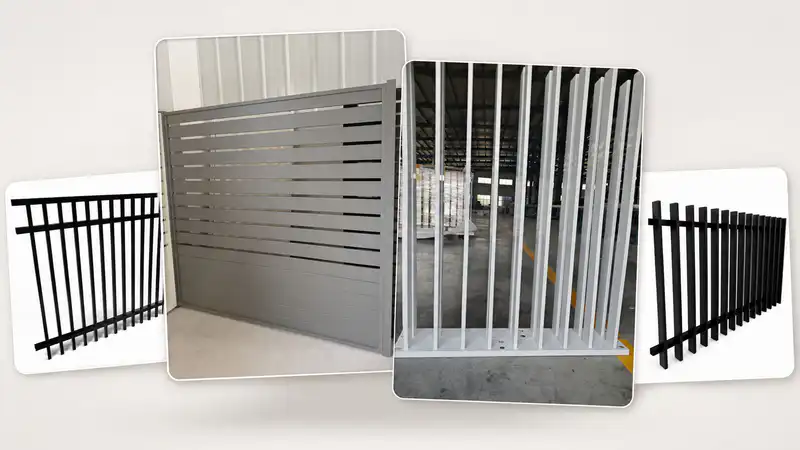
At JZH Fence, the main aluminum fencing configurations include full-privacy aluminum fencing, semi-privacy aluminum fencing, blade fencing, and aluminum tubular fencing.
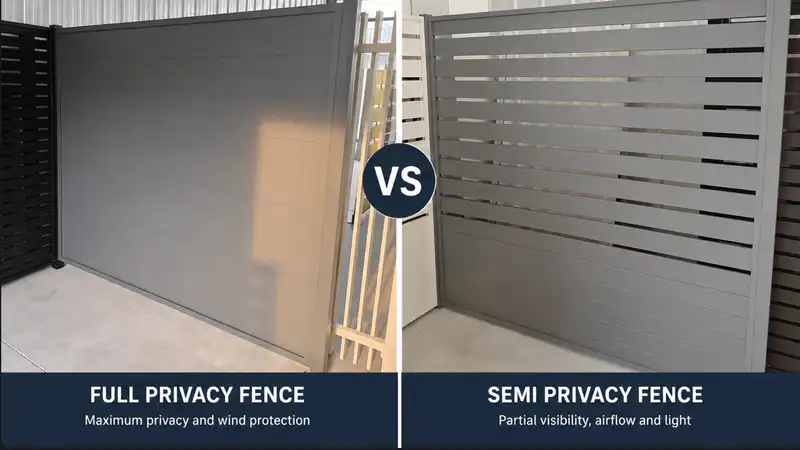
Full-Privacy Aluminum Fence
A full-privacy aluminum fence uses closely arranged or overlapping profiles to significantly restrict the view through the fence.
It is a good option when privacy is one of the project’s main objectives.
Typical applications include:
- Residential boundaries
- Commercial properties
- Courtyards
- Privacy screening
- Street-facing boundaries
Because solid panels receive more wind pressure than open fencing, panel dimensions, post configuration, and installation conditions should be considered when specifying the system.
Semi-Privacy Aluminum Fence
A semi-privacy aluminum fence creates separation without completely closing the boundary.
Small spaces between profiles can allow more light and airflow while still reducing direct sightlines.
We commonly see this type of aluminum fencing used for:
- Residential boundaries
- Commercial projects
- Modern housing developments
- Outdoor areas where some airflow is desirable
It provides a middle ground between a solid privacy wall and an open tubular fence.
Aluminum Blade Fence
An aluminum blade fence uses narrow vertical aluminum profiles to create a clean, contemporary appearance.
By adjusting the blade dimensions and spacing, the design can balance visibility, security, and architectural appearance.
Blade fencing can be considered for:
- Pool fencing
- Residential boundaries
- Modern developments
- Architectural perimeter fencing
Although blade fencing is often associated with pool and security-style applications, it is not limited to those uses.
Our Australian project experience provides a good example.
Aluminum Tubular Fence
Aluminum tubular fencing is an open-style system normally constructed from vertical pickets connected by horizontal rails.
It provides greater visibility than privacy fencing and works well when defining the boundary is more important than blocking the view.
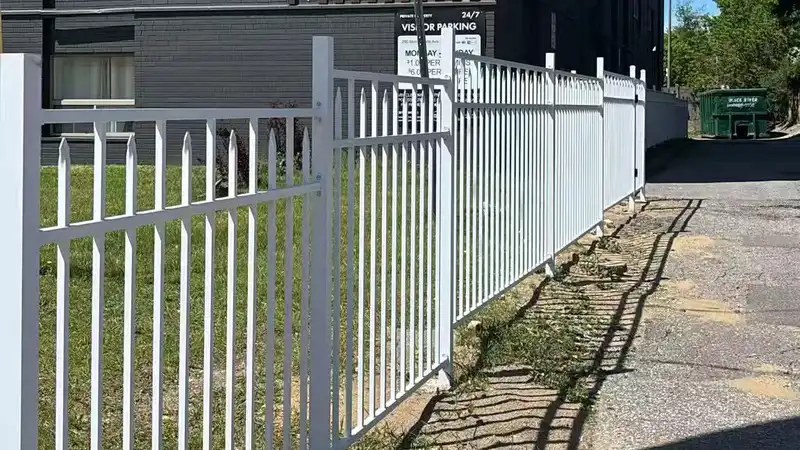
You can also explore our garrison and tubular fencing systems for residential, commercial, and pool-related applications.
At JZH Fence, common applications include:
- Residential boundaries
- Commercial projects
- Pool fencing
Tubular fencing can also be customized through different picket profiles, spacing, top designs, heights, and powder-coated colors.
Real Project: Aluminum Blade Fence for an Australian Residential Boundary
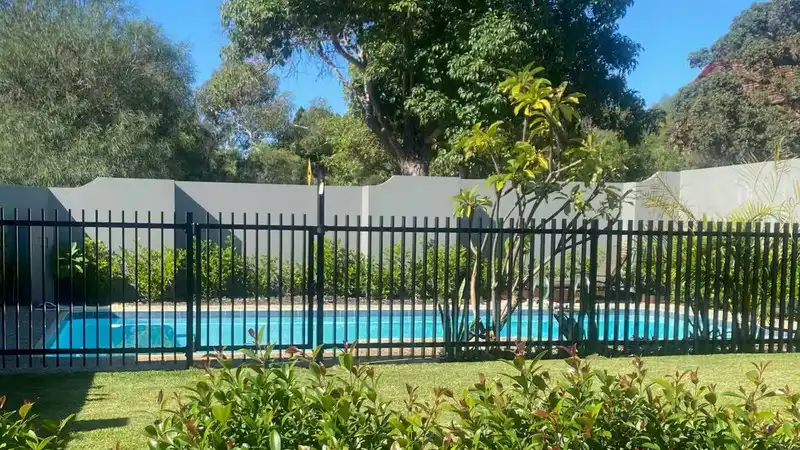
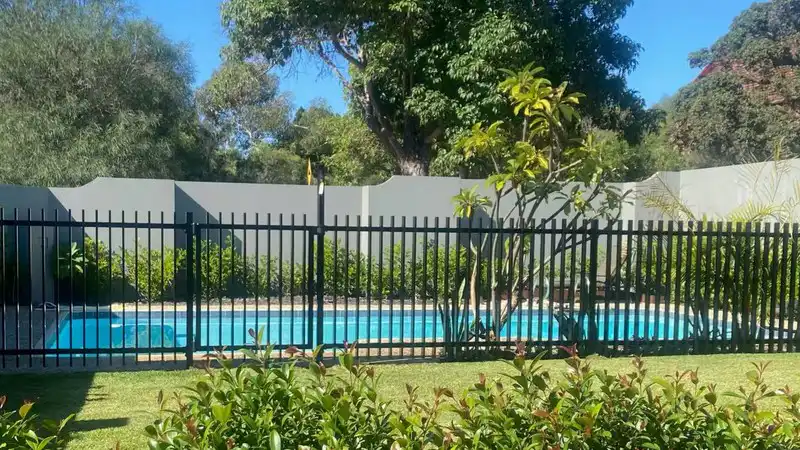
One of our Australian customers selected an aluminum blade fence for a residential boundary project.
The specification included:
- Application: Residential boundary
- Fence type: Aluminum blade fence
- Height: 1.4 m
- Width: 600 mm*
- Color: Black
- Surface: Powder coated
- Installation: Screw-fixed onto a concrete surface
*The exact meaning of the 600 mm dimension should be reconfirmed before final publication.
Instead of installing the fence directly into soil, the system was fixed to the existing concrete surface with screws.
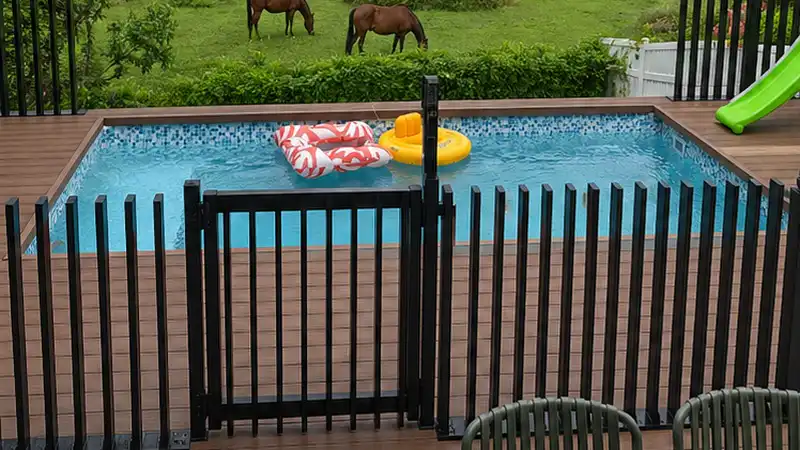
This project is useful because it shows that aluminum blade fencing is not limited to swimming-pool applications.
When the design matches the building, site conditions, dimensions, and installation requirements, blade fencing can also create a clean, modern residential boundary.
How to Choose Aluminum Fence Panels for Different Applications
Residential Boundary Projects
For a residential boundary, start by deciding how much privacy you actually need.
If blocking the view is the priority, a full-privacy aluminum fence is usually the more suitable direction.
If you want some separation while maintaining airflow and a lighter appearance, consider a semi-privacy system.
Blade and tubular fencing are useful when the architectural appearance or visibility is more important than creating a completely solid screen.
Commercial Projects
Commercial projects often require a balance between appearance, security, maintenance, and procurement efficiency.
A street-facing section may need a modern privacy fence, while another part of the same site may require a higher-security perimeter system. If security is the primary requirement, you can also compare JZH Fence’s commercial and security fence systems.
Before choosing a system, consider:
- Required visibility
- Access points
- Gate size
- Fence length
- Security requirements
- Maintenance expectations
- Installation surface
- Project appearance
Pool Fence Projects
Pool fencing requires more careful specification because the fence may perform a safety function in addition to defining the boundary.
At JZH Fence, aluminum blade fence and aluminum tubular fence are two aluminum configurations used for pool projects.
But choosing one of these styles is only the beginning.
For example, the U.S. Consumer Product Safety Commission’s Safety Barrier Guidelines for Residential Pools provide guidance on barrier height, openings, gates, and other safety considerations. You should still confirm the requirements that apply to your specific project with the relevant local building or code authority.
From Our Experience: Confirm Pool Fence Style and Height Before Ordering
When we receive an aluminum pool fence inquiry, one of the things we remind customers to confirm is the fence style and required height.
This matters because the requirements for a pool barrier can differ depending on the destination market and project.
Rather than selecting a design from a photo and immediately moving to production, a better process is:
Project Location → Applicable Requirements → Fence Style → Fence Height → Detailed Dimensions → Final Specification
Depending on the project, other details may also need to be checked, including spacing and gate configuration.
JZH Fence Tip: If you’re sourcing aluminum fencing for a pool project, tell your supplier that it is a pool fence at the beginning of the inquiry, rather than simply requesting “aluminum fence panels.”
How to Specify Custom Aluminum Fence Panels
A good quotation starts with a good specification.
The more accurately you describe your project, the easier it is for a manufacturer to recommend the appropriate aluminum fence system.
Step 1: Define the Application
First, tell the supplier what the fence needs to do:
- Residential boundary
- Commercial perimeter
- Pool barrier
- Privacy screening
- Architectural boundary
- Access control
Step 2: Select the Fence Style
Next, choose the general configuration:
- Full privacy
- Semi privacy
- Blade fence
- Aluminum tubular fence
If you’re unsure, send reference photos or architectural drawings and explain the intended application.
Step 3: Confirm the Dimensions
Provide:
- Total fence length
- Fence height
- Panel dimensions
- Number of sections
- Gate width
- Gate height
- Number of pedestrian gates
- Number of vehicle gates
For pool projects, confirm the required height before production.
Step 4: Tell the Supplier About the Environment
Tell the manufacturer whether the project is located in:
- A coastal area
- A high-humidity region
- A high-UV environment
- An industrial environment
- A normal inland environment
Our experience with coastal aluminum fencing means we pay additional attention to powder-coating durability and the selection of corrosion-resistant fasteners.
Step 5: Confirm the Installation Method
Common options include:
- Posts installed into the ground
- Posts set in concrete
- Base plates anchored to concrete
- Screw-fixed systems
- Wall-mounted systems
The Australian blade fence project discussed earlier, for example, used a screw-fixed installation onto an existing concrete surface.
Step 6: Confirm the Color and Surface Finish
Common aluminum fence colors include:
- Black
- Grey
- White
- Other RAL colors
If color matching is important, request a color or finish sample before bulk production.
Ordering Custom Aluminum Fence Panels from JZH Fence
JZH Fence manufactures fencing products for overseas distributors, contractors, project buyers, and other B2B customers.
For aluminum fencing, the quotation process becomes much more efficient when you provide complete project information from the beginning.
What Should You Send Before Requesting a Quote?
A useful aluminum fence inquiry should include:
- Fence type
- Project application
- Project location
- Total fence length
- Fence height
- Panel dimensions, if already specified
- Color
- Gate quantity and dimensions
- Installation method or surface
- Project drawings or site photos, if available
FAQs About Aluminum Fence Panels
1. Are aluminum fence panels suitable for coastal areas?
Aluminum fencing can be considered for coastal applications, but the entire system should be evaluated rather than only the aluminum profiles.
Based on JZH Fence’s project experience, we pay particular attention to high-durability powder coating and corrosion-resistant stainless-steel or aluminum-alloy screws for coastal projects.
2. Which aluminum fence is best for privacy?
If maximum visual screening is your priority, a full-privacy aluminum fence is usually the first option to consider.
A semi-privacy system is more suitable if you want to reduce direct sightlines while maintaining some airflow and openness.
3. Can aluminum blade fencing be used for residential boundaries?
Yes. In one JZH Fence project in Australia, a customer selected a black powder-coated aluminum blade fence for a residential boundary. The fence was approximately 1.4 m high and was screw-fixed onto a concrete surface.
4. Which aluminum fence types can be used around pools?
JZH Fence commonly considers aluminum blade fencing and aluminum tubular fencing for pool projects.
However, the final style, height, spacing, gate configuration, and other dimensions should be checked against the requirements applicable to the specific project. For U.S. projects, the CPSC pool barrier guidelines are a useful starting reference, alongside applicable local codes.
Get Custom Aluminum Fence Panels from JZH Fence
Choosing aluminum fence panels is not simply a matter of finding a style you like.
A successful project requires the fence type, dimensions, coating, fasteners, gates, and installation method to work together. Coastal and pool projects may require additional attention because environmental exposure and project requirements can affect the final specification.
JZH Fence supplies aluminum privacy fence systems, tubular and garrison fencing, and other perimeter solutions for overseas wholesalers, contractors, distributors, and project buyers.
If you’re planning an aluminum fence project, send us your project location, fence dimensions, application, quantity, gate requirements, drawings, and site photos.
Contact JZH Fence to request a quotation, discuss a custom aluminum fence solution, or request product and finish samples for your project.