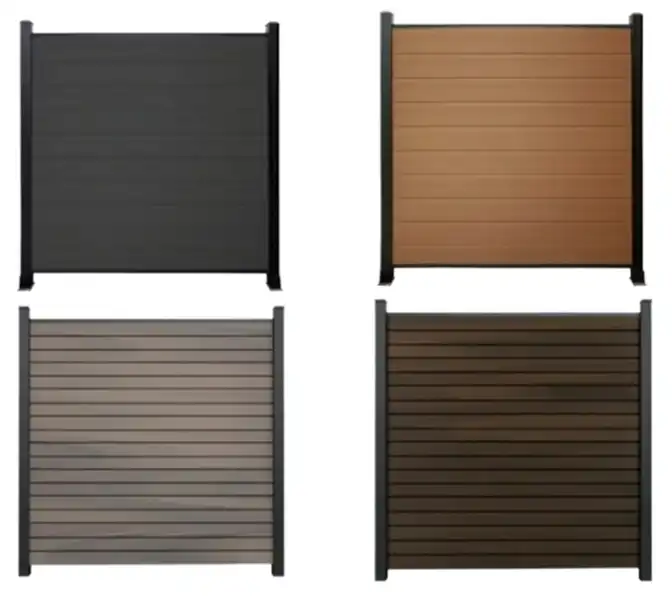
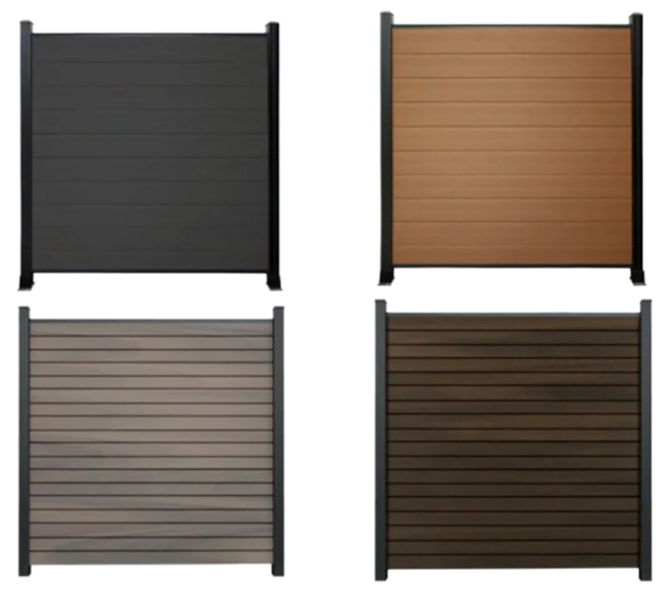
Choosing between a horizontal and vertical fence affects far more than appearance. Board direction changes how the boundary relates to the building, handles sloping ground, creates privacy and must be supported. This horizontal vs vertical fence guide compares seven practical differences for residential developments, commercial landscapes and distributor product ranges. It also explains when a low-maintenance WPC horizontal fence is a better fit than timber or a conventional vertical design. Use the comparison below to define a safer, more accurate project specification.
What Is the Difference Between a Horizontal and Vertical Fence?
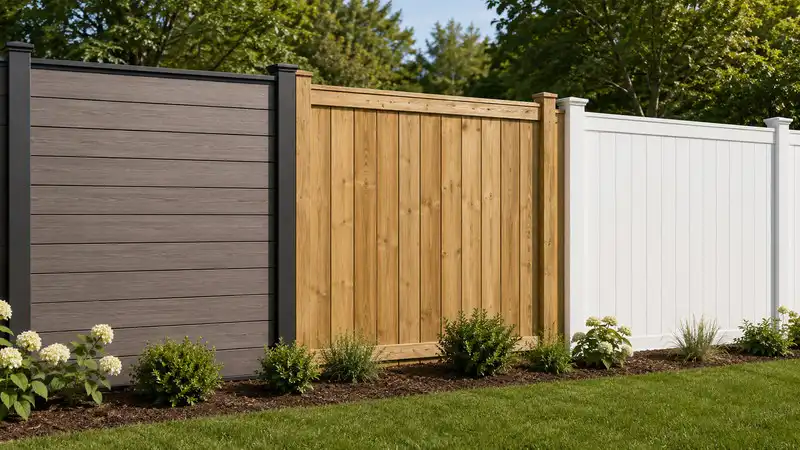
A horizontal fence places its boards or slats parallel to the ground. Its long lines suit modern architecture and can make a narrow space appear wider. A horizontal slat fence has intentional gaps for light and airflow, while a horizontal privacy fence uses tightly joined, overlapping or tongue-and-groove boards to block direct sight lines.
A vertical fence places its boards upright. Timber versions usually fix the boards to horizontal rails, while modular metal or composite systems may use framed panels. Vertical lines tend to feel more traditional and can visually emphasise height. They are also easier to adapt to an irregular or strongly sloping boundary.
Both orientations can use timber, aluminium, steel or WPC. Choose by considering the site gradient, privacy target, span, wind exposure, installation skills and lifecycle cost.
Horizontal vs Vertical Fence: 7 Key Differences
The following table gives you a quick project-level comparison before we examine each factor.
| Comparison factor | Horizontal fence | Vertical fence | Project impact |
|---|---|---|---|
| Appearance | Modern, linear and architectural | Classic, familiar and height-focused | Must suit the building and target market |
| Perceived space | Can make a boundary look wider | Can make the fence look taller | Influences small courtyards and entrance areas |
| Privacy | Adjustable gaps or full-privacy boards | Full privacy is easy with close-set boards | Depends on profile and spacing, not direction alone |
| Sloping ground | Best on level ground or engineered steps | Easier to rack or step over uneven ground | Affects labour, custom parts and visual alignment |
| Structure | Span and post stiffness are critical | Rails support upright boards | Affects deflection and wind performance |
| Installation | Requires accurate levels and consistent joints | Usually more tolerant of small level changes | Affects installation time and callbacks |
| Cost | May need stronger framing or more precise work | Often economical for long, simple boundaries | Compare the complete system and maintenance |
1. Modern Appearance and Perceived Space
Horizontal boards work well with flat roofs, wide windows and minimalist landscaping. Their long lines can make a compact courtyard feel broader. Vertical boards draw the eye upward and often look more natural beside traditional homes or rural properties. The best option is the one that matches the building, gate and local market.
2. Privacy, Light and Airflow
A common misconception is that a horizontal fence offers less privacy. That is only true when the design uses wide gaps. A full-privacy WPC system can stack interlocking boards with no direct sight line, while a slatted system can use controlled gaps to admit light and air.
Vertical fencing can also be full or semi-private. Define the required sight-line control and gap size rather than simply asking for “horizontal” or “vertical” panels. For dense housing, check privacy from both standing and upper-floor viewing angles.
3. Flat Ground vs Sloped Ground
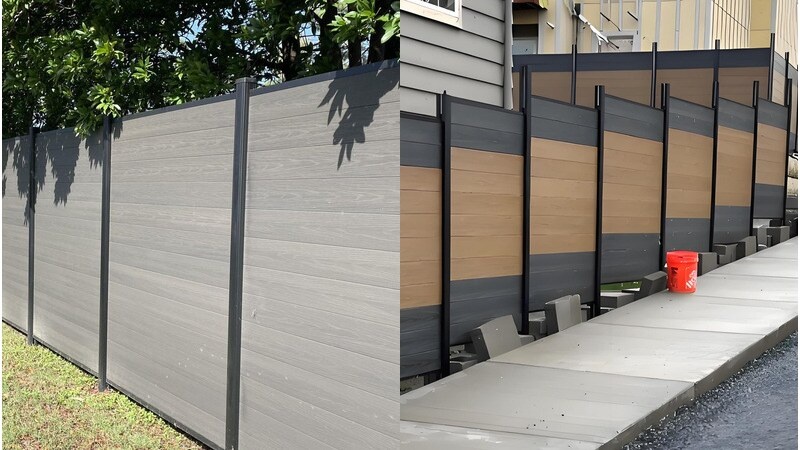
Horizontal lines reveal every level change. A slope may require stepped bays, terracing or project-specific brackets, while vertical boards are generally easier to trim, rack or step along uneven ground. Before ordering, provide the rise and fall for each run; total length alone is not enough.
4. Posts, Spans and Structural Support
Horizontal boards span from post to post, so excessive distance between supports can increase deflection. Correct centres depend on board profile, fence height, wind load, rail design and foundations. Vertical systems transfer loads through rails or a panel frame but still need structural review.
Never copy spacing from a same-height fence. A 1.8 m open slat panel and a full-privacy panel present different wind-exposed areas.
5. Weather Exposure and Drainage
Vertical boards naturally direct rain downward. Horizontal systems need suitable joints, bottom clearance and drainage paths.
Material quality still matters more than direction. Outdoor WPC is lower maintenance than timber but not immune to moisture or weathering. USDA Forest Service research on WPC durability explains why formulation, mould and polymer degradation still deserve attention.
Keep every fence clear of soil and standing water.
6. Installation Accuracy
A horizontal fence makes alignment errors easy to see and repeat across several bays. Installers should establish one datum and recheck posts with a laser or string line before adding boards.
Vertical fencing usually tolerates small level variations more easily. For a large project, request approved drawings, a post schedule and one trial bay.
7. Initial Cost and Lifecycle Cost
A horizontal fence can cost more when it needs stronger posts, shorter spans, custom steps or more precise labour. Yet board generation, gates, foundations, packing and freight may have a larger effect.
Our composite fencing cost guide explains why buyers should compare an itemised system. Also include future timber painting or replacement. WPC and powder-coated aluminium can reduce this work but still need inspection.
JZH Fence Experience: How We Help Customers Choose
We normally consider a WPC horizontal fence first when the site is flat or gently sloping, the building has a modern design, the project needs strong privacy and the owner wants to avoid routine timber painting.
A height near 1.8 m or 6 ft is common for privacy boundaries, but local rules and structural requirements still control the final height.
JZH Fence commonly combines WPC boards with powder-coated aluminium posts. Options may include 70 × 70 mm or 80 × 80 mm profiles, with 1.4 mm wall thickness used for selected systems.
These are product options, not a universal engineering recommendation. We confirm the structure after reviewing height, board profile, wind and site conditions.
When a site has a steep gradient, a long budget-sensitive boundary or traditional architecture, a vertical or stepped solution may be easier. Horizontal is better only when the complete system suits the site.
Why WPC Is a Strong Choice for Horizontal Fencing
WPC combines wood fibre and polymer with pigments and additives. It can deliver a repeatable wood-look finish without routine staining or painting.
Repeatable profiles also help distributors match panels, replacement boards and gates. Review JZH Fence’s WPC fence systems for privacy and project applications.
Low maintenance does not mean no maintenance. Clean the boards, keep drainage clear and inspect the structure. Compare other low-maintenance fence options for commercial projects.
Contact JZH Fence to request technical drawings, a project quotation, colour samples or a complete composite fencing catalogue.
Why WPC Is a Strong Choice for Horizontal Fencing
WPC combines wood fibre and polymer with pigments and additives. It can deliver a repeatable wood-look finish without routine staining or painting.
Repeatable profiles also help distributors match panels, replacement boards and gates. Review JZH Fence’s WPC fence systems for privacy and project applications.
Low maintenance does not mean no maintenance. Clean the boards, keep drainage clear and inspect the structure. Compare other low-maintenance fence options for commercial projects.
Traditional WPC vs Co-Extrusion WPC
Not all WPC boards provide the same surface performance. The first sourcing question should be whether the quotation covers traditional WPC or co-extrusion WPC.
| Feature | Traditional WPC fence | Co-extrusion WPC fence |
|---|---|---|
| Initial price position | Usually lower | Usually higher |
| Surface | Exposed WPC body | Protective co-extruded outer layer |
| Stain and scratch resistance | Suitable for basic applications | Better daily surface protection |
| Colour and UV performance | More dependent on formulation and exposure | Better suited to appearance-sensitive, high-UV projects |
| Best fit | Price-sensitive ranges and basic screening | Long-term privacy, coastal or premium ranges |
Traditional WPC can be a practical choice when initial cost drives the decision. Co-extrusion WPC is usually stronger for buyers who prioritise stain resistance, scratch resistance and long-term appearance.
Our composite fence panel import guide provides a fuller comparison for professional buyers.
Avoid absolute claims such as “fade-proof” or “scratch-proof.” Outdoor colour change and surface wear depend on the formula, cap layer, colour, climate, handling and maintenance. Ask for a physical colour sample and available test documents before mass production.
How Is a WPC Horizontal Fence System Constructed?
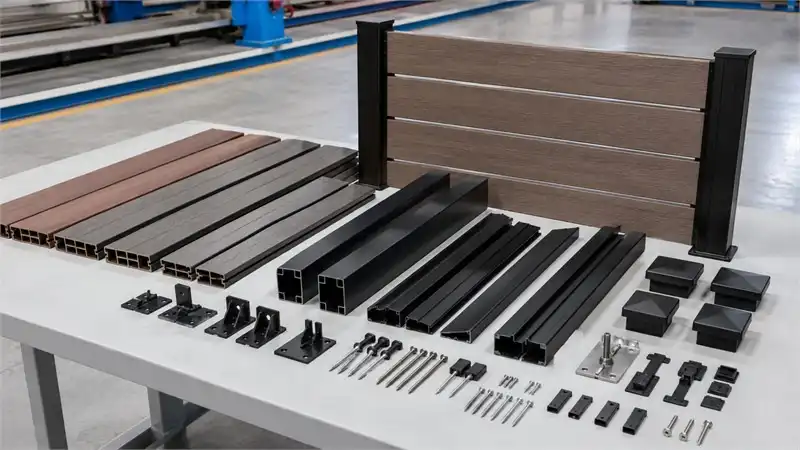
A WPC horizontal fence should be purchased as a system, not as a stack of boards. A typical bill of materials includes:
- Horizontal WPC boards
- Powder-coated aluminium posts
- Top and bottom rails or channels
- End, corner and intermediate posts, caps and trims
- Brackets, fasteners and required reinforcement
- Matching pedestrian, swing or sliding gates
The boards usually stack or slide into aluminium post channels. Rails finish the edges and help keep boards engaged. See our composite material fence guide for the full system.
Around 1.2 m can suit low dividers, while 1.8 m or 6 ft is common for privacy. Some 1.8 m systems use 11 boards, but the count changes with board width, overlap and rail design.
A moving gate creates different loads from a fixed panel, so confirm its frame, hinges, post and clear opening independently. Compare matching entrances in this composite gate buying guide.
How to Prevent Sagging and Deformation in WPC Horizontal Fences
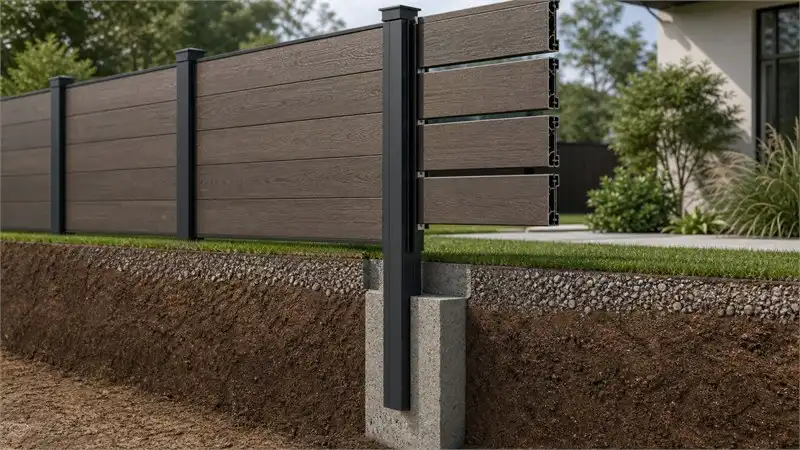
The long-term stability of a WPC horizontal fence depends on more than board quality. Post strength, clear span, thermal movement, foundation conditions, drainage and installation accuracy work together.
| Common problem | Likely cause | Practical response |
|---|---|---|
| Boards sag or bow | Span is too long or board profile is unsuitable | Review span, shorten post centres or add approved reinforcement |
| Boards crown after heating | End clearance is insufficient or boards are locked too tightly | Allow movement according to the board drawing and installation temperature |
| Joints become inconsistent | Posts are out of plumb or dimensions accumulate | Set posts from one datum and check each bay before adding boards |
| Long runs lose their level line | Uneven foundations or repeated level errors | Use a laser/string line and recheck the line in sections |
| Fence moves in strong winds | Posts, footings or connections are underspecified | Recalculate the full system for local wind exposure |
| Dirt or water gathers below | Boards sit too close to grade or drainage is blocked | Maintain ground clearance and keep drainage paths open |
Match Post Spacing to the Board and Site
There is no universal post spacing for every WPC horizontal fence. Review:
- Hollow or solid board construction
- Traditional or co-extrusion WPC
- Cross-section, length and finished height
- Privacy design and local wind exposure
- Posts, rails, reinforcement and footings
A higher fence increases the demand on posts, connections and foundations. Do not create an 8 ft system by simply adding boards to a standard 6 ft design.
Allow for Thermal Expansion
WPC expands and contracts with temperature. Leave the board-end clearance shown on the approved drawing and do not lock boards against intended movement.
The gap depends on board length, formulation and temperature range, so confirm it against the current technical sheet.
Control Alignment from the First Post
Before adding boards, check foundations, post centres, plumb and top levels. For long runs, work in control sections and recheck dimensions.
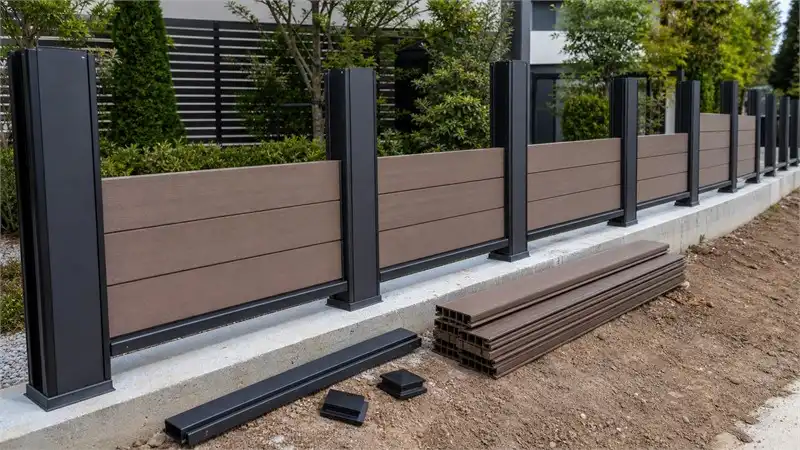
A trial bay confirms board engagement, height, joints and accessories before full installation.
Adjust the System for Coastal and High-Wind Areas
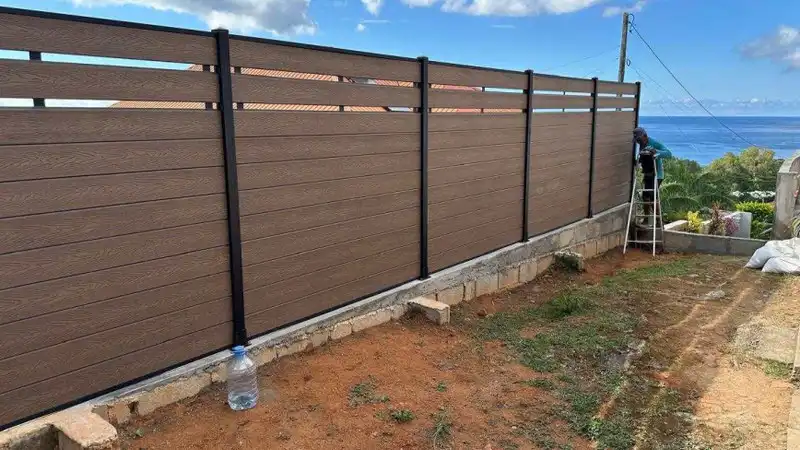
Full-privacy fencing catches more wind than an open slat design. Exposed sites may need stronger posts, shorter centres, larger footings or reinforcement based on local engineering requirements.
Coastal projects also need compatible corrosion-resistant connections. The U.S. Whole Building Design Guide advises selecting suitable stainless steel or equivalent corrosion protection for exterior metal framing, fasteners and connections in coastal structures. See its coastal corrosion guidance when developing the metal specification.
Co-extrusion WPC may better suit high-UV coastal projects, but its outer layer cannot compensate for weak posts, poor drainage or incorrect foundations.
When Should You Choose a Horizontal or Vertical Fence?
Choose a horizontal fence when:
- The architecture is modern or minimalist
- The ground is flat or only gently sloping
- You need full privacy or carefully controlled gaps
- You want a wider visual effect and can support precise installation
- You prefer a low-maintenance WPC or aluminium system
Choose a vertical fence when:
- The boundary crosses a strong or irregular slope
- The fence line is long and budget is the first constraint
- The building has a traditional style
- You need a forgiving layout for a rural or utility-focused application
A mixed solution can control cost: use WPC horizontal fencing at the main entrance or courtyard, then a simpler vertical system along sloping side boundaries. Match gate frames and colours for a coordinated result.
Before finalising height, check local rules. England’s Planning Portal guidance for fences, gates and walls applies different limits beside highways and elsewhere, with extra conditions for listed buildings and conservation areas. Verify requirements for the actual address.
What Professional Buyers Should Confirm Before Ordering WPC Horizontal Fencing
Prepare the following information before requesting samples or a quotation:
- Project country, address and application
- Total length and finished fence height
- Site levels, slopes, corners and changes in direction
- Gate quantity, type and clear openings
- Full-privacy or semi-privacy requirement
- Traditional or co-extrusion WPC preference
- Board colour, texture and physical sample
- Wind, UV, coastal and temperature exposure
- Ground, footing and installation conditions
- Posts, rails, reinforcement, accessories, drawings, packing and delivery term
For EU-bound orders, do not treat a generic “test report” as sufficient. The European Commission describes REACH as the EU’s principal law for managing chemical risks. Match each report to the tested sample, formula and date.
Also compare the physical sample with the production specification. Our seven WPC fence quality checks cover board generation, cross-section, colour, surface, system completeness, packing and supplier evidence.
Frequently Asked Questions
1. Is a Horizontal Fence More Expensive Than a Vertical Fence?
It can be, but direction alone does not set price. Posts, spans, slopes, boards, gates, foundations, freight and labour all matter. Compare the same complete system.
2. Do Horizontal Fence Boards Sag Over Time?
They can sag when spans are too long or support is weak. Correct post spacing, reinforcement, footings and installation reduce the risk. Ask the supplier to approve your span.
3. Is WPC Good for a Horizontal Fence?
Yes. WPC offers a wood-like appearance with less routine painting than timber. It still needs correct posts, expansion clearance and drainage. Co-extrusion WPC usually better suits high-UV, appearance-sensitive projects.
4. How Much Gap Should Be Left Between Horizontal Fence Boards?
Visible gaps depend on privacy and airflow. Thermal clearance depends on board profile, length, temperature and installation instructions. Full-privacy joints and ventilated slat gaps need different measurements.
5. Is a Horizontal or Vertical Fence Better for Sloped Ground?
A vertical fence is usually easier on an irregular slope. Horizontal fencing can use stepped bays or terracing on gentler slopes but needs careful planning. Compare bottom gaps, custom parts and labour.
Choose the Fence Orientation as a Complete System
The right answer to horizontal vs vertical fence depends on architecture, privacy, slope, structure, installation and lifecycle cost. Horizontal fencing is a strong choice for modern, level sites where clean lines and privacy matter. Vertical fencing often works better on steep ground, traditional properties and long budget-sensitive boundaries.
For a durable WPC horizontal fence, evaluate the boards, aluminium posts, span, expansion clearance, foundation, drainage and gates as one system.
Send JZH Fence your dimensions, site conditions, finish and destination. Contact us for a project quotation, catalogue or sample, and our team can prepare a suitable WPC fence proposal.