
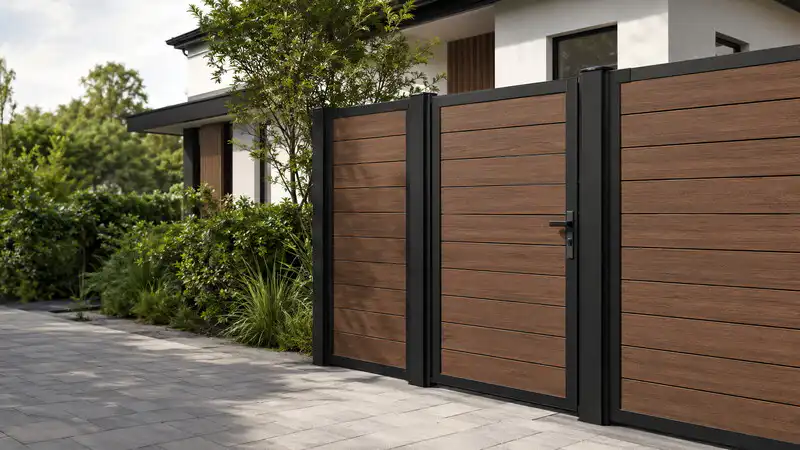
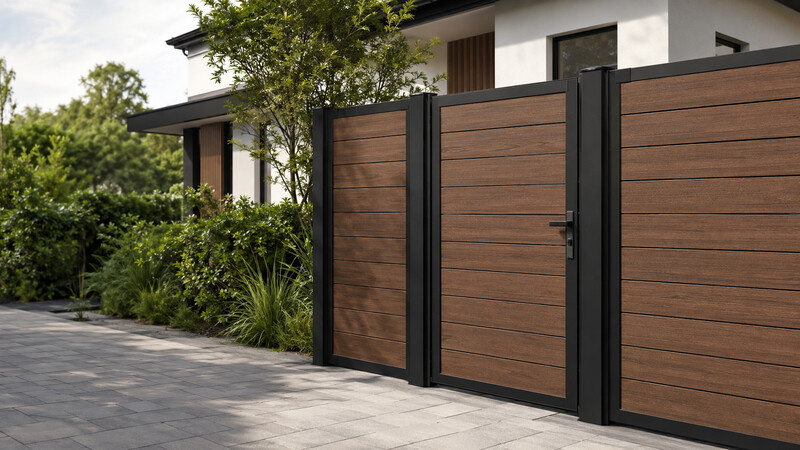
If you’re planning an upgrade to your outdoor space—whether for a single property or across hundreds of managed sites—composite garden gates deliver the performance and appearance that timber simply cannot sustain.
This guide explains what composite gates are made of, how long they last, which designs are available, and what you should consider before specifying them for your next project.
What Are Composite Garden Gates?
A composite gate combines wood–plastic composite infill boards with a rigid aluminium frame. This structure creates the appearance of natural wood while resisting many of the problems associated with traditional timber gates, including:
- Rot
- Warping
- Insect damage
- Frequent repainting
- Regular staining
Unlike untreated steel gates, which may corrode without suitable surface protection, or softwood gates that require regular maintenance, composite garden gates can provide long-term outdoor performance with minimal intervention.
JZH Fence—Nanjing Jia Zhi He New Material Technology Development Co., Ltd.—manufactures composite garden gates primarily for:
- Builders
- Fencing contractors
- Property managers
- Importers
- Distributors
- International wholesalers
The same systems can also be used in residential gardens, courtyards, side entrances, driveways and property boundaries.
Key benefits include:
- Long service life
- Low maintenance
- No regular painting or staining
- Full or partial privacy
- Modern appearance
- Coordinated designs with composite fencing
- Custom sizes and colours
- Powder-coated aluminium frames that help prevent sagging and warping
JZH Fence can supply stand-alone pedestrian gates, double swing gates and integrated gate sections for complete composite fencing systems.
What Are Composite Gates Made Of?
Composite Infill Boards
Composite materials generally combine wood fibres with recycled plastic, pigments, UV stabilisers and bonding agents.
The plastic content improves resistance to moisture and rot, while the wood fibre helps create a more natural surface appearance.
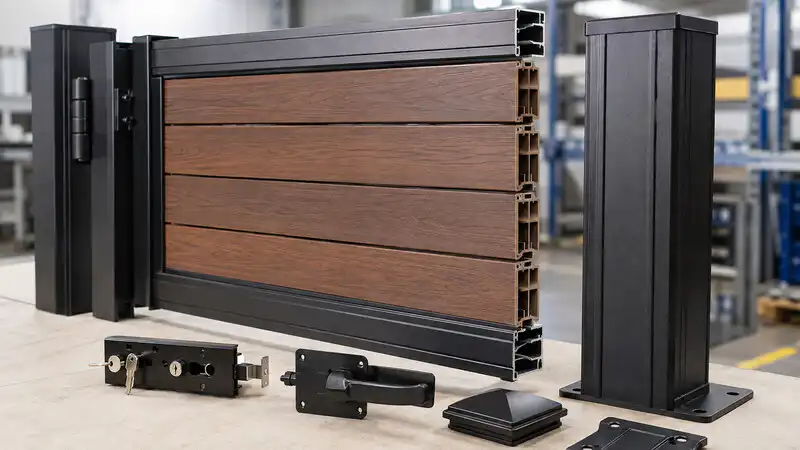
Co-extrusion WPC boards can be used as the infill material inside the aluminium gate frame. Compared with traditional WPC boards, co-extrusion boards normally provide better resistance to:
- UV exposure
- Surface stains
- Scratches
- Moisture
- Colour fading
- Outdoor ageing
The exact material composition should be confirmed according to the selected board profile and production specification.
Aluminium Frames
Although aluminium and galvanized steel can both be used for composite gate frames, JZH Fence’s main composite gate systems use 6063-T5 aluminium profiles with a powder-coated finish.
Common aluminium-frame colours include:
- RAL 7016 Anthracite Grey
- RAL 9005 Jet Black
- Custom RAL colours
Composite boards require a load-bearing frame because the boards alone are not designed to support the structural load of an opening gate.
Depending on the gate size and application, the aluminium frame may incorporate:
- Internal reinforcement ribs
- Concealed fixings
- Anti-sag cross rails
- Reinforcement plates
- Adjustable hinges
- Lock and latch mounting points
Matching Posts and Accessories
JZH Fence can supply composite garden gates as part of a complete fencing package, including:
- Aluminium posts
- Reinforced gate posts
- Post caps
- Adjustable hinges
- Locks
- Latches
- Gate stops
- Mounting plates
- Composite fence panels
- Installation accessories
Using matching composite boards, frame colours and accessories helps create a consistent appearance across the entire boundary.
Standard Composite Garden Gate Sizes and Opening Types
JZH Fence supplies both standard and customised gate sizes for contractors, distributors and project buyers.
Standard Sizes
The standard composite garden gate height is 1.8 metres.
Common standard widths include:
- 3 feet
- 4 feet
- 5 feet
| Gate Type | Standard Height | Common Width | Typical Application |
|---|---|---|---|
| Walking gate | 1.8 m | 3 ft, 4 ft or 5 ft | Garden, courtyard or side entrance |
| Double swing gate | 1.8 m or customised | Based on total opening | Driveway or vehicle entrance |
| Custom project gate | Based on drawing | Based on opening | Commercial or residential project |
Non-standard dimensions can be produced according to the customer’s approved drawing and actual gate opening.
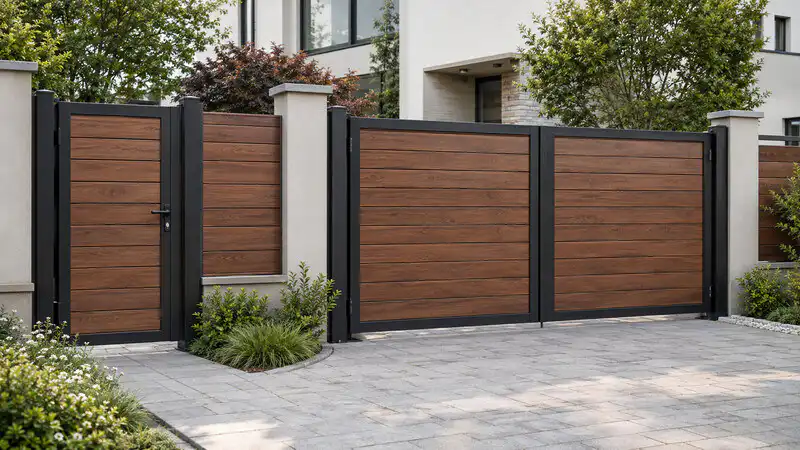
Walking Gates
A walking gate is a single-leaf pedestrian gate commonly used for:
- Garden entrances
- Side passages
- Courtyards
- Residential boundaries
- Property service entrances
- Access between fencing sections
The gate can use full-privacy composite boards or spaced slats, depending on the project’s privacy and design requirements.
Double Swing Gates
A double swing gate consists of two gate leaves that open from the centre. It is suitable for:
- Wider driveways
- Vehicle entrances
- Residential developments
- Commercial properties
- Managed housing projects
Before ordering a double swing gate, you should confirm:
- Total opening width
- Required gate height
- Inward or outward opening
- Ground clearance
- Post positions
- Manual or automated operation
- Wind exposure
- Installation method
How JZH Fence Reduces Sagging and Alignment Problems
Gate sagging is not determined by the composite boards alone. The frame profile, gate width, hinge capacity, post strength and installation accuracy all affect long-term performance.
Three Adjustable Heavy-Duty Hinges
JZH Fence configures each standard gate leaf with three adjustable heavy-duty hinges.
For double swing gates, each individual gate leaf has its own hinge configuration.
The three-point hinge arrangement helps:
- Distribute the weight of the gate leaf
- Improve structural stability
- Reduce movement during frequent opening
- Make on-site alignment easier
- Correct the gate height and level
- Align the lock and latch accurately
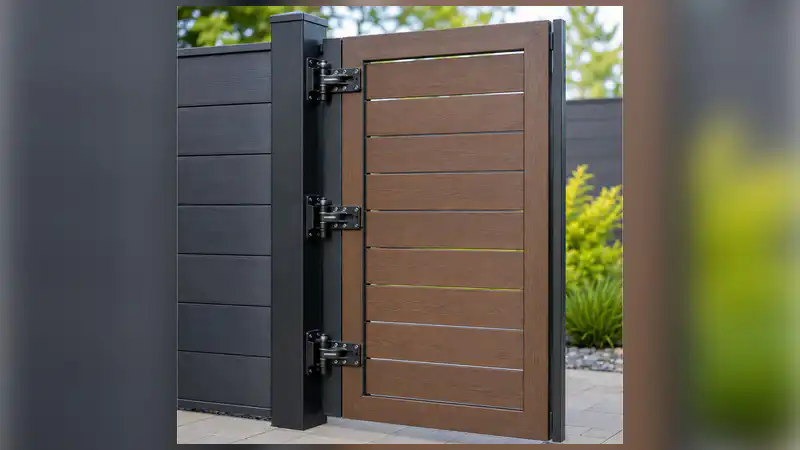
Because the hinges are adjustable, installers can make minor corrections after the posts and gate leaves have been positioned.
Why the Aluminium Frame Matters
A reliable composite gate requires a rigid metal frame. When evaluating a gate system, you should consider:
- Aluminium profile dimensions
- Profile wall thickness
- Internal reinforcement
- Gate width and height
- Number and capacity of hinges
- Post dimensions
- Post foundation
- Lock position
- Installation accuracy
A wider gate creates greater leverage on the hinges and gate post. Therefore, wider walking gates and double swing gates may require heavier frames, reinforced posts or additional structural support.
Strong-Wind and Coastal Projects
Full-privacy composite gates have a relatively large wind-facing surface. Strong-wind and coastal projects therefore require more careful structural and coating specifications.
For these environments, JZH Fence can:
- Strengthen the gate posts
- Increase structural support
- Review the gate’s wind-facing area
- Confirm the opening direction
- Recommend suitable foundations
- Apply an HDP coating to improve metal weather resistance
- Adjust the frame and post configuration according to the project
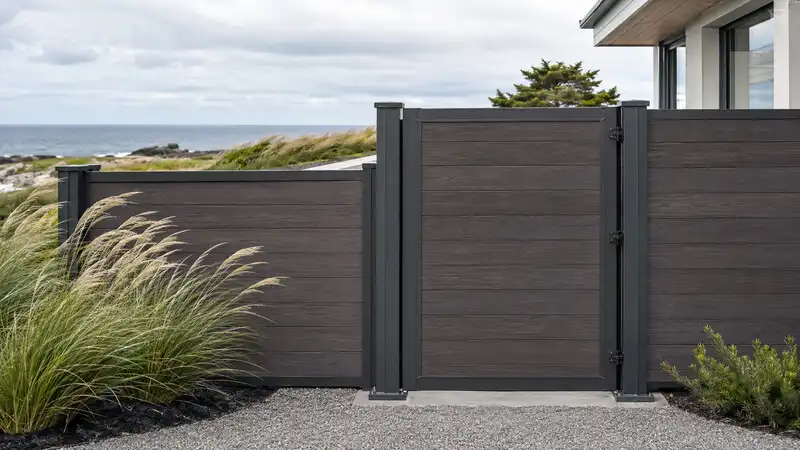
HDP coating can improve weather and corrosion resistance, but the final configuration should still be selected according to the site’s wind conditions, coastal exposure and local requirements.
Information Required Before Quotation
To receive an accurate composite gate quotation, provide:
- Gate height
- Total opening width
- Walking gate or double swing gate
- Required quantity
- Manual or automated operation
- Installation location
- Coastal or high-wind conditions
- Preferred composite-board colour
- Aluminium-frame colour
- Post-fixing method
Service Life, Durability and Low-Maintenance Performance
Composite garden gates combine moisture-resistant boards with corrosion-resistant metal framing.
When correctly specified and installed, they can provide a longer and more predictable service life than many untreated softwood gates.
Resistance to Rot, Moisture and Insects
Compared with traditional timber, composite boards are less likely to suffer from:
- Rot
- Insect damage
- Splitting
- Moisture absorption
- Frequent surface deterioration
Composite gates do not require regular staining or oiling. This reduces routine maintenance for homeowners, contractors and property managers responsible for multiple sites.
UV Exposure and Colour Change
Co-extrusion composite boards generally provide better UV and colour-fading resistance than traditional WPC boards.
However, transparent communication is important. Some minor colour lightening may occur during the first months of outdoor UV exposure. The extent of the change can depend on:
- Board composition
- Surface treatment
- Colour
- UV intensity
- Installation direction
- Local climate
Before placing a bulk order, buyers can request colour samples, technical specifications or available testing information.
Cleaning and Routine Maintenance
Composite garden gates require relatively simple maintenance.
Recommended maintenance includes:
- Cleaning the surface once or twice per year
- Using clean water, mild soap and a soft cloth
- Removing mud and debris from beneath the gate
- Checking hinges and fixings
- Lubricating applicable moving hardware
- Checking that locks and latches engage correctly
- Avoiding highly corrosive cleaning products
Regular cleaning can also help prevent the accumulation of mould, dirt and organic residue in damp or shaded environments.
Thermal Expansion
Composite boards can expand and contract as temperatures change.
Correct installation should therefore allow suitable clearance according to the approved drawing and board profile. The aluminium frame helps constrain and support the boards, while appropriate installation gaps reduce the risk of seasonal movement causing distortion.
Types of Composite Garden Gates and Design Options
JZH Fence offers composite gates for gardens, side entrances, courtyards, residential boundaries and driveways.
Horizontal Composite Gates
Horizontal composite boards create clean lines and a modern appearance. They can also visually widen a garden or boundary.
Horizontal designs are commonly used for:
- Modern residential properties
- Garden entrances
- Courtyards
- Privacy boundaries
- Matching horizontal composite fences
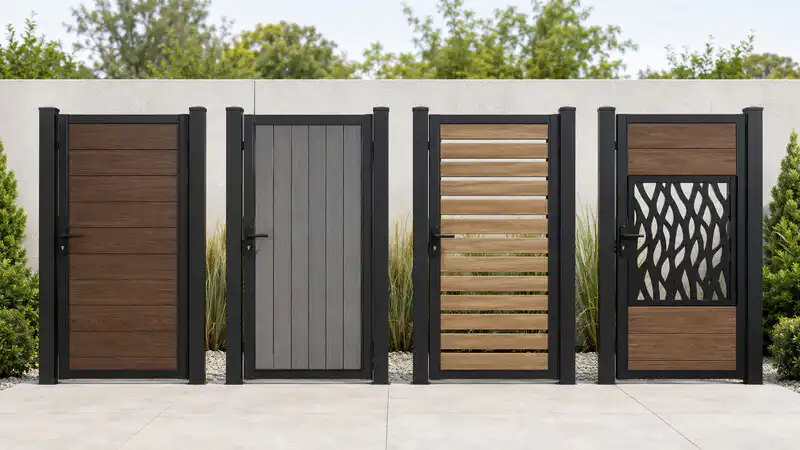
Vertical Composite Gates
Vertical boards provide a more traditional proportion while maintaining the low-maintenance benefits of composite material.
They are suitable for:
- Narrow pedestrian gates
- Traditional property designs
- Tall privacy gates
- Projects that require a vertical visual line
Full-Privacy Gates
Full-privacy composite gates use closely fitted boards with minimal visible gaps.
They are commonly selected for:
- Side entrances
- Residential gardens
- Courtyards
- Service areas
- Property boundaries
- Driveways requiring visual screening
Semi-Privacy and Decorative Designs
For projects that require additional light or ventilation, gates can use:
- Spaced composite slats
- Venetian-style arrangements
- Decorative metal sections
- Laser-cut screens
- Mixed composite and aluminium elements
The spacing and design should be confirmed according to the required level of privacy, airflow and security.
Colours and Finishes
Composite boards can be supplied in colours such as:
- Grey
- Walnut
- Oak
- Black
- Coffee
- Wood-grain finishes
The aluminium frame can be powder-coated in standard or customised RAL colours.
For a coordinated fencing system, buyers can match:
- Composite board colour
- Gate-frame colour
- Fence-post colour
- Post caps
- Locks
- Gate accessories
OEM and Project Customisation
JZH Fence supports OEM and project-based customisation, including:
- Custom gate dimensions
- Custom composite colours
- Frame colour matching
- Horizontal or vertical board layouts
- Custom locking arrangements
- Private-label packaging
- Matching fence panels
- Project drawings
- Complete accessory packages
This allows distributors to build product ranges for different markets while contractors can order gates suited to specific openings and site conditions.
Automation, Security and Hardware Considerations
Locking Hardware
Composite gates can be equipped with different locking systems according to their application.
Available options may include:
- Euro-profile cylinder locks
- Heavy-duty latches
- Security-grade hinges
- Anti-lift hinge pins
- Gate stops
- Multipoint locks for applicable designs
- Keypad or intercom preparation
The selected lock should suit the gate width, frame design and required security level.
Automation Readiness
Composite driveway gates built around rigid aluminium frames can be prepared for automated operation.
Possible preparation includes:
- Reinforcement plates for motor installation
- Suitable hinge positions
- Space for above-ground operators
- Structural provision for underground operators
- Clearance planning for the swing arc
- Cable-routing considerations
Automation motors and electronic access-control systems are normally sourced and installed locally. JZH Fence can manufacture the gate structure and provide drawings showing mounting areas, clearances and relevant structural details.
Wind Load and Safety
Tall, wide or full-privacy gates can receive significant wind pressure.
For exposed locations, you should consider:
- Gate height and width
- Total solid surface area
- Local wind conditions
- Post dimensions
- Post reinforcement
- Concrete-footing size
- Opening direction
- Hinge capacity
- Gate stops
- Automation safety devices
Larger driveway gates and automated systems should be installed and commissioned by experienced professionals.
Installation and Integration With Composite Fencing
Composite gates can be supplied with pre-drilled hinge positions and fitted or prepared locking hardware to make installation more efficient.
Typical Installation Process
- Confirm the gate opening and approved drawing.
- Mark the post positions.
- Install reinforced aluminium or steel posts.
- Construct suitable concrete footings where required.
- Position the gate leaf.
- Install the three adjustable heavy-duty hinges.
- Adjust the height, level and side clearance.
- Install the lock, latch and gate stop.
- Check the opening direction and swing arc.
- Test the gate repeatedly to confirm smooth operation.
Installation clearance should be confirmed according to the approved gate drawing and hinge configuration rather than applying one fixed clearance to every gate.
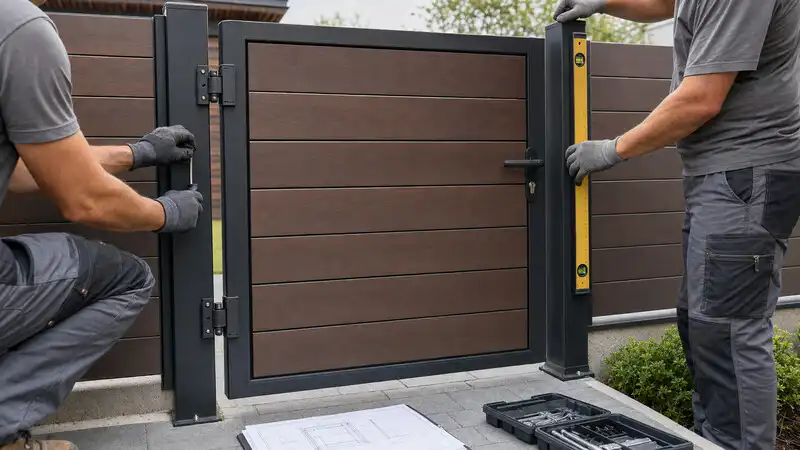
Integration With Composite Fencing Systems
Composite garden gates can be coordinated with surrounding fencing through:
- Matching board profiles
- Matching board colours
- Consistent aluminium finishes
- Matching posts and caps
- Aligned top lines
- Coordinated locks and accessories
This creates a unified boundary around gardens, patios, courtyards, driveways and managed properties.
JZH Fence can provide:
- Technical drawings
- Installation guidance
- Loading recommendations
- Gate and fence layouts
- Matching accessory lists
- Packaging documentation
Complete-system sourcing can reduce missing accessories, mismatched finishes and installation preparation problems. Our modular fencing guide explains how coordinated panels, posts, gates and accessories can support faster project installation.
Retrofit Projects
Composite gates can also replace existing timber gates installed between brick pillars or existing posts.
Before producing a replacement gate, confirm:
- Actual opening width at several heights
- Opening height
- Condition of the existing pillars
- Hinge-fixing surface
- Ground slope
- Required opening direction
- Installation clearance
- Lock position
Adjustable hinge plates and customised aluminium frames can reduce the need for extensive civil work, but the existing structure must be strong enough to support the new gate.
How JZH Fence Inspects Composite Gates Before Shipment
Quality control is particularly important when a buyer orders dozens or hundreds of composite gates for distribution or project installation.
Three Quality-Control Records
JZH Fence uses dedicated quality-control documents during production and before shipment:
- Production patrol inspection form
- Final inspection report
- QC checklist
These records help ensure that inspection requirements are documented instead of relying only on verbal confirmation.
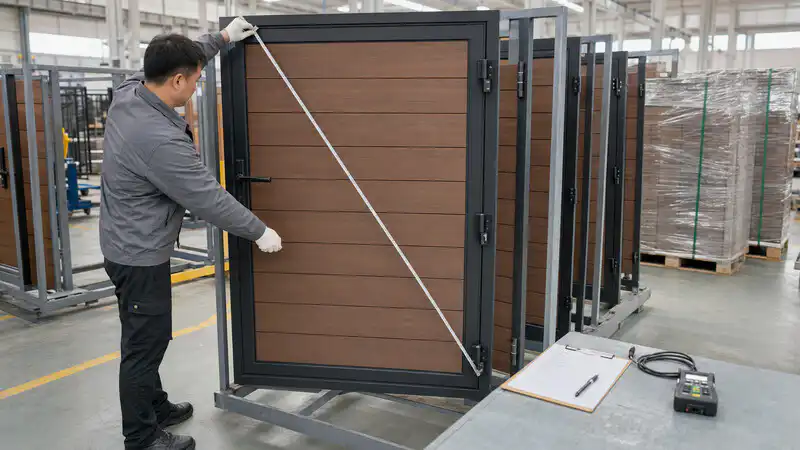
100% Finished-Gate Inspection
JZH Fence performs 100% finished-gate inspection rather than checking only a small sample from the order.
Every finished composite gate is inspected against the approved drawing and order specifications before shipment.
This means each gate is checked individually for relevant dimensional, structural, functional and appearance requirements.
Main Inspection Items
The inspection process can cover:
- Overall gate height
- Overall gate width
- Diagonal alignment
- Frame straightness
- Weld appearance
- Composite-board condition
- Hinge quantity
- Hinge position
- Lock installation
- Latch engagement
- Opening and closing performance
- Coating appearance
- Colour consistency
- Accessory completeness
- Packaging condition
Coating Inspection Requirements
| Inspection Item | JZH Fence Requirement |
|---|---|
| Powder-coating thickness | 60–80 μm |
| Salt-spray test | 500 hours |
| Colour difference | Only minor variation accepted |
| Finished-gate inspection | 100% inspection |
| Inspection records | Production patrol form, final inspection report and QC checklist |
Salt-spray testing should not be interpreted as a direct prediction of the gate’s exact outdoor service life.
The official ISO 9227 salt-spray testing standard explains that salt-spray tests are useful for detecting pores, discontinuities and defects in metallic and organic coatings. However, the standard does not itself specify the exposure period or interpretation requirements for every individual product.
If a project requires a specific colour-difference value, coating class or additional corrosion standard, the requirement should be confirmed before production.
Functional Opening Test
Before shipment, the functional inspection should confirm that:
- The gate opens without binding
- The hinges can be adjusted correctly
- The lock and latch engage properly
- The frame remains aligned
- The gate closes correctly
- Accessories match the packing list
- The finished product matches the approved drawing
How to Choose the Right Composite Garden Gate Supplier
Before choosing a supplier, check whether the manufacturer can provide:
- Composite boards and aluminium gate frames
- Standard and customised dimensions
- Adjustable heavy-duty hinges
- Reinforced posts for wide gates
- Configurations for coastal and strong-wind projects
- Powder-coating inspection records
- Salt-spray testing information
- Individual finished-gate inspection
- Production and final QC records
- Matching posts, locks and accessories
- Installation drawings
- OEM packaging and project support
Price is important, but it should not be evaluated separately from frame strength, hardware quality, coating performance and inspection procedures.
When comparing suppliers, ask each company to quote the same:
- Gate dimensions
- Frame specification
- Composite board type
- Hinge configuration
- Locking hardware
- Post specification
- Coating requirement
- Accessory list
- Packaging method
- Delivery term
A lower quotation may exclude reinforced posts, locks, spare accessories, installation components or project-specific packaging.
Why Choose Composite Garden Gates From JZH Fence?
JZH Fence is a manufacturer of metal and composite fencing systems serving customers in Australia, Europe, North America and other international markets.
Our production capabilities cover:
- Composite board production
- Aluminium-frame fabrication
- Powder coating
- Gate assembly
- Hardware installation
- Finished-product inspection
- Export packaging
For distributors, contractors and project buyers, the practical benefits include:
- Consistent quality across bulk orders
- Standard and customised gate sizes
- Walking gates and double swing gates
- Coordinated composite fencing systems
- Low-maintenance products for end users
- Coastal and high-wind configuration support
- OEM and private-label options
- Technical drawings and installation guidance
- Documented quality-control procedures
Frequently Asked Questions
1、What Is the Standard Size of a Composite Garden Gate?
The standard height is 1.8 metres. Common standard widths include 3 feet, 4 feet and 5 feet. Custom sizes can be produced according to the project opening and approved drawing.
2、How Many Hinges Does a Composite Gate Need?
JZH Fence’s standard composite gate leaves use three adjustable heavy-duty hinges. For a double swing gate, each gate leaf has its own set of three hinges.
3、Can Composite Garden Gates Be Used in Coastal Areas?
Yes, but the gate should be configured according to the coastal environment and wind exposure. JZH Fence can strengthen the posts and apply an HDP coating to improve weather and corrosion resistance.
4、Can a Composite Driveway Gate Be Automated?
Yes. The aluminium frame can be prepared for automation, but the gate size, weight, post strength, opening direction, motor type and installation clearances must be confirmed before production.
5、Do Composite Garden Gates Require Painting?
Composite boards do not normally require regular painting, staining or oiling. The gate should still be cleaned periodically, while hinges, locks and other moving parts should be inspected.
6、How Does JZH Fence Inspect Composite Gates?
JZH Fence uses a production patrol inspection form, final inspection report and QC checklist. Every finished composite gate is inspected against the approved drawing and order specifications before shipment.
Request a Composite Garden Gate Quotation
The right composite garden gate should combine durable infill boards, a rigid aluminium frame, reliable hardware and a post configuration suited to the installation environment.
JZH Fence supplies walking gates, double swing gates and matching composite fencing systems for distributors, contractors and project buyers.
To receive an accurate quotation, send us:
- Gate-opening dimensions
- Required height
- Gate type
- Order quantity
- Installation location
- Wind or coastal conditions
- Preferred board and frame colours
- Manual or automated operation
Contact JZH Fence to request technical drawings, a project quotation, colour samples or a complete composite fencing catalogue.