Choosing between a colorbond vs timber fence is not only about which material looks better. This guide compares the cost of colorbond fence, panel durability, maintenance, installation, and long-term project value. Many buyers first ask for the price per metre, but for builders, developers, contractors, and property managers, the better question is the full project cost over the fence’s service life. By the end, you will know when to choose colorbond or timber fence for residential, commercial, and bulk supply projects.
COLORBOND® is a registered trademark of BlueScope Steel Limited. JZH Fence supplies Colorbond-style steel fencing systems, not genuine COLORBOND® steel unless otherwise confirmed.
Quick Summary: Colorbond vs Timber Fence at a Glance
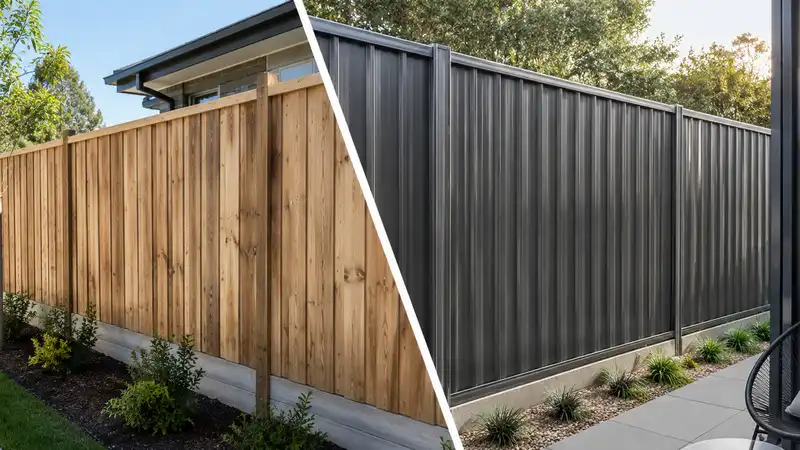
Colorbond-style metal fencing and timber fencing both have clear advantages. Timber fencing usually looks cheaper at the beginning and gives a natural appearance. Colorbond-style fencing often costs more upfront, but it can reduce long-term maintenance, repair work, and replacement risk.
For B2B buyers, the best choice is not always the lowest price. The better comparison is total project cost, including material, accessories, installation, maintenance, lifespan, and after-sales risk.
| Factor | Colorbond-style Steel Fence | Timber Fence |
|---|---|---|
| Upfront Cost | Usually higher than basic timber | Usually lower at the beginning |
| Long-term Cost | More stable because of low maintenance | Can rise due to repair and maintenance |
| Maintenance | Low maintenance | May need maintenance 1–2 times per year |
| Appearance | Modern, clean, uniform colours | Natural, warm, traditional |
| Durability | Strong when steel grade and coating are correct | Can rot, crack, warp, or suffer pest damage |
| Coastal Use | Can use upgraded anti-corrosion systems | Higher risk in humid or termite-prone areas |
| B2B Suitability | Good for builders, developers, wholesalers, and bulk projects | Better for small projects where natural appearance matters most |
What Is Colorbond Fencing?
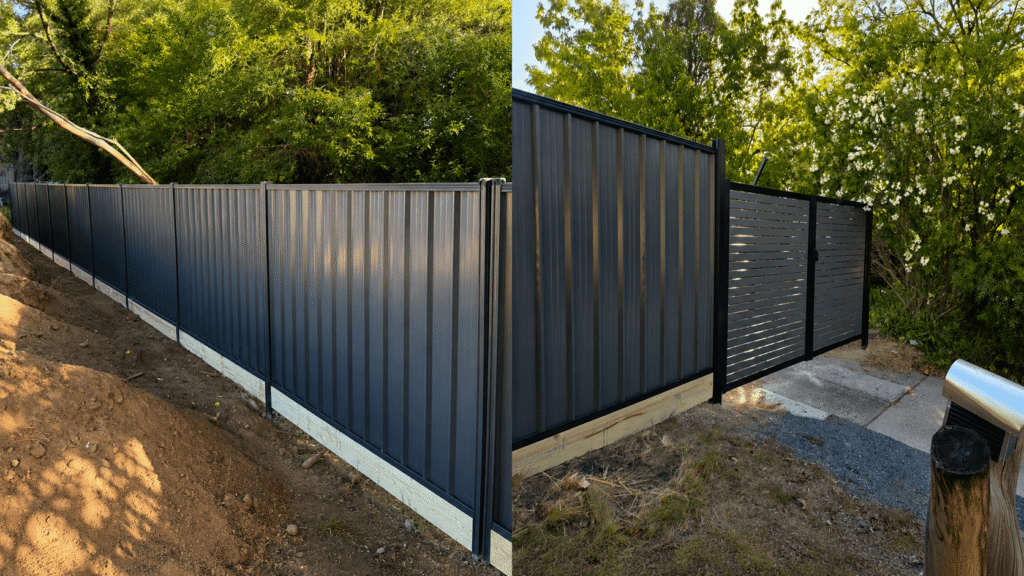
Colorbond fencing usually refers to a pre-painted steel fence system made from metal panels, posts, rails, capping, gates, and matching accessories. It is widely used for residential boundaries, commercial perimeters, garden privacy, property developments, and project-based fencing supply.
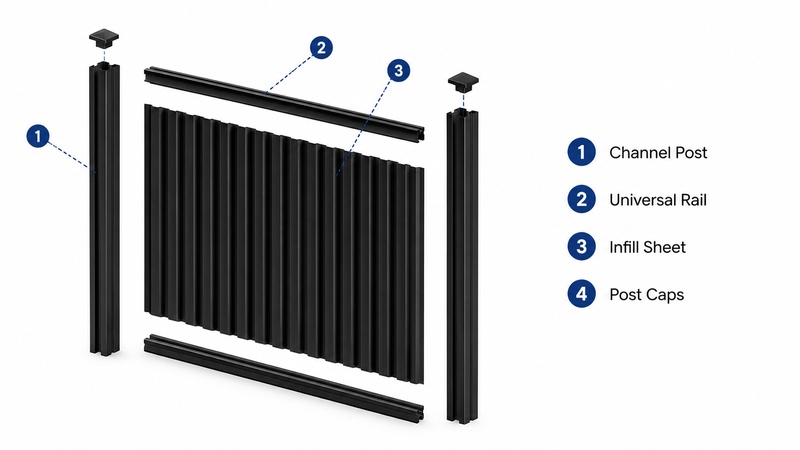
A typical Colorbond-style fence system includes:
- Colorbond fence panels
- Steel posts
- Top and bottom rails
- Capping
- Gates
- Screws and fixing accessories
- Optional lattice, slat, or decorative sections
For B2B buyers, colorbond fence panels are only one part of the full system. The final performance also depends on steel grade, coating system, anti-corrosion protection, posts, fixings, and installation method.
Field Note: Not All Metal Fence Panels Are the Same
In project supply, we do not only look at surface colour. We also consider the material specification behind the panel.
For example, G550 steel can provide higher hardness and better wind resistance. HDP coating helps improve salt spray resistance and ageing resistance. AM100 anti-corrosion protection can improve corrosion resistance and provide better protection in demanding outdoor environments.
This matters for coastal, high-UV, high-humidity, and strong-wind areas. In these conditions, choosing the cheapest panel is not always the safest option.
What Is Timber Fencing?
Timber fencing is a traditional fence system made from wooden posts, rails, and boards. Common styles include vertical paling fences, lapped and capped fences, horizontal slat fences, and post-and-rail fences.
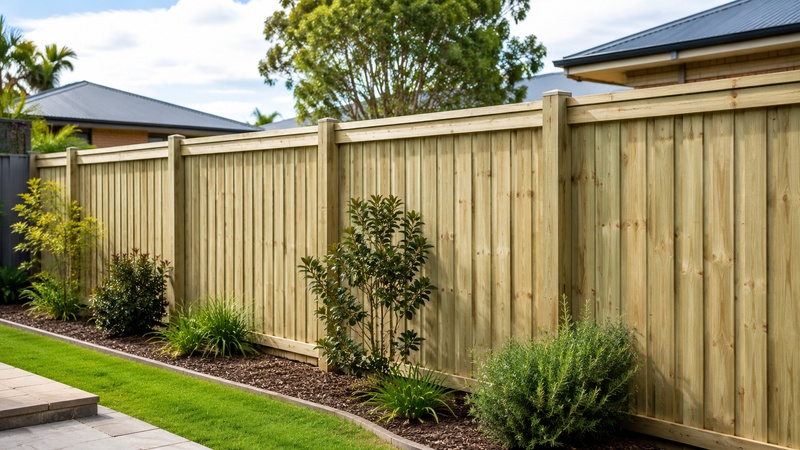
Many buyers like timber because it looks natural and warm. It suits traditional homes, gardens, rural properties, and projects where a softer visual style is preferred.
Common timber fencing materials include:
- Treated pine
- Hardwood
- Merbau
- Spotted gum
- Ironbark
However, timber is a natural material. It reacts strongly to moisture, sunlight, insects, and temperature changes. Over time, timber fence panels may crack, warp, rot, fade, or develop wider gaps. In termite-prone areas, pest damage can also become a serious issue.
Cost Comparison: Colorbond Fence vs Timber Fence
Cost is usually the first question buyers ask. Many customers want to compare the cost of colorbond fence materials with timber fencing before choosing a solution.
This is understandable, especially at the early quotation stage. But for B2B projects, the first price is not always the final cost.
Upfront Price: Why Timber Often Looks Cheaper First
Timber fencing usually has a lower upfront material cost. For a small backyard or simple boundary fence, this can make timber look more attractive.
Colorbond-style fencing usually costs more at the beginning because it is a complete metal fence system. The cost may include:
- Steel fence panels
- Posts
- Rails
- Capping
- Gates
- Screws and accessories
- Surface coating
- Anti-corrosion protection
- Export packaging
- Container loading
- Freight and local delivery
If the project requires custom colour, custom height, non-standard dimensions, stronger posts, or upgraded coating, the cost will increase.
So when a buyer says Colorbond-style fencing is “more expensive,” the real reason is not only the panel. The price reflects the full system, project requirements, and long-term performance.
Field Experience: Why Per-Metre Price Is Not Enough
Many Australian buyers ask for the colorbond fence cost per meter first. This is normal. But in real B2B project discussions, the more important figure is often the full project cost.
A builder, developer, contractor, wholesaler, or property manager usually needs to consider:
- Material cost
- Accessories
- Packaging
- Transportation
- Installation efficiency
- Maintenance frequency
- Repair risk
- Replacement cost
- Long-term appearance
From project communication experience, buyers often care about both per-metre price and whole-project cost. But for larger projects, the final decision usually depends more on whether the fence can reduce maintenance, avoid repeated repair work, and keep the project stable over time.
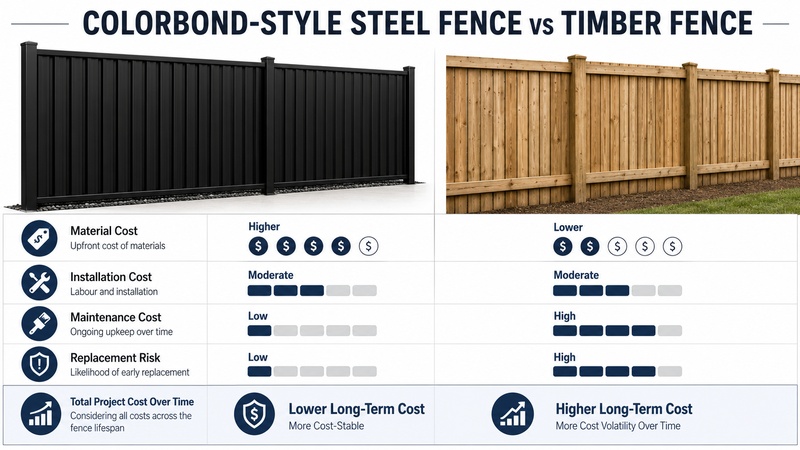
That is why comparing colorbond or timber fence options only by upfront price can lead to the wrong decision.
Lifetime Maintenance Cost: Timber Needs More Attention
Timber fencing may look cheaper at the beginning, but it often needs more maintenance over time.
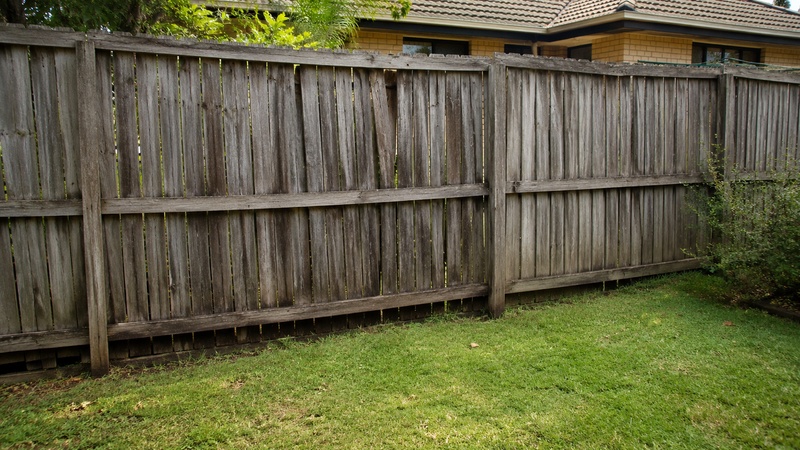
In many outdoor conditions, timber may need attention once or twice a year. This can include:
- Painting
- Staining
- Pest checking
- Re-fastening loose boards
- Replacing warped boards
- Replacing rotten sections
- Repairing cracks or splinters
For one small residential fence, this may not seem like a major problem. But for a property manager, developer, or builder handling many lots, repeated maintenance can become a real cost.
Colorbond-style metal fencing is designed as a low-maintenance system. It does not need regular painting or staining like timber. In most cases, basic cleaning and occasional checking of fixings are enough.
This is one of the main reasons many project buyers consider metal fencing after comparing the full lifecycle cost.
Field Note: A Canberra Project Discussion
In one Canberra project discussion, the buyer initially considered timber fencing because of its lower upfront cost. This is common because timber can look more budget-friendly at the quotation stage.
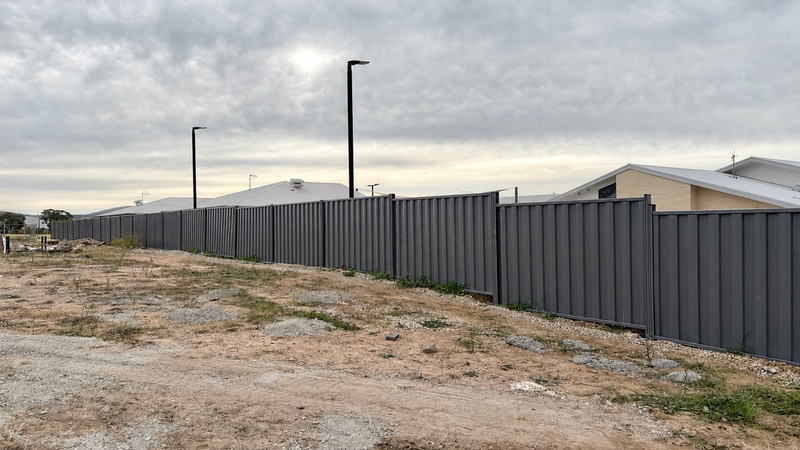
However, after comparing maintenance frequency, long-term appearance, weather exposure, and possible board replacement, the discussion shifted toward a lower-maintenance metal fencing solution.
This type of situation is common in project buying. Timber may look attractive at the beginning, but once the buyer includes maintenance, repainting, repair work, and replacement risk, the decision can change.
For B2B buyers, the question should not be:
“Which fence is cheaper today?”
A better question is:
“Which fence will create fewer problems over the next 10 to 20 years?”
Durability & Maintenance: Low-Maintenance Metal vs Natural Timber
Durability is one of the biggest differences between Colorbond-style metal fencing and timber fencing.
Timber is natural, so it changes with the environment. Metal fencing is more stable, but only when the right material, coating, and installation details are selected.
Timber Fence Maintenance Risks
Timber fencing can face several common problems in Australian outdoor conditions:
- Rotting in wet or humid areas
- Cracking under strong sun exposure
- Warping after repeated wet-dry cycles
- Termite or insect damage
- Paint or stain fading
- Surface peeling
- Gaps widening between boards
- Splinters and loose sections
These problems do not always appear immediately. But over time, they can affect privacy, appearance, strength, and safety.
This is why timber fence panels may require more frequent maintenance than metal systems, especially in humid, coastal, or termite-prone areas.
Colorbond-style Metal Fence Maintenance Risks
Colorbond-style metal fencing is more durable and lower-maintenance, but buyers still need to choose the right specification.
In complex environments, you should not only look at the panel. You should also check:
- Steel grade
- Coating system
- Anti-corrosion protection
- Screws and fixings
- Posts
- Footing design
- Site drainage
- Installation method
For example, a low-cost metal panel with weak screws or poor coating may still create maintenance problems later. In sloped, windy, humid, or coastal areas, the whole system matters.
A reliable metal fence is not just a panel. It is a complete system.
Environmental Conditions: Why Site Location Changes the Fence Specification
The location of the project can change the right fence specification. This is especially important in Australia, where projects may face strong UV, coastal salt spray, high wind, heavy rain, and termite risk.
Coastal Areas and Salt Spray
Coastal projects need special attention. Salt spray, humidity, and wind can speed up corrosion if the material is not properly specified.
In coastal environments, buyers should check:
- Coating grade
- Anti-corrosion system
- Screw and fixing quality
- Post protection
- Panel edge protection
- Cut edge and hole protection
- Packaging protection during transport
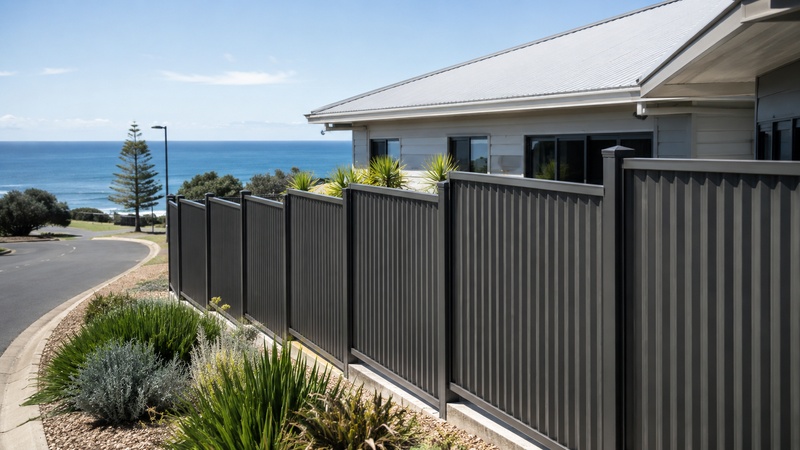
For coastal projects, the cheapest coating system is not always the safest choice. If the fence is installed close to salt air, ordinary coating may not be enough for long-term performance.
For harsher environments, options such as HDP coating and AM100 anti-corrosion protection may be considered. HDP coating helps improve salt spray resistance and ageing resistance. AM100 can improve anti-corrosion performance and help provide better protection in demanding outdoor conditions.
Strong UV and Colour Fading
Strong UV exposure can affect the long-term appearance of fencing materials.
Timber can fade, dry out, crack, or lose its surface finish. Paint and stain may need to be refreshed regularly.
Colorbond-style metal fencing has a more uniform surface and stronger colour stability when the coating system is suitable for the environment. This is one reason many buyers choose it for residential estates, commercial boundaries, and managed properties where long-term appearance matters.
A consistent fence colour can also reduce future replacement mismatch. This is important for developers and property managers who want the whole project to keep a clean and unified look.
High Humidity and Heavy Rainfall
High humidity and heavy rainfall can be difficult for timber fencing. Moisture can cause swelling, rot, mould, warping, and pest problems.
For metal fencing, the key is not moisture absorption, but corrosion control. Buyers should check coating, anti-corrosion layer, fixings, post base design, and water drainage around the installation area.
If water collects around the post base or screw holes, even a metal system may face long-term risk. Good installation matters as much as good material.
High-Wind Areas
In high-wind areas, buyers should not only ask about fence height and panel style. Wind performance depends on the whole structure.
Important points include:
- Steel grade
- Fence height
- Panel profile
- Post spacing
- Post thickness
- Footing depth
- Fixing method
- Site exposure
For projects where wind resistance matters, G550 steel can be recommended as a stronger option because of its higher hardness and better wind performance.
This is especially useful for exposed sites, open land, coastal areas, or projects where local wind requirements must be considered.
Appearance & Design Flexibility
Appearance is another important factor when choosing colorbond or timber fence options.
Timber has a natural look. It works well with traditional homes, cottage-style gardens, rural properties, and projects where warmth and natural texture are important. It can also be painted or stained to match the property design.
However, timber changes over time. It can fade, crack, warp, or weather unevenly. If some boards are replaced later, the new timber may not match the old sections.
Colorbond-style metal fencing offers a more modern and consistent appearance. It is suitable for contemporary homes, commercial boundaries, residential estates, and projects where uniform colour and clean lines are preferred.
For B2B projects, this consistency can be important. A property manager does not want different sections of the fence to age differently. A developer may also want the whole estate to keep a clean and polished look for many years.
Privacy, Security, and Noise Control
Privacy is one of the main reasons people install fencing.
Colorbond-style metal fencing usually provides strong privacy because the panels are solid and have no large gaps. This makes it suitable for backyards, side boundaries, pool areas, storage yards, and commercial properties.
The smooth vertical surface also makes it harder to climb than many timber fence designs. There are fewer footholds, and the panel surface is more difficult to grip.
Timber fencing can also provide privacy, especially with lapped and capped designs. But standard timber paling fences may develop gaps over time as boards shrink, move, or warp. These gaps can reduce privacy and affect appearance.
For noise control, solid metal panels can help reduce some sound transmission from roads, neighbours, or activity areas. They are not a full acoustic wall, but they can provide better noise reduction than open-style fencing.
Installation Considerations: Installing Colorbond Fence vs Timber Fence
Installation is another cost factor that many buyers overlook.
When comparing the cost of colorbond fence and timber fencing, you should not only compare material price. You should also consider installation speed, labour requirements, site complexity, and long-term maintenance access.
Installing Colorbond Fence
A Colorbond-style metal fence system is usually modular. Panels, posts, rails, caps, and fixings are designed to work together.
This can make installation more efficient for standard projects, especially when dimensions are consistent. For bulk projects, standardization can reduce installation complexity and improve project speed.
However, correct installation is still important. The installer needs to consider post alignment, footing depth, site slope, wind exposure, panel fixing, and water drainage.
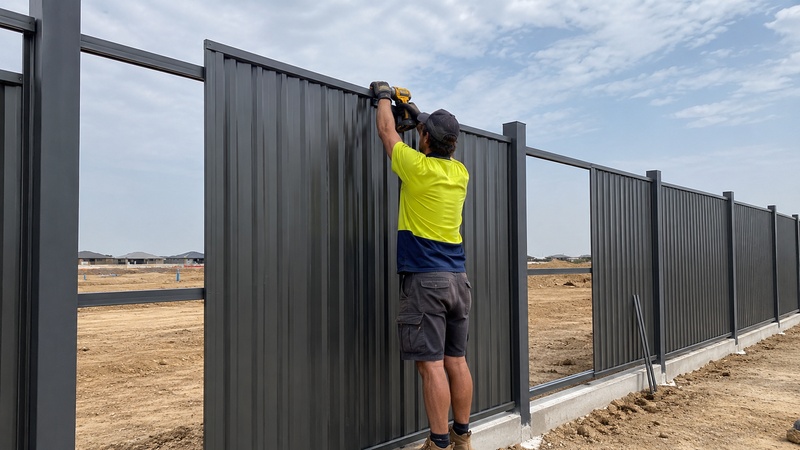
If you are searching for how to install a colorbond fence, you should remember that site conditions matter. A flat residential boundary is different from a sloped, coastal, or high-wind project.
Installing Timber Fence
Timber fencing can be more flexible on site because boards can be cut, adjusted, and repaired section by section. This can be useful for small custom projects.
But timber installation can also require more site labour. Boards need to be aligned, fixed, treated, painted, or stained. Over time, timber may require more repair visits.
For B2B projects, labour efficiency can be a major part of the total project cost. A fence that is cheaper to buy may not always be cheaper to install and maintain.
Budget Advice: Choose Standard Products Before Reducing Quality
When customers have a limited budget, the first reaction may be to ask for a cheaper material. But reducing core material quality can create higher repair risk later.
A better way to control cost is to simplify the specification.
From project experience, if the budget is limited, we usually recommend:
- Standard height instead of custom height
- Standard colour instead of custom colour
- Standard panel size instead of special dimensions
- Unified accessories
- Standard packaging
- Fewer decorative upgrades
- Bulk production with consistent specifications
In simple terms: choose standard products before reducing quality.
This approach helps reduce production complexity, improve container loading efficiency, support faster installation, and still protect long-term performance.
How B2B Buyers Should Choose Between Colorbond and Timber Fence
Different buyers care about different things. A homeowner may focus on appearance and upfront budget. A builder may focus on installation and handover. A property manager may focus on long-term maintenance. A wholesaler may focus on stable supply and repeat orders.
For Builders and Developers
Builders and developers should consider:
- Total project cost
- Installation efficiency
- Delivery schedule
- Site conditions
- Maintenance risk
- Owner complaints after handover
- Long-term appearance
If you are managing a multi-lot project, Colorbond-style metal fencing may be more suitable when low maintenance and consistent appearance matter more than the lowest upfront price.
For Property Managers
Property managers usually care about maintenance frequency, repair cost, tenant complaints, and appearance over time.
Timber may require more regular checking and repair. Colorbond-style metal fencing can reduce long-term maintenance work and make it easier to manage multiple properties.
For Wholesalers and Distributors
Wholesalers and distributors should focus on:
- Standard sizes
- Stable supply
- Packaging
- Container loading
- Market colours
- Repeatable specifications
- Price range
- After-sales risk
For wholesale supply, standardized Colorbond-style fencing systems can be easier to stock, ship, and resell.
Specification Checklist Before Quotation
Before requesting a quotation for colorbond fence panels or timber fence panels, it is helpful to confirm the project conditions first.
| Question to Confirm | Why It Matters |
|---|---|
| What country or city is the project in? | Helps judge climate, compliance, and transport |
| Is the site near the coast? | Helps decide whether stronger corrosion protection is needed |
| What fence height is required? | Affects material cost, wind load, and installation |
| Is the ground flat or sloped? | Affects post design and installation method |
| Is it for residential, commercial, pool, or industrial use? | Helps determine safety and specification requirements |
| Are there wind load or council requirements? | Affects steel grade, post spacing, and footing |
| Do you need standard colour or custom colour? | Affects price and production time |
| Do you need gates, posts, rails, caps, and fixings? | Helps quote the full system, not only panels |
| Is it a full container or small batch? | Affects packaging, shipping, and unit cost |
| What is the target budget or delivery time? | Helps create a practical project solution |
This checklist can prevent wrong pricing. It also helps buyers avoid choosing a low-cost specification that is not suitable for the site environment.
When Should You Choose Colorbond-style Metal Fence?
Choose Colorbond-style metal fencing when:
- You want lower maintenance
- The project is large or long-term
- The site is near the coast
- The area has strong UV exposure
- The site is humid, rainy, or windy
- You need consistent appearance
- You manage residential estates or commercial properties
- You want to reduce repair and replacement work
- You need standard specifications for bulk supply
- You care about total project cost more than the lowest upfront price
For B2B buyers, Colorbond-style metal fencing is often a practical option because it helps control long-term risk.
When Should You Choose Timber Fence?
Choose timber fencing when:
- You prefer a natural appearance
- The project is small
- The upfront budget is the main concern
- The site is not highly humid, coastal, or termite-prone
- Regular maintenance is acceptable
- The design needs a warm or traditional look
- Local labour can handle future repair work easily
Timber can still be a good option when the project values natural appearance more than long-term low maintenance.
The key is to understand the maintenance responsibility before choosing it.
Final Recommendation: Compare Lifecycle Value, Not Just Fence Price
When comparing colorbond vs timber fence options, the best choice depends on your project priorities.
Timber fencing may win on natural appearance and lower upfront cost. But it often requires more regular maintenance, especially in outdoor, humid, or termite-prone environments.
Colorbond-style metal fencing may cost more at the beginning, but it offers stronger long-term value for many B2B projects. It is lower-maintenance, more consistent in appearance, and better suited for projects where durability, installation efficiency, and reduced repair work matter.
For Australian-style projects, site environment is especially important. Coastal areas, strong UV, high humidity, heavy rainfall, and high wind can all change the right specification.
So before choosing colorbond or timber fence, do not only ask:
“What is the price per meter?”
Ask:
“What is the total project cost over the full service life?”
That question will lead to a better fencing decision.
Steel is also widely recycled, which can support long-term material sustainability when specified responsibly.
Get a Project-Based Fence Quotation from JZH Fence
If you are comparing Colorbond-style metal fencing and timber fencing for a residential development, commercial boundary, wholesale supply, or project-based order, JZH Fence can help you build a cost-optimized specification.
JZH Fence supplies metal fence panels, posts, rails, caps, gates, and accessories for B2B projects across Australia, North America, Europe, and other markets. Depending on your market and site environment, we can discuss project-based options such as G550 steel, HDP coating, AM100 anti-corrosion protection, standard colours, standard sizes, and bulk packaging.
Contact JZH Fence to get a project quotation, request a catalogue, or discuss the best fence configuration for your market.