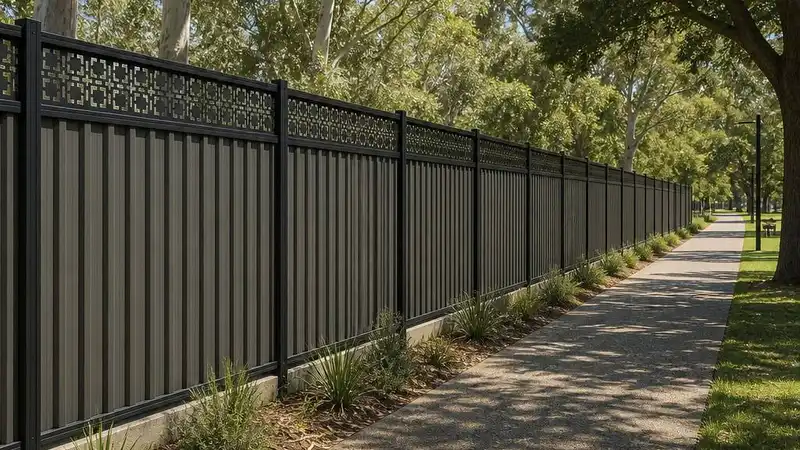
If your existing fence no longer provides enough privacy, replacing the entire boundary is not always the first option to consider. Colorbond fence extensions can add extra height above an existing steel fence using solid panels, slats, louvres, screens or purpose-made extension components.
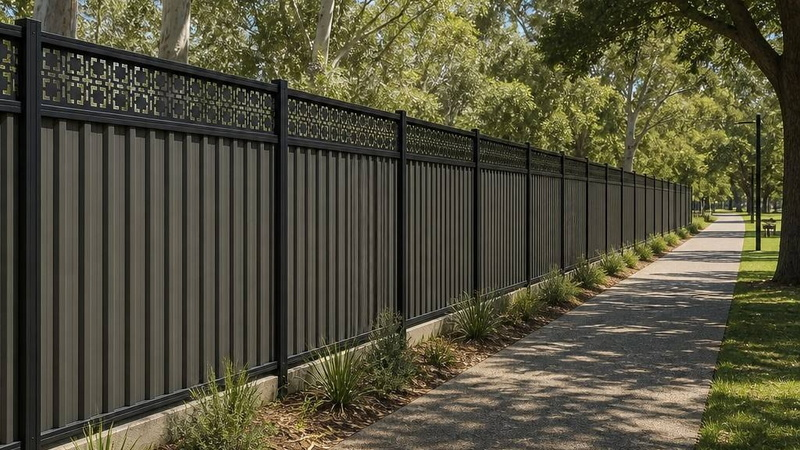
But adding height is not simply a matter of ordering another 300 mm or 600 mm of steel.
Before choosing an extension, you need to check the existing posts, footing, measurements, panel profile, wind exposure and local fence-height requirements.
This guide explains how to choose the right fence extension, what to measure before ordering, and when an existing fence may need reinforcement rather than a simple height extension.
If you are still comparing complete steel fence systems rather than just the extension, you can first review our Colorbond-style steel fencing range.
What Are Colorbond Fence Extensions?
Colorbond fence extensions are additional components installed above an existing steel boundary fence to increase its overall height.
A typical extension system may include:
- Post extension sleeves
- Extension brackets
- Additional rails
- Solid steel infill
- Aluminium or steel slats
- Louvre panels
- Decorative screens
- Mesh panels
- New post caps or top capping
Instead of removing an otherwise serviceable fence, an extension uses the existing fence as part of the supporting structure.
A simplified system looks like this:
Existing fence → post extension → new rail → extension panel → new top cap
Fence extensions are commonly considered when a property owner wants to:
- Increase backyard privacy
- Reduce overlooking from neighbouring windows or balconies
- Improve security
- Update the appearance of an older fence
- Add screening around patios or courtyards
- Adapt an existing boundary after surrounding properties change
The important point is that an extension becomes part of the complete fence system. Its suitability depends on much more than the extension panel itself.
Why Extend a Colorbond Fence Instead of Replacing It?
If the existing posts, rails and foundations are still in good condition, an extension can be more practical than removing the complete fence.
More Privacy
Privacy is one of the most common reasons for increasing fence height.
A boundary that once provided enough screening may no longer work after:
- A neighbouring property adds a second storey
- A balcony or deck overlooks the backyard
- A block is subdivided
- New development reduces the distance between properties
- A patio or outdoor living area needs additional screening
Adding height can block direct sight lines without replacing the entire boundary.
Less Disruption Than Full Fence Replacement
Removing a complete fence may involve:
- Removing old posts
- Breaking out concrete footings
- Waste disposal
- New excavation
- Reinstallation
- Possible disturbance to landscaping
If the original structure remains suitable, adding an extension can reduce the amount of work required.
That does not mean every old fence should automatically be extended. The existing structure needs to be checked first.
If you are comparing extension with complete replacement, our Colorbond-style fencing cost and installation guide explains the main factors that influence material, installation and total project cost.
Improved Security
Additional fence height may also make access more difficult around:
- Residential yards
- Storage areas
- Commercial compounds
- Building sites
- Equipment enclosures
For commercial projects, however, visibility and airflow may be just as important as maximum privacy.
A Visual Upgrade
Fence extensions do not have to look like another strip of solid steel.
Slats, louvres and decorative screens can give an existing fence a more modern appearance while adding useful height.
How High Can You Extend a Colorbond Fence?
Many existing Australian boundary fences are around 1800 mm high, so customers often ask about extensions such as:
- 300 mm
- 450 mm
- 600 mm
For planning purposes, these dimensions may create combinations such as:
| Existing Fence | Added Extension | Final Height |
|---|---|---|
| 1800 mm | 300 mm | 2100 mm |
| 1800 mm | 450 mm | 2250 mm |
| 1800 mm | 600 mm | 2400 mm |
These are dimensional examples rather than universal permitted heights.
Actual requirements depend on:
- State and local council rules
- Residential or commercial zoning
- Front, side or rear boundary location
- Existing fence construction
- Wind exposure
- Post and footing condition
- Extension design
For example, the NSW Planning Portal states that side and rear boundary fences in specified residential zones must not exceed 1.8 metres to satisfy the relevant exempt-development standard.
Brisbane City Council takes a different approach. Its boundary fence requirements state that building approval is required when a proposed fence is more than 2 metres above the natural ground surface.
So before ordering an extension, confirm both:
Can the existing fence structurally support the extra height?
and
Is the proposed final height permitted at the property?
Can Every Existing Colorbond Fence Be Extended?
No. An existing fence should be inspected before additional height is added.
Our Experience: A Fence That Is Still Standing Is Not Automatically Ready for More Height
When customers ask about a Colorbond fence height extension, one of the first questions is often:
“Can I add another 300 or 600 mm?”
A more useful question is:
“Can the existing fence structure support the additional height and wind exposure?”
Adding height increases the surface area exposed to wind.
That additional load travels through the whole system:
Extension → rails → posts → footing → ground
For that reason, we would first look at the existing fence instead of immediately recommending the tallest available extension.
Check the Existing Posts
Look for:
- Visible corrosion
- Loose posts
- Bent posts
- Movement when the fence is pushed
- Damaged post channels
- Sections already out of alignment
A weak post does not become stronger simply because an extension bracket can be attached to it.
Check the Rails
Existing rails should also be inspected for:
- Corrosion
- Bending
- Loose connections
- Damaged fixing points
If the original frame is already under stress, adding a large solid extension can make the problem worse.
Check the Concrete Footings
A post may appear fine above ground while the footing is the actual weak point.
Signs worth checking include:
- Post movement at ground level
- Cracked concrete
- Leaning fence sections
- Soil movement
- Poor drainage around the post
Consider How Much Height Is Being Added
Adding 300 mm and adding 600 mm are not the same structural change.
As the extension becomes taller, it becomes more important to review:
- Post section
- Post spacing
- Rail configuration
- Footing
- Wind exposure
- Extension openness
Consider Wind Exposure
A sheltered suburban boundary and an exposed coastal or open site should not automatically use the same configuration.
A solid panel blocks more airflow than an open slat or mesh extension.
For exposed projects, the extension type therefore needs to be considered together with the supporting structure.
When Should You Avoid Simply Adding a Fence Extension?
A simple extension may not be the right solution if:
- The existing posts are visibly loose or corroded
- The fence already leans or moves in wind
- The concrete footings appear inadequate
- The rails are damaged
- A large solid extension is planned
- The site is highly wind-exposed
- The existing system cannot accept compatible extension components
Depending on the problem, a better solution may be to:
- Reinforce the existing structure
- Replace selected posts
- Reduce the extension height
- Change the extension design
- Use a more open upper section
- Rebuild part of the fence
The objective should not simply be to achieve the maximum possible height. The extension needs to work with the actual site.
Types of Colorbond Fence Extensions
Once the existing structure has been checked, the next question is which type of extension best suits the project.
Solid Steel Panel Extensions
Solid extensions continue the visual barrier above the existing fence.
They work well when the main goal is:
- Maximum visual privacy
- Screening neighbouring properties
- Creating a consistent steel appearance
- Improving security
A solid extension can integrate visually with the existing steel fence, particularly when the colour and profile are coordinated.
Because it creates a closed surface, however, wind exposure deserves additional attention.
Slat Fence Extensions
Slats create extra height while leaving gaps between individual members.
They are suitable where you want:
- Privacy
- Airflow
- A lighter appearance
- A modern architectural finish
Slat spacing can be adjusted to balance screening and openness.
Louvre Fence Extensions
Louvres provide visual screening while still allowing airflow.
They can work well around:
- Courtyards
- Patios
- Outdoor entertaining areas
- Residential boundaries
Their angled design can reduce direct sight lines without making the upper fence completely solid.
Laser-Cut Screen Extensions
Decorative screens are more design-focused.
They may be used where the customer values:
- Architectural appearance
- Custom patterns
- Feature boundaries
- Decorative screening
They are particularly useful where the fence is visible from a landscaped or outdoor living area.
Mesh or Hybrid Extensions
Commercial sites do not always need complete visual privacy.
A solid lower fence can be combined with:
- Welded mesh
- Tubular steel
- Other open metal sections
above it.
This can add height while preserving visibility around warehouses, CCTV areas and commercial boundaries.
Which Colorbond Fence Extension Type Should You Choose?
Our Experience: Start With the Problem, Not the Product
Customers sometimes begin an enquiry by saying:
“I need another 600 mm.”
But the required height does not tell us which extension type is best.
We first want to understand why the extra height is needed.
If Maximum Privacy Is the Priority
A solid steel extension is usually the first option to consider.
It is suitable for:
- Neighbour overlooking
- Backyard privacy
- Side boundaries
- Outdoor living areas
If Privacy and Airflow Are Both Important
Consider:
- Slat extensions
- Louvre extensions
These provide additional screening while keeping part of the upper fence open.
If Appearance Is the Main Priority
A laser-cut screen or architectural slat system may be more suitable.
If Security and Visibility Are Both Important
Commercial projects may benefit from an open mesh or hybrid upper section.
| Main Requirement | Extension Direction to Consider |
|---|---|
| Maximum privacy | Solid steel |
| Privacy + airflow | Slat |
| Privacy + controlled sight lines | Louvre |
| Decorative appearance | Laser-cut screen |
| Commercial visibility | Mesh / hybrid |
| Exposed or windy site | Review open-area options and supporting structure |
This is why we do not recommend selecting an extension only from a product photo.
The site conditions and the reason for adding height should guide the specification.
Solid vs Slat vs Louvre Fence Extensions
The following comparison can help narrow down the options.
| Feature | Solid | Slat | Louvre |
|---|---|---|---|
| Visual privacy | Highest | Medium–High | High |
| Airflow | Low | Good | Good |
| Open area | Low | Adjustable | Moderate |
| Modern appearance | Good | Very good | Very good |
| Match with solid steel fence | Very good | Good | Good |
| Decorative flexibility | Medium | High | High |
There is no single “best” extension type.
The right choice depends on the project.
How to Measure an Existing Fence Before Ordering Extensions
This is where many compatibility problems begin.
A customer may describe the existing system as:
“standard Colorbond fencing”
But that description alone is not enough information for manufacturing compatible extension parts.
Our Experience: “Standard Colorbond Fence” Does Not Confirm Compatibility
Steel privacy fencing can vary between:
- Suppliers
- Product systems
- Installation periods
- Post profiles
- Rail sizes
- Sheet profiles
- Cap designs
- Bracket systems
Two fences may look almost identical from several metres away but use different connection dimensions.
For this reason, we recommend checking several measurements before production.
5 Measurements to Check Before Ordering a Fence Extension
1. Post Centre Distance
Measure from the centre of one post to the centre of the next.
Do not rely only on the visible sheet width.
Post-centre dimensions help confirm:
- Bay width
- Rail length
- Panel configuration
2. Existing Post Size
Measure the existing post carefully.
Useful dimensions may include:
- Overall width
- Channel width
- Depth
- Wall thickness where practical
This is especially important when a sleeve or bracket connects directly to the existing post.
3. Top Rail Dimensions
Measure:
- Rail width
- Rail height
- Fixing position
If the original top rail remains part of the extension system, its dimensions affect bracket and fixing design.
4. Sheet Profile
Take clear photos of the steel sheet from both the front and side.
Check:
- Rib shape
- Rib spacing
- Panel orientation
Even if the new extension uses slats or a decorative screen, understanding the existing profile helps with connection detailing.
5. Existing Height and Required Final Height
Record the three figures separately.
For example:
Existing fence: 1800 mm
Extension: 300 mm
Required final height: 2100 mm
This simple distinction helps prevent misunderstandings during quotation and production.
What Photos Should You Send Before Ordering?
Measurements are much more useful when supported by clear photos.
For an extension enquiry, we recommend providing:
- Full fence photo
- Post close-up
- Top rail close-up
- Panel profile close-up
- Photo showing a tape measure against the post or rail
- Corner or end-post photo
For larger contractor or wholesale orders, a measured drawing is even better.
It can show:
- Total fence length
- Bay widths
- Post centres
- Extension height
- Gate locations
- Corner positions
- Different fence sections
If you already have a CAD drawing or project plan, send that as well.
A few clear measurements before production can prevent much more expensive rework after delivery.
Common Compatibility Problems With Fence Extensions
Wrong Post Size
If an extension sleeve is designed for a different post profile, it may not fit correctly.
Incorrect Post Centres
If the new rail or panel is manufactured against the wrong bay dimension, site adjustment becomes more difficult.
Different Sheet Profiles
A solid extension may not align visually with the existing steel sheets.
Different Rail Systems
Even when two fences look similar, their top rails may use different widths or fixing details.
Assuming All Steel Fences Use the Same Components
This is one of the easiest mistakes to avoid.
Do not order a large quantity of extension parts based only on the statement:
“My fence is standard.”
Check the actual fence first.
Colours and Matching an Existing Fence
Colour matching matters because the extension sits directly above the existing fence.
You generally have two design directions.
Match the Existing Fence
Choose a finish that visually coordinates with the existing steel fencing.
This creates the most continuous appearance.
Use a Contrasting Extension
A contrasting extension can also be intentional.
For example:
- Dark steel fence + timber-look slats
- Grey fence + black screen
- Neutral fence + architectural feature panel
For overseas and customised projects, colours may also be selected using:
- RAL references
- Approved colour samples
- Customer-supplied swatches
For larger orders, confirm the finish using a physical sample when colour consistency is critical.
How to Install Colorbond Fence Extensions
Installation details vary between systems, but the general process usually follows these steps.
Step 1: Inspect the Existing Fence
Before installing anything, check:
- Posts
- Rails
- Footings
- Corrosion
- Alignment
- Movement
If the fence already has structural problems, deal with those issues first.
Step 2: Confirm the Permitted Final Height
Check the requirements applying to the actual property.
Rules may differ according to:
- Location
- Zoning
- Front, side or rear boundary
- Residential or commercial use
The NSW Planning Portal also notes that exempt works must be structurally adequate and installed in accordance with manufacturer specifications and applicable building requirements.
Step 3: Remove or Modify Existing Top Capping
Some extension systems require the original top cap or rail to be removed before the extension is installed.
Follow the design of the actual system.
Step 4: Install Post Extension Sleeves or Brackets
Fix the extension components to the existing posts.
Confirm:
- Alignment
- Height
- Connection position
before installing the full fence run.
Step 5: Install New Rails
Fit the supporting rails between the extended posts.
Check that they are level before completing all connections.
Step 6: Install the Extension Infill
Depending on the design, install:
- Solid sheets
- Slats
- Louvres
- Screens
- Mesh
Step 7: Fit Caps and Finish the Connections
Complete the system with:
- Post caps
- Top caps
- Trims
- Fixing covers where required
If the project also includes a pedestrian, side or driveway gate, our fence gate range can help you plan the fence and gate as one complete system.
6 Common Colorbond Fence Extension Mistakes
1. Extending a Weak Existing Fence
An extension does not repair weak posts or footings.
Inspect the existing structure first.
2. Ordering Before Measuring the Posts
A wrong post dimension can make a custom sleeve or bracket unusable.
3. Assuming All Profiles Are Compatible
Similar-looking steel fencing can still use different rails, posts and sheet profiles.
4. Choosing a Solid Extension Without Considering Wind
More privacy also means more closed surface area.
On exposed sites, check the complete supporting structure.
5. Choosing the Maximum Height Just Because It Is Available
The tallest possible extension is not automatically the best solution.
Choose the height required to solve the actual privacy or security problem.
6. Ignoring Local Fence Rules
Manufacturing capability and planning permission are two different things.
Check what is allowed before placing the order.
What Affects Colorbond Fence Extension Cost?
There is no useful universal Colorbond fence extension cost per metre without knowing the specification.
The main cost factors include:
- Extension height
- Total project length
- Solid, slat, louvre or screen design
- Steel or aluminium material
- Post extension design
- Brackets
- Surface finish
- Custom colour
- Custom hole patterns
- Quantity
- Packaging
- Shipping destination
For example, a standard 300 mm solid extension and a custom 600 mm laser-cut screen extension should not be compared only by price per metre.
The material, fabrication and support requirements are different.
If you are comparing extension costs with a completely new fence, our Colorbond-style fencing cost and installation guide covers the main cost variables in more detail.
What Information Should You Send for a Fence Extension Quote?
The more complete the initial information, the fewer clarification rounds are normally required.
A useful enquiry might include:
| Information | Example |
|---|---|
| Existing fence height | 1800 mm |
| Required final height | 2100 mm |
| Extension required | 300 mm |
| Total fence length | 100 m |
| Post centres | 2400 mm |
| Post dimensions | See attached measurement |
| Extension type | Slat |
| Colour | Dark grey |
| Project location | Australia |
| Site photos | Attached |
Also mention whether the project is for:
- One residential boundary
- A contractor project
- A development
- Wholesale stock
- Distribution
This helps the supplier understand whether the order needs one project-specific configuration or a repeatable system suitable for future orders.
Frequently Asked Questions About Colorbond Fence Extensions
Can I Add Height to an Existing Colorbond Fence?
Potentially, yes.
But the existing posts, rails, footing, dimensions and local requirements should be checked before an extension is selected.
How Much Height Can I Add to a Colorbond Fence?
Common extension dimensions include 300 mm, 450 mm and 600 mm, but the appropriate amount depends on the existing structure and local requirements.
Do not assume that every 1.8 m fence can simply be extended to 2.4 m.
Can I Extend a 1.8 m Colorbond Fence to 2.1 m?
A 300 mm extension is a common dimensional option, but structural suitability and planning requirements still need to be confirmed for the actual property.
Do Colorbond Fence Extensions Need New Posts?
Not always.
Some systems use sleeves or brackets fixed to existing posts.
However, weak, damaged or incompatible posts may need reinforcement or replacement.
Are Fence Extensions Suitable for High-Wind Areas?
They can be, but high-wind locations require more attention to:
- Extension openness
- Post condition
- Post spacing
- Rails
- Footings
- Connections
The fence should be considered as a complete system.
How Do I Measure My Fence for an Extension?
At minimum, measure:
- Existing height
- Post centres
- Post size
- Top rail dimensions
- Required final height
Clear site photos are also recommended.
Are All Colorbond Fence Extensions Compatible?
No.
Post, rail, sheet and bracket dimensions can vary between fence systems.
Confirm the actual dimensions before ordering.
Is a Solid or Slat Fence Extension Better for Privacy?
A solid extension generally provides greater visual screening.
Slats provide a balance between screening and airflow.
The better choice depends on what you are trying to achieve.
Colorbond-Style Fence Extension Supply for Trade and Project Buyers
For contractors, fencing importers, distributors and project buyers, the extension should be specified as part of the complete fence system.
JZH Fence supplies steel fencing systems for wholesalers, contractors and overseas project buyers.
Depending on the project requirements, supply can include:
- Extension posts
- Post sleeves
- Rails
- Solid steel panels
- Slat extensions
- Decorative screens
- Custom brackets
- Matching gates
- Custom dimensions
- Custom colours
- OEM / ODM production
- Drawing support
- Export packaging
For custom projects, providing your existing fence dimensions and site photos during the quotation stage helps us review compatibility before production.
For repeat wholesale orders, we can also work from an agreed drawing so that the post, rail, bracket and panel dimensions remain consistent between production batches.
Conclusion
A successful Colorbond fence extension project starts before the extension is ordered.
Check three things first:
- Can the existing fence structure support the additional height?
- Have the existing posts, rails and profiles been measured correctly?
- Does the selected extension type actually solve the privacy, airflow, appearance or security problem?
If those three questions are answered properly, it becomes much easier to choose between solid panels, slats, louvres, screens and other extension systems.
If you are sourcing fence extensions for a contractor project, wholesale order or distribution business, send us:
- Existing fence height
- Required final height
- Post dimensions
- Post centres
- Total length
- Extension type
- Site photos
You can contact JZH Fence with your measurements, site photos or drawings, and we can review the information required to prepare a suitable Colorbond-style fence extension specification before quotation.