If you are planning a swimming pool fence in Western Australia, knowing the pool fence requirements WA applies is only the first step. You also need to translate those rules into the right panel height, post length, gate configuration and installation method.
Western Australia requires private pools and spas containing more than 300 mm of water to have an effective safety barrier restricting access by young children.
For contractors, fencing companies and project buyers, this creates an important distinction: a fence that looks correct on a drawing is not necessarily compliant once installed.
From our own pool fencing work in Western Australia, we have learned to check the finished barrier, not just the nominal size of an individual panel. That is also why, although the minimum fence height is generally 1.2 m, our production specification for relevant Australian pool fence projects is commonly around 1.25 m, subject to the actual project design and installation conditions.
This guide explains the WA requirements and the practical manufacturing details we check before production.
Quick Answer: What Are the Main Pool Fence Requirements in WA?
For a typical internal pool safety barrier in Western Australia, these are some of the key dimensions and gate requirements that need to be checked.
Item | Key WA Requirement |
Pool barrier height | At least 1200 mm |
Gap between vertical members | Maximum 100 mm |
Gap under the barrier | Maximum 100 mm |
Non-climbable zones | Commonly based around 900 mm NCZ dimensions |
Gate direction | Must open away from the pool area |
Gate closing | Must self-close |
Gate latch | Must self-latch |
Latch release | Must meet specified height or shielding requirements |
The current WA Government guidance provides detailed diagrams covering barrier heights, non-climbable zones, gaps and gates.
You can refer to the official WA Rules for Pools and Spas for current requirements.
For example, the official guidance specifies a maximum 100 mm horizontal opening between vertical members and a maximum 100 mm gap between the safety barrier and the stabilised ground surface.
These figures should be treated as design inputs rather than a complete project specification. Pool approval date, barrier type, boundary conditions and local government requirements may affect the final solution.
Which Pools and Spas Need a Safety Barrier in WA?
In Western Australia, private swimming pools, spa pools and portable pools capable of containing water more than 300 mm deep generally require a compliant safety barrier designed to restrict access by young children.
This can include:
- In-ground swimming pools
- Above-ground pools
- Permanent spa pools
- Outdoor hot tubs
- Certain portable swimming pools
The safety barrier is only one part of pool safety.
WA Government guidance describes these barriers as child-resistant rather than child-proof and stresses that active adult supervision remains essential.
For project buyers, the important point is that the barrier needs to be considered as a complete system:
Panel + post + gate + latch + hinge + fixing method + finished ground level
Looking only at the fence panel can overlook problems that become obvious once the system is installed.
Pool Fence Height Requirements in WA
For standard internal pool fencing, 1200 mm is the key minimum barrier height commonly applied in Western Australia.
But there is an important manufacturing detail behind that number.
Why We Produce Around 1.25m Instead of Exactly 1.2m
When we handle Australian swimming pool fence enquiries, we do not normally treat 1200 mm as simply the height that should appear on the factory production drawing.
Our usual production approach for relevant pool fencing projects is around 1250 mm, depending on the final project specification.
Why?
Because the regulatory requirement relates to the finished safety barrier, while manufacturing involves individual components that still need to be installed on a real site.
Factors such as:
- Ground level
- Bottom clearance
- Base plate configuration
- Post fixing method
- Installation tolerance
- Final panel position
can affect the finished result.
The WA guidance measures safety barrier height relative to the finished ground surface, which is why the site condition matters rather than only the nominal panel dimension.
Our practical rule is simple: we confirm the finished barrier height, not just the panel height.
That distinction is especially important for overseas buyers sending a specification such as:
Pool fence, 1200 mm high.
For a normal decorative fence, that might be enough information to start pricing.
For a pool safety barrier, we need to understand what 1200 mm means after installation.
A 1200mm Panel Does Not Automatically Mean a 1200mm Finished Barrier
Imagine two projects using a similar aluminium panel.
One is installed onto existing concrete with a base-plated post.
The other uses longer posts embedded into concrete.
The finished heights may both need to meet the same pool safety requirement, but the required post length, fixing details and panel position can differ.
That is why our production team prefers to work backwards:
Required finished barrier → Installation method → Post configuration → Panel dimensions → Production drawing
For more information about the aluminium systems we manufacture, you can also review our aluminium fence panels and blade fencing options.
Real Project: Aluminium Blade Pool Fence in Western Australia
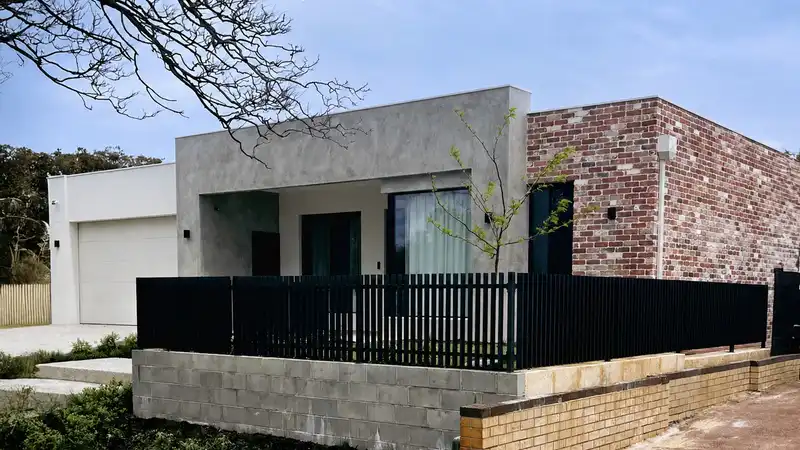
One of the most useful references behind our current pool fencing process came from an aluminium blade pool fence project in Western Australia.
Our company owner was personally involved in this project.
That experience matters because the project was not simply about making a row of aluminium panels. It required the fence configuration to be considered together with the pool application, installation conditions and safety requirements.
Why Blade Fencing Was Used for the Pool Area
The project used an aluminium blade fence.
Blade fencing uses vertical aluminium profiles to create a clean architectural appearance while still allowing the spacing, panel construction and finish to be configured around the project.
For modern pool areas, this can provide a different visual effect from conventional tubular pool fencing.
You can compare blade fencing with other systems in our guide to different types of pool fencing.
However, appearance was not the only issue we needed to consider.
Because this was a pool fence, the dimensions and spacing had to be reviewed from the perspective of the complete installed barrier.
What We Check Before Production
The Western Australia project reinforced an important lesson for our team: a pool fence should not be processed as an ordinary panel enquiry.
Instead of simply asking the customer: What fence height do you want?
we already know that a WA pool barrier needs to satisfy applicable safety requirements.
The questions that matter more are things the manufacturer cannot determine without understanding the project, such as:
- Ground condition
- Installation method
- Fence layout
- Gate arrangement
- Final barrier height
- Panel and post dimensions
- Surface finish
- Technical drawing requirements
Before a similar project enters production, we therefore review:
Project location → Applicable regulations → Final barrier height → Panel and post dimensions → Fixing method → Gate system → Finish → Technical drawing
This avoids repeatedly asking customers questions that a professional pool fence supplier should already understand, while focusing the discussion on information that genuinely changes production.
What We Took From the WA Blade Fence Project
The main lesson was that a pool fence cannot be specified as a collection of separate panels.
The posts, panels, gate, hinges, latch, ground condition and installation method all influence the final barrier.
This experience now affects how we review later Australian pool fence enquiries.
For contractors working on project-based fencing, our project and contractor fencing solutions explain how we approach project specifications and installation-oriented supply.
Pool Fence Gaps and Non-Climbable Zones
Height alone does not make a pool fence compliant.
WA’s current guidance states that the maximum horizontal gap between vertical members is 100 mm, while the gap beneath a safety barrier and the stabilised ground surface must also be no more than 100 mm.
This is particularly important with blade and tubular fencing.
A designer may focus on the profile width because it determines the appearance of the fence, but the clear opening between profiles is just as important for a pool application.
The WA rules also define non-climbable zones intended to prevent children from using nearby components or objects as handholds and footholds.
A commonly referenced dimension is 900 mm.
That means site conditions matter.
A barrier that originally complied can later become problematic if someone places:
- Outdoor furniture
- Planter boxes
- Retaining elements
- Pool equipment
- Barbecues
- Other climbable objects
inside the non-climbable area.
This is one reason pool barrier compliance is not purely a factory issue.
Product design, installation and ongoing site use all matter.
Pool Gate Requirements in WA
The pool gate is one of the most important parts of the entire barrier.
WA Building and Energy identifies gates as a common access point in drowning incidents and highlights problems such as gates being propped open, faulty latches and gates that no longer self-close properly.
Pool Gates Must Open Away From the Pool
WA guidance states that pool gates must swing outwards, away from the swimming or spa pool area.
They should not simply be treated like ordinary garden gates where opening direction is chosen only according to convenience.
The Gate Must Self-Close and Self-Latch
A compliant gate needs a mechanism that automatically returns it to the closed position.
The self-closing function needs to work properly rather than relying on the user to push the gate closed manually.
The latch also needs to automatically secure the gate when it closes without manual assistance.
This is why we do not treat the gate lock as an optional accessory upgrade.
For a pool fence, the gate hardware is part of the safety barrier system.
What About Child-Resistant Locks?
This point needs to be described carefully.
It would be inaccurate to say that every WA pool gate legally has to require two hands to open.
Instead, the WA requirements control the position and accessibility of the latch release.
One compliant arrangement places the latch release at least 1500 mm above finished ground level. Other configurations may use shielding and specified reach arrangements.
The aim is the same:
The latch should not be readily accessible to a young child.
When we review gate production details, we therefore look at the following together:
- Gate opening direction
- Hinge
- Self-closing mechanism
- Latch arrangement
- Gate post
- Gate width
- Ground condition
rather than specifying a generic residential gate lock.
For current regulatory details, refer to the official WA swimming pool and spa safety barrier requirements.
Base Plate Fixing or Embedded Posts?
Another detail that should be confirmed before production is how the fence will actually be fixed to the site.
Base Plate Fixing on Concrete
Where the site has a suitable concrete surface, a project may use a post with a base plate and mechanical anchors.
This can make installation straightforward, but the supplier still needs to know the intended fixing arrangement before confirming the post and panel dimensions.
Embedded Posts
Another option is using longer posts that are embedded and concreted into position.
Here, the total post length includes both:
- The visible above-ground section
- The embedded section below ground
That means a buyer cannot simply send: Fence height: 1.2 m.
and assume the post specification is obvious.
The supplier also needs to know:
How much post needs to remain above ground, and how much needs to be fixed below ground?
For this reason, we normally confirm the ground type and fixing method before finalising production drawings.
7 Details We Confirm Before Producing a Pool Fence
For a Western Australia project, our review process focuses on project variables rather than asking customers to explain basic regulations back to us.
| What We Confirm | Why It Matters |
|---|---|
| 1. Project location | Determines which regulations need to be checked |
| 2. Finished barrier height | More useful than only knowing nominal panel height |
| 3. Ground condition | Affects installation and clearance |
| 4. Post fixing method | Base plate and embedded posts require different configurations |
| 5. Panel, post and gate dimensions | Needed for the complete fence layout |
| 6. Gate, hinge and latch details | Gate is a critical part of the pool safety barrier |
| 7. Colour, coating and technical drawing | Finalises appearance and production requirements |
This is one of the biggest differences between sourcing a decorative garden fence and sourcing a pool barrier.
A general fence quotation can often begin with height, length and style.
A pool fence quotation needs more context because the application affects the specification.
Which Pool Fence Materials Work in Western Australia?
WA regulations do not require every pool fence to use one particular material.
The important issue is whether the finished safety barrier satisfies the applicable requirements.
For aluminium systems, common choices include the following.
Aluminium Tubular Pool Fence
Tubular aluminium fencing provides open visibility around the swimming pool and is widely used for conventional residential and commercial pool applications.
Aluminium Blade Fence
Blade fencing provides stronger architectural lines.
It can work particularly well where the buyer wants the pool barrier to form part of the wider building design rather than look like a purely functional fence.
Our Western Australia project is one example of blade fencing being used specifically for a pool application.
Aluminium Batten Fence
Batten fencing is another architectural option where profile dimensions and spacing can be adapted around the design.
When comparing these systems, the product name alone is not enough.
Buyers should compare the actual:
Profile dimensions + Spacing + Panel height + Post system + Gate + Coating + Installation drawing
That is far more useful than comparing only a photograph or price per panel.
What About Coastal Western Australia?
Western Australia includes many coastal environments, so corrosion resistance can be relevant to product selection.
For aluminium pool fence projects, we normally pay attention to:
- Aluminium construction
- Powder-coated finish
- Fastener material
- Exposure conditions
- Project location
when the fence is exposed to demanding outdoor environments.
However, the exact coating and hardware specification should be selected around the actual site rather than assuming that every Western Australian project requires the same system.
This is another reason we ask for the project location before finalising production.
Approvals and Inspections in Western Australia
Older information online may state that every new pool fence requires a building permit.
That is no longer the most accurate general description.
WA regulatory changes removed the requirement for a building permit for most isolation fences used as pool safety barriers.
However, certain barriers can still require approval, such as where the barrier also performs another regulated building function. The swimming pool or spa itself may also require relevant approval.
Project owners should therefore confirm the exact requirements with their local government.
You can check the current requirements through the official WA Building and Energy swimming pool and spa safety barrier guidance.
Initial Inspection
Local governments inspect new swimming pool and spa safety barriers after completion in accordance with WA requirements.
Owners should keep relevant compliance documentation available for the inspector.
Periodic Inspections
WA local governments also carry out periodic inspections of applicable private swimming pool and spa safety barriers.
In many areas, the maximum interval between inspections is four years.
This makes ongoing maintenance important.
A fence that was compliant on installation day can later develop problems through:
- Ground movement
- Damaged hardware
- Corrosion
- Landscaping
- Loose posts
- Changes around the barrier
Common Pool Fence Specification Mistakes
From a manufacturing perspective, several mistakes can be avoided before production begins.
Mistake 1: Treating 1.2m as Only a Panel Production Dimension
The finished installed barrier is what matters.
This is why our relevant Australian production specification is commonly around 1.25 m, rather than simply manufacturing every panel at exactly 1.2 m.
Mistake 2: Quoting Before Confirming the Fixing Method
Base-plated posts and embedded posts require different production considerations.
Knowing the installation method early helps avoid changing post specifications later.
Mistake 3: Treating a Pool Gate Like a Normal Garden Gate
The pool gate needs to work as part of a child-resistant safety barrier with suitable self-closing and self-latching hardware.
Mistake 4: Providing Only the Total Fence Length
A complete project also needs information about:
- Panel layout
- Post quantity
- Corner posts
- End posts
- Gate positions
- Accessories
- Installation conditions
Mistake 5: Starting Production Before the Technical Drawing Is Confirmed
A drawing makes the relationship between the panel, post, gate and installation method visible before material is cut or fabricated.
For a project buyer, a few extra minutes spent reviewing that drawing can prevent far more expensive changes on site.
Pool Fence Maintenance Checklist
Compliance does not stop after installation.
WA authorities specifically warn that damaged or poorly maintained gates can compromise pool safety.
Gates should never be propped open, and hinges and latches need to remain functional.
Owners and property managers should regularly check that:
- The gate closes by itself from different open positions
- The latch engages correctly
- Posts and panels remain secure
- The bottom clearance has not changed
- Landscaping has not created a new climbing point
- Furniture and other objects remain clear of the non-climbable zone
- Hinges, latches and other hardware remain in good condition
These checks are particularly useful after landscaping work, severe weather or modifications around the pool area.
FAQs
Is a 1.2m Pool Fence High Enough in Western Australia?
1.2 m is the key minimum barrier height for typical internal pool fencing, but that should not automatically be interpreted as: Order a 1200 mm factory panel.
The final installed barrier has to meet the applicable requirement.
This is why we commonly work with an approximately 1.25 m production configuration for relevant Australian pool fence projects, subject to the final drawing and installation method.
Why Does JZH Fence Produce Around 1.25m When the Requirement Is 1.2m?
Because we want to work from the finished installation requirement, rather than manufacture directly to the minimum number without considering site conditions.
The additional production allowance helps us consider the relationship between:
- Panel
- Ground level
- Bottom clearance
- Fixing configuration
- Finished barrier height
The final configuration still needs to be checked for each project.
What Is the Maximum Gap Under a Pool Fence in WA?
The current WA guidance specifies a maximum 100 mm gap between the barrier and the stabilised ground surface.
What Is the Maximum Gap Between Vertical Fence Members?
For the relevant open-style barrier provisions, the maximum horizontal opening between vertical members is generally 100 mm.
For blade fencing, this is one reason the actual profile spacing should be confirmed from a technical drawing rather than judged only from a product photo.
Does a WA Pool Gate Need to Self-Close?
Yes.
The gate needs to self-close and the latch needs to automatically secure the gate when it closes.
The gate must also open away from the swimming or spa pool area under the applicable requirements.
Does a WA Pool Gate Have to Require Two Hands to Open?
Not as a universal WA requirement.
Instead, the regulations use latch location, reach and shielding requirements to reduce the ability of young children to operate the gate.
One standard configuration places the latch release at least 1500 mm above finished ground level.
The exact latch configuration should be checked against the applicable WA requirements.
What Should I Send a Pool Fence Manufacturer for a Quote?
For a more accurate quotation, send:
- Project location
- Total fence length
- Required finished height
- Panel layout
- Ground condition
- Fixing method
- Gate dimensions and quantity
- Preferred colour
- Available technical or site drawings
With that information, the supplier can review the complete barrier rather than quoting only a panel price.
Specify the Finished Pool Barrier, Not Just the Fence Panel
The most important point in understanding pool fence requirements WA is that compliance does not come from one number.
A 1.2 m minimum height, 100 mm maximum gap and self-closing gate are important requirements, but they need to work together in the finished installation.
Our Western Australia aluminium blade pool fence project reinforced this for us firsthand.
Since then, when we review similar projects, we focus first on the applicable local requirements and then on the information that genuinely changes manufacturing:
- Finished barrier height
- Ground condition
- Fixing method
- Panel layout
- Post configuration
- Gate hardware
- Technical drawings
If you are a contractor, wholesaler or project buyer sourcing aluminium pool fencing, JZH Fence can help you review the panel, post, gate and accessory configuration before production.
You can explore our pool fencing resources and Australian fencing solutions or contact JZH Fence for a project quotation.
Send us your project location, fence layout and installation method to review your pool fence configuration before production.