Selecting a tubular pool fence involves more than comparing panel prices.
For importers, wholesalers, contractors and project buyers, the final specification must account for local pool barrier regulations, panel dimensions, picket spacing, post construction, gate hardware, ground conditions and environmental exposure.
A standard catalogue panel may work for one residential project but require substantial adjustment for a commercial development, a cold-climate market or a coastal swimming pool.
This guide explains the main decisions buyers should make before requesting a quotation or approving production.
What Is a Tubular Pool Fence?
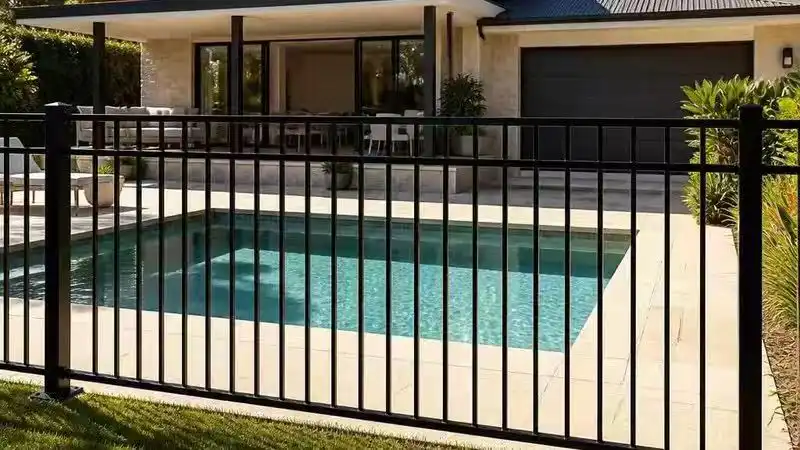
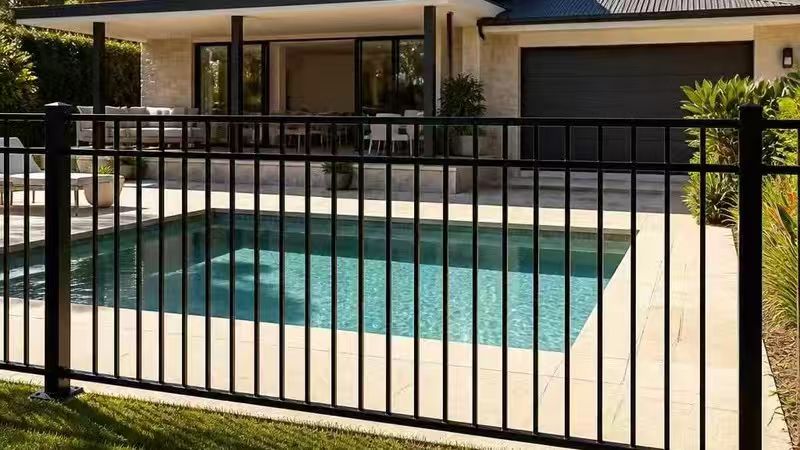
A tubular pool fence is an open-style metal barrier assembled from vertical pickets, horizontal rails, posts and gates. Most systems are manufactured from aluminum or galvanized steel tubes and finished with an outdoor powder coating.
Compared with a solid privacy fence, tubular construction provides several practical advantages:
- Clear visibility around the swimming pool
- Lower material consumption
- Easier transportation and handling
- Flexible panel and gate configurations
- Compatibility with concrete and landscaped areas
- A clean appearance for residential and commercial projects
Buyers comparing different systems can first review the main types of pool fencing and decide whether an open tubular design is suitable for the project.
JZH Fence supplies tubular and garrison fence systems for distributors, contractors, fence companies and project buyers.
Check Local Pool Fence Requirements Before Confirming the Design
Pool barrier requirements vary between countries, states, provinces and municipalities. Buyers should not approve a panel based only on a supplier’s standard catalogue dimensions.
Important items to confirm include:
- Minimum fence height
- Maximum opening between pickets
- Ground clearance below the panel
- Non-climbable zone requirements
- Gate opening direction
- Self-closing and self-latching hardware
- Latch position
- Distance between the fence and the pool
- Permit and inspection requirements
For example, Health Canada’s swimming safety guidance recommends building a fence at least 1.2 metres high around the pool and installing a self-closing, self-latching gate. It also advises property owners to check the specific rules established by their town or city.
Municipal requirements can be more detailed. The City of Toronto’s pool enclosure rules cover enclosure height, openings, visibility, climbability, gates and permit requirements.
For projects in the United States, the U.S. Consumer Product Safety Commission’s pool barrier guidance can provide an additional design reference. However, it does not replace state or local regulations.
Buyer Tip: Confirm the applicable regulations with the local installer, contractor or authority before production. A fence manufacturer can manufacture according to an approved specification, but should not be treated as the final authority on local compliance.
What Does a Complete Tubular Pool Fence System Include?
A complete pool fence system normally includes more than fence panels.
| Component | Main function | Information to confirm |
|---|---|---|
| Fence panel | Forms the main barrier | Height, width, rail quantity and picket spacing |
| Post | Supports adjoining panels | Section size, wall thickness, length and fixing method |
| Gate | Provides controlled access | Width, frame size and opening direction |
| Bracket | Connects panels to posts | Material, color and fixing method |
| Base plate | Fixes posts to concrete | Plate size, thickness and hole arrangement |
| Fastener | Secures brackets and posts | Material, coating and substrate suitability |
| Gate hardware | Controls gate movement | Hinge, latch and self-closing requirements |
| Post cap | Closes the top of the post | Material, shape and color |
When comparing quotations, buyers should confirm whether the price includes:
- Posts
- Brackets
- Post caps
- Gate hinges
- Gate latches
- Base plates
- Anchors or expansion bolts
- Other installation hardware
A low panel-only price may result in a much higher complete-system cost if the buyer must purchase these components separately.
Which Aluminum Alloy and Temper Should Buyers Select?
6063 aluminum is commonly used for architectural extrusions because it provides a practical balance between extrudability, appearance and corrosion resistance.
The Hydro technical overview of 6063 aluminum identifies T5 and T6 as common tempers. It also notes that the correct temper depends on the application and fabrication process.
The Aluminum Association provides further information about aluminum alloy and temper designation systems.
6063-T5 Versus 6063-T6
T5 and T6 describe the temper condition of the aluminum rather than two different aluminum grades.
A buyer should not select a temper in isolation. The decision should also consider:
- Post and rail dimensions
- Tube wall thickness
- Panel width
- Welding method
- Gate size and weight
- Installation method
- Wind exposure
- Snow and ice conditions
- Local structural requirements
T6 may offer a higher-strength temper condition than T5 when the material is correctly processed. However, specifying T6 alone does not prove that the finished fence meets a particular wind or snow load.
The complete system still needs to be evaluated.
Project Experience: Adjusting a Fence Specification for a Canadian Customer
During a specification review for a Canadian customer, the original tubular pool fence configuration was reconsidered because of the local cold climate and the customer’s weather-exposure requirements.
Instead of using the standard configuration without modification, the material temper, picket spacing and post tube size were adjusted together.
| Specification item | Initial configuration | Revised configuration |
|---|---|---|
| Aluminum specification | 6063-T5 | 6063-T6 |
| Clear spacing between pickets | Approximately 110 mm | Approximately 50–75 mm |
| Post square tube size | 19 × 19 × 0.9 mm | 25 × 25 × 1.2 mm |
The post square tube was therefore increased in both section size and wall thickness. At the same time, the clear spacing between pickets was reduced.
According to the business team’s preliminary calculation, changing the aluminum from T5 to T6 added several hundred RMB per metric ton in processing cost. However, the specification was adjusted according to the customer’s application rather than simply retaining the lowest-cost standard configuration.
This experience illustrates an important procurement principle:
A cold-climate fence should be evaluated as a complete system. Alloy temper, post size, picket spacing, gate configuration and fixing method all need to be reviewed together.
The revised configuration should not be described as a certified wind-load or snow-load solution unless it is supported by project-specific engineering calculations or test documentation.
Why Does Picket Spacing Matter?
Picket spacing affects more than the appearance of the fence.
It can influence:
- The size of accessible openings
- Child-safety requirements
- Climbability
- The number of pickets per panel
- Panel weight
- Material consumption
- Welding workload
- Visibility around the pool
- Final product cost
Reducing the clear spacing from approximately 110 mm to 50–75 mm increases the number of pickets required in each panel. This normally increases material and production costs, but it may be necessary to meet the buyer’s design or local opening requirements.
When submitting an enquiry, buyers should clarify whether the required measurement refers to:
- Clear spacing between pickets
- Centre-to-centre distance
- Maximum opening anywhere in the panel
- Finished spacing after coating and assembly
These measurements are not interchangeable.
A supplier’s standard picket spacing should never be assumed to comply automatically with the destination market’s pool barrier rules.
Base Plate or Embedded Post: Which Installation Method Is Better?
The installation method should be selected after reviewing the actual ground conditions.
Base Plate with Expansion Bolts
A base-plated post is commonly used when the pool fence will be installed on an existing concrete surface.
Typical applications include:
- Concrete pool decks
- Finished patios
- Concrete retaining structures
- Replacement fences on existing hard surfaces
- Projects where excavation is restricted
For this installation method, a steel or aluminum base plate is welded to the bottom of the post. The post is then fixed to the concrete using suitable anchors or expansion bolts.
Before confirming the arrangement, the installer should check:
- Concrete thickness
- Concrete strength and condition
- Distance from the slab edge
- Anchor type and embedment depth
- Drainage slopes
- Waterproofing layers
- Underground utilities
- Post alignment requirements
A base plate cannot compensate for weak, cracked or unsuitable concrete.
Embedded Posts
Embedded posts are generally more appropriate for soft ground or areas where individual concrete footings can be prepared.
Typical applications include:
- Grass
- Soil
- Landscaped areas
- Newly constructed concrete footings
- Fence lines without a continuous concrete slab
The post is inserted into a prepared hole and secured with concrete.
The required post length, embedment depth and footing dimensions depend on:
- Fence height
- Soil conditions
- Local weather exposure
- Post spacing
- Gate location
- Applicable engineering requirements
Installation Selection Table
| Ground condition | Typical fixing method | Main point to verify |
|---|---|---|
| Existing sound concrete deck | Base plate and suitable anchors | Slab and anchor suitability |
| Grass or soil | Embedded post with concrete footing | Footing size and embedment depth |
| Mixed concrete and landscaped areas | Combination of both methods | Transition between post types |
| Weak, cracked or thin concrete | Site assessment required | Whether new footings are necessary |
| Waterproofed deck | Specialist fixing detail | Protection of waterproofing layer |
| Unknown substrate | Do not finalize the post design | Request photos and site information |
Project Experience: Ground Conditions Should Be Confirmed Before Quotation
In many pool fence enquiries handled by our team, the area surrounding the pool has already been completed with concrete.
In this situation, embedded posts may not be practical. The first option discussed is usually a post with a welded base plate, secured to the concrete using expansion bolts or another suitable anchoring system.
However, the same project may also include grass, soil or landscaped sections. Those areas may require embedded posts instead.
For this reason, our enquiry review normally asks the buyer to confirm the ground condition before the post design is finalized.
For larger projects, site photographs and layout drawings are particularly useful. They help identify:
- Concrete and landscaped sections
- Drainage channels
- Retaining walls
- Changes in ground level
- Corners and gate positions
- Areas where drilling may be restricted
A mixed installation system may be more practical than forcing the same post detail onto every part of the fence line.
How Should a Tubular Pool Fence Be Adjusted for Coastal or Saltwater Environments?
Coastal air, saltwater splash, pool chemicals and persistent humidity can increase the risk of coating deterioration and localized corrosion.
Powder coating alone should not be treated as a guarantee of coastal performance. Buyers should evaluate the complete protection system.
1. Base Material
Aluminum is often selected because it does not rust in the same way as unprotected carbon steel. However, aluminum can still suffer from pitting, localized corrosion or coating failure if the surface preparation, installation or maintenance is inadequate.
2. Surface Pretreatment
Pretreatment affects powder adhesion and corrosion resistance.
Buyers should ask the supplier to confirm:
- Cleaning and degreasing process
- Conversion coating or pretreatment type
- Rinsing and drying controls
- Treatment of welded areas
- Process inspection records
- Compatibility between pretreatment and powder coating
3. Powder-Coating Specification
An AkzoNobel powder coating can be specified for the fence system. The Interpon architectural powder-coating range includes coating products intended for architectural applications such as fencing and railing.
However, the brand name alone does not establish coastal suitability.
The buyer should also confirm:
- Exact powder product or series
- Intended exposure environment
- Required coating thickness
- Pretreatment requirements
- Color and gloss level
- Batch traceability
- Relevant test reports
- Applicator and warranty conditions
A coastal-durability or salt-spray claim should only be made against the exact pretreatment and powder-coating system being supplied.
4. Hardware and Fasteners
Hinges, latches, screws, brackets and anchors should be selected for the same environment as the fence panels.
A corrosion-resistant aluminum panel can still experience early problems if it is installed with incompatible or inadequately protected hardware.
Buyers should confirm:
- Fastener material
- Hardware coating
- Contact between dissimilar metals
- Use of isolation washers where necessary
- Availability of replacement gate hardware
- Suitability of anchors for the substrate and environment
5. Drainage and Maintenance
Water should not remain trapped inside posts, rails or base-plate areas.
Drainage holes, properly closed tube ends and suitable site grading can help reduce long-term moisture exposure.
In coastal or saltwater environments, periodic rinsing and inspection are still advisable. The fence should not be promoted as “maintenance-free” unless that claim is supported by the applicable product specification and warranty.
What Information Should Buyers Provide for an Accurate Quotation?
A supplier can prepare a more reliable quotation when the enquiry includes complete project information.
Project Information
- Destination country and city
- Residential, commercial or public project
- Total fence length
- Number and size of gates
- Estimated order quantity
- Required delivery date
Product Information
- Flat-top or spear-top design
- Number of horizontal rails
- Panel height and width
- Clear picket spacing
- Picket dimensions
- Rail dimensions
- Post square tube size
- Required color and surface finish
Buyers can review available aluminum fence panel options before confirming the final design.
Installation Information
- Concrete, grass, soil or mixed ground
- Base-plated or embedded posts
- Available site drawings
- Photographs of the installation area
- Drainage channels
- Changes in ground level
- Corners and gate positions
- Underground service restrictions
Compliance Information
- Applicable local pool fence regulation
- Minimum barrier height
- Maximum permitted openings
- Gate and latch requirements
- Required certificates
- Required test reports or engineering documents
If the customer has not supplied this information, the sales team should request it before the final proposal is approved.
How JZH Fence Reviews a Tubular Pool Fence Enquiry
The review normally begins with four groups of questions.
1. What Fence Style Is Required?
The buyer should confirm:
- Flat top or spear top
- Number of horizontal rails
- General appearance
- Required panel and gate arrangement
2. What Are the Required Dimensions?
The main dimensions include:
- Panel height
- Panel width
- Gate width
- Clear picket spacing
- Tube section sizes
- Tube wall thicknesses
- Post length
3. What Is the Ground Condition?
Concrete usually leads to a discussion about base-plated posts, while grass or soil may require embedded posts.
Mixed ground conditions may require both solutions in the same project.
4. What Is the Installation Environment?
The supplier should know whether the project is located in:
- A standard inland environment
- A coastal area
- A saltwater pool environment
- A high-humidity location
- A cold-climate market
- A high-wind location
For a regular catalogue order, the style and dimensions may be sufficient for an initial quotation.
For a larger or more complex project, site photographs and drawings should be reviewed before the specification is finalized.
This process helps identify missing information before production and reduces the risk of redesigning posts, gates, brackets or fixing components later.
Why Buyers Should Compare Complete-System Cost
A tubular fence normally uses less material than a fully enclosed privacy fence. However, buyers should still avoid comparing suppliers using the panel price alone.
A complete cost comparison should include:
- Fence panels
- Posts
- Gates
- Brackets
- Base plates
- Hinges and latches
- Anchors and fasteners
- Surface treatment
- Powder coating
- Packaging
- Freight
- Installation labor
- Maintenance
- Replacement parts
JZH Fence quotations can include the posts, horizontal rails, pickets and brackets as a coordinated package. This reduces the need for the buyer to source basic connection components separately.
Buyers who need greater visual screening can also compare tubular fencing with aluminum privacy fence systems.
Cost Experience from an Open Tubular Configuration
According to an internal preliminary estimate, an approximately 1.8 × 2.4 m interval-style aluminum fence unit had a product cost of more than US$70 under one configuration.
This figure should not be interpreted as a standard selling price or a current quotation. Actual pricing depends on:
- Aluminum alloy and temper
- Tube dimensions
- Wall thickness
- Number of pickets
- Panel and post quantity
- Gate configuration
- Surface treatment
- Powder-coating specification
- Hardware scope
- Packaging requirements
- Order quantity
- Delivery term
The more reliable commercial conclusion is that an open tubular design generally consumes less raw material than a fully enclosed fence of comparable dimensions.
Tubular Pool Fence Procurement Checklist
- Destination market and applicable pool barrier rules
- Fence height and panel width
- Clear spacing between pickets
- Picket and rail dimensions
- Post square tube size
- Aluminum alloy and temper
- Gate width and opening direction
- Self-closing and self-latching requirements
- Ground conditions
- Base-plated or embedded posts
- Anchor or footing requirements
- Surface pretreatment
- Exact powder-coating product or series
- Hardware and fastener materials
- Coastal, saltwater or cold-climate exposure
- Site drawings and installation photographs
- Complete scope of supplied accessories
- Packaging, MOQ and delivery terms
Frequently Asked Questions
Is 6063-T6 always better than 6063-T5 for a pool fence?
Not automatically.
T6 may provide a higher-strength temper condition, but suitability also depends on tube dimensions, wall thickness, welding, panel width, post spacing, fabrication and project loads.
The complete fence system should be reviewed instead of selecting a temper based only on its designation.
Why was the post tube increased from 19 × 19 × 0.9 mm to 25 × 25 × 1.2 mm?
The post square tube was increased as part of a more robust configuration for a Canadian customer’s project conditions.
The change increased both the outside dimensions and wall thickness of the post. It was considered together with the T6 temper and reduced picket spacing rather than as an isolated adjustment.
Can tubular pool fencing be installed on concrete?
Yes.
A common approach is to weld a base plate to the post and fix it to suitable concrete using expansion bolts or another approved anchoring system.
The installer should first verify the concrete thickness, condition, edge distance and anchor requirements.
When should embedded posts be used?
Embedded posts are generally suitable for soil, grass and landscaped areas where concrete footings can be prepared.
The post length, embedment depth and footing dimensions should be determined according to site conditions and applicable engineering requirements.
Is powder-coated aluminum suitable for coastal pools?
It can be, but performance depends on the alloy, pretreatment, exact powder-coating system, application quality, hardware, drainage, installation and maintenance.
The powder brand alone is not sufficient evidence of coastal suitability.
Does the quotation include installation accessories?
The final scope should be stated clearly in the quotation.
A coordinated package may include panels, posts, brackets, post caps, gate hardware and fixing components. Buyers should verify the final bill of materials before ordering.
Can the manufacturer confirm compliance with local pool regulations?
The manufacturer can produce the fence according to an approved drawing or specification.
Final compliance should be confirmed by the buyer, local installer, engineer or relevant authority in the destination market.
Request a Project-Specific Tubular Pool Fence Proposal
To receive a more accurate proposal, provide:
- Project location
- Total fence length
- Panel and gate dimensions
- Required clear picket spacing
- Ground conditions
- Local compliance requirements
- Preferred color and finish
- Site drawings or photographs
- Target order quantity
- Required delivery schedule
Contact the JZH Fence team to discuss tubular pool fence panels, post specifications, gates, brackets, fixing methods and project-specific production requirements.