
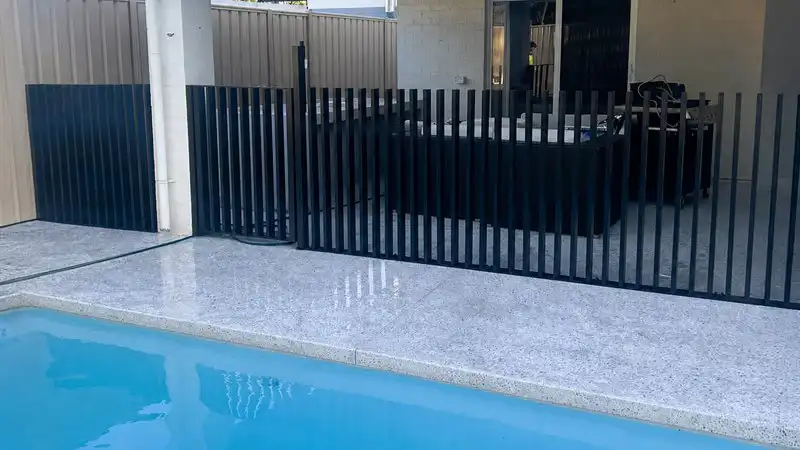
A pool fence can look neat and still have a safety problem. A gate that misses its latch, a raised garden bed beside a panel, or an oversized gap beneath a fence can undermine the finished barrier. For homeowners, contractors and fence buyers, the best time to identify these issues is before the layout and material order are finalised.
Pool fence regulations in NSW cover the complete installed barrier, including access points and the surrounding area. Buying a panel described as suitable for pool fencing does not establish that the finished installation complies.
This guide combines NSW Government pool-safety guidance with JZH Fence’s experience of reviewing panel layouts, finished surface levels and gate configurations before production. It explains ten checks that help you ask better questions and reduce avoidable rework.
Start with the applicable requirements. Pool age, later alterations and the approved design can affect the assessment. Confirm the requirements for your property with your local council or an appropriately registered certifier before ordering or changing a barrier. This planning guide does not replace an assessment of the site.
NSW Pool Fence Requirements at a Glance
The following figures summarise the NSW Government’s published guidance. They are an initial screening tool; an assessor must confirm how the relevant rules apply to your barrier.
| Item | Published NSW guidance | Practical check before ordering |
|---|---|---|
| Pool fence height | At least 1,200 mm from finished ground level | Measure from the completed surface, allowing for paving and landscaping. |
| Boundary fence used as a pool barrier | 1,800 mm high | Ask the assessor to confirm the boundary arrangement and relevant clearances. |
| Gap beneath the fence | No greater than 100 mm | Check the largest opening along the entire run, especially on sloping ground. |
| Gaps between vertical bars | No greater than 100 mm | Review clear openings, including connections and transitions. |
| Non-climbable zone | A 900 mm zone, measured in an arc from the top of the fence; the guidance also addresses space 300 mm inside | Review nearby objects and the complete barrier profile with the assessor. |
| Pool gate | Opens away from the pool, closes automatically and self-latches | Confirm the hardware, gate size, swing clearance and installed operation together. |
See the NSW Government’s pool-owner obligations and barrier measurements for the official guidance behind these figures.
1. Confirm Which Requirements Apply Before Choosing a Fence
Begin with the property’s records rather than a supplier’s standard panel size. Find out when the pool was built, what approvals exist and whether the barrier or surrounding area has subsequently changed.
Ask the council or certifier to identify the applicable requirements, including the relevant edition of AS 1926.1 and any approved design conditions. A newer edition of a standard does not, by itself, tell you which requirements govern an existing pool.
For a new pool, resolve approval and certification arrangements early. NSW Government guidance calls for temporary child-resistant fencing during construction and an inspection of the permanent barrier. It also states that the pool must not be used before an occupation certificate is issued.
Costly mistake to avoid: ordering all panels before the approved barrier line and assessment requirements have been confirmed. Begin with the official owner-obligations guidance.
2. Measure Fence Height from the Finished Surface
NSW Government guidance specifies a minimum pool fence height of 1.2 metres measured from finished ground level. It also identifies a 1.8-metre requirement where a boundary fence forms part of the pool barrier.
The word finished matters. A panel selected before paving or landscaping is complete may have less effective height once those works are installed. Check the final relationship between the top of the barrier and the surrounding surfaces, rather than relying only on the panel’s catalogue dimension.
Record steps, raised edges, retaining sections and changes in level on the layout drawing. Where the measurement is uncertain, obtain the assessor’s direction before production.
Costly mistake to avoid: treating the height of a loose panel as proof of the height of the installed barrier.
3. Control Gaps Along the Whole Barrier
The published NSW guidance limits gaps beneath the fence and between vertical bars to 100 mm. On site, those openings can change when a fence meets uneven ground, a wall, a post or a different panel type.
Review the complete fence run. Look closely at the lower end of sloping sections, gate clearances, corners and the points where the fence connects to another structure. Ask the installer how the proposed layout will maintain the required openings after the final surfaces are complete.
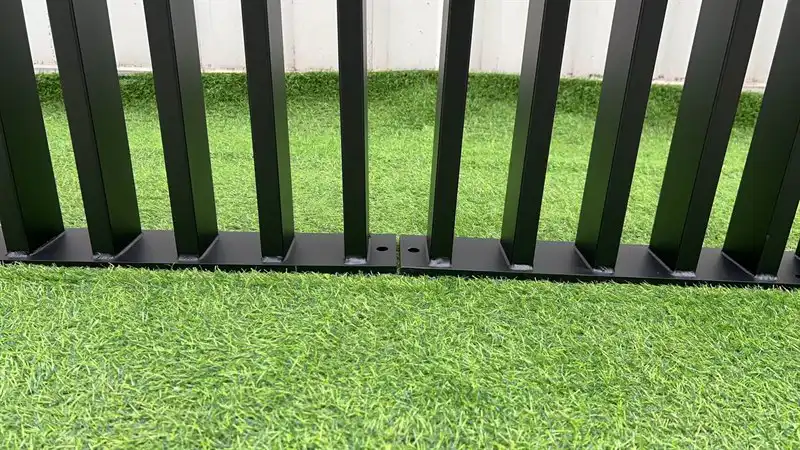
A useful drawing records clear openings as well as overall dimensions. This gives the supplier and installer a shared reference and makes unusual transitions easier to identify.
Costly mistake to avoid: checking the middle of a standard panel while overlooking a larger opening at its end.
4. Protect the Non-Climbable Zone
A tall fence can lose its protective value when something beside it provides a step. NSW Government guidance describes a 900 mm non-climbable zone measured in an arc from the top of the fence and also addresses space extending 300 mm inside the pool area.
Review furniture, pot plants, toys, ladders, barbeques, vegetation and other potential climbing aids. The fence profile also matters: the official guidance includes requirements for climbable horizontal members. Have the assessor check the relevant zones for your actual barrier arrangement.
Make this part of the landscape plan. It is easier to relocate a proposed planter on a drawing than after paving, irrigation and planting are finished.
Costly mistake to avoid: approving the fence in isolation, then adding furniture or landscaping that creates a climbing route.
5. Specify the Gate as a Complete Working Assembly
The NSW Government says a pool gate must swing away from the pool, close automatically from any open position and self-latch. It must also be kept shut and never propped open. See the official gate guidance.
Choose the gate leaf, hinges, latch, posts and fixings together. Check compatibility with the proposed gate dimensions and weight, then allow enough room for the required swing. Ask the assessor to confirm latch positioning, shielding and any associated clearances under the applicable requirements.
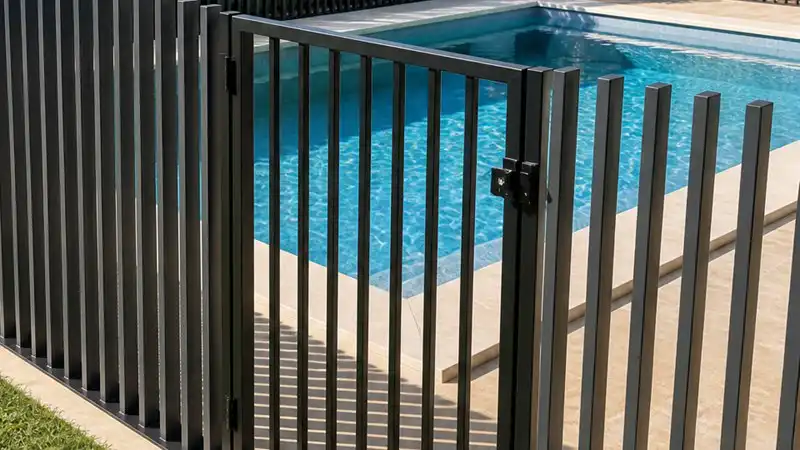
At handover, demonstrate that the installed gate closes and latches without a push. Recheck it after adjustments or changes to nearby surfaces.
Costly mistake to avoid: assuming that purchasing self-closing hinges guarantees that the installed gate will work correctly.
For planning considerations around panels and gates, see our tubular pool fence project guide.
6. Review Site Levels and Layout Before Production
Slopes, lowered outdoor areas, steps and retaining sections deserve attention at the quotation stage. Give the supplier a marked layout showing panel runs, posts, gate positions and finished surface levels. Identify dimensions that are still provisional.
Agree how changes will be handled before the order is released. A small change to the fence line can affect panel widths, gate clearance, post positions and the relationship with nearby structures. Written confirmation helps everyone work from the same design.
Installation Experience: Why Site Conditions and Layout Checks Matter
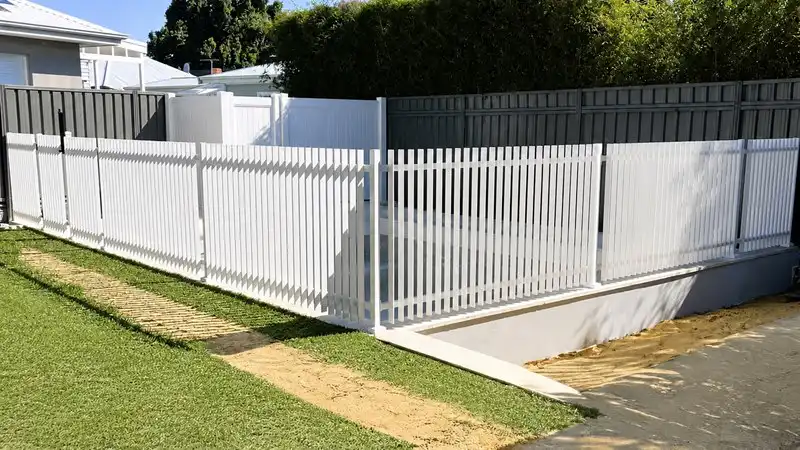
In one residential-style pool barrier installation, a white aluminium fence system was used to enclose a lowered outdoor area next to the house. Projects like this show why pool fencing is not only about choosing the right panel style. The site condition, surrounding surfaces, and fence layout all affect how the final barrier performs.
From our experience, one of the most common issues in pool-related fencing projects is assuming that a standard panel size alone is enough for compliance. In practice, contractors still need to review the actual installation environment carefully. Changes in finished ground level, raised edges, steps, retaining sections, or nearby structures can all affect the effective barrier height and the overall safety of the installation.
Before production, we usually recommend checking three points carefully:
- Barrier height against the finished surface level
- Panel layout and post spacing
- Gate position, access flow, and hardware configuration
This kind of pre-production review helps reduce installation adjustments on site and makes the finished pool fence look cleaner and more consistent. It also gives contractors a better starting point before confirming compliance with the applicable NSW pool fencing requirements and AS 1926.1.
Costly mistake to avoid: finalising production dimensions while the paving levels or gate location are still undecided.
7. Check Doors, Windows and Connections to Existing Structures
Do not assume that a house door, an ordinary window or an existing boundary arrangement provides acceptable separation from the pool. The NSW Government specifically flags older door and window arrangements in its pool-barrier guidance.
Where the proposed fence meets the house, a shed, a wall or an existing fence, show the connection on the drawing and request an assessment. Ask how openings, changes in level and access from adjoining areas must be addressed. This is particularly important when modifying an older pool enclosure.
Costly mistake to avoid: leaving the connection to an existing structure for the installer to resolve without an agreed detail.
For design options to discuss after the safety requirements are established, explore our comparison of pool fencing types.
8. Include Portable Pools and Spas in the Safety Review
Portable or inflatable does not automatically mean exempt. NSW Government guidance says swimming pool laws cover relevant pools and spas capable of being filled to a depth greater than 30 cm. Do not assume that keeping the water below that level removes obligations based on the pool’s capacity.
Some spas may use a securely fastened child-resistant cover or other qualifying structure, but the official guidance notes that this depends on the spa’s size or function. Larger swim spas may require fencing. Confirm the arrangement before installation.
Costly mistake to avoid: buying a portable pool or spa first and checking its barrier requirements afterwards. Read the official portable-pool and spa guidance.
9. Register the Pool and Check CPR Signage
NSW pool and spa owners must register their pool or spa. Check the property address on the NSW Swimming Pool Register, including when you purchase a property with an existing pool.
Registration and compliance are separate. A registration record does not establish that the installed barrier has passed an inspection.
The NSW Government also requires CPR signage near the pool, including portable pools. Its guidance says the sign must be in good condition and readable from three metres away. Confirm the signage requirements applicable to a new or altered installation.
Costly mistake to avoid: treating the registration certificate as a pool-barrier compliance certificate.
10. Arrange Certification Early and Keep Maintaining the Barrier
Organise inspections before a sale, lease or planned use creates a deadline. The NSW Government says a certificate of compliance is valid for three years. That validity period does not remove the owner’s ongoing responsibility to maintain a safe barrier.
Sale and rental documentation requirements should be confirmed for the particular transaction. Ask the relevant professional which certificate or other evidence is needed, and check the official selling, renting and certification guidance before relying on an existing document.
Keep inspection records, approved drawings, hardware information and maintenance instructions together. Check gates, fixings, panels and nearby climbing aids regularly, and seek reassessment when alterations could affect the barrier.
Costly mistake to avoid: leaving an inspection until the last stage of a transaction, or assuming a previous pass covers later changes.
What Buyers Should Confirm Before Ordering Pool Fence Panels
For contractors and trade buyers, a clear specification helps the manufacturer prepare the intended components. It also makes the limits of the supply scope easier to understand.
| Order detail | Information to confirm | Why it helps |
|---|---|---|
| Assessed design | Applicable requirements, layout and details confirmed by the project's assessor | Gives the order an agreed design basis. |
| Panel schedule | Quantity, width, height and identification of any custom panels | Reduces ambiguity about what is being manufactured. |
| Finished levels | Paving, steps, retaining sections and sloping runs | Helps the team identify height and gap issues before installation. |
| Posts and connections | Post positions, fixing method, supporting surfaces and interfaces | Makes installation assumptions visible. |
| Gate assembly | Opening size, swing direction, hardware, mounting details and clearances | Supports coordinated selection of compatible components. |
| Materials and finish | Agreed material, colour, finish and maintenance information | Allows an informed choice for the intended environment. |
| Product evidence | Relevant drawings, specifications and any claimed test documentation | Allows claims to be checked against the actual supplied configuration. |
| Delivery and handover | Pack identification, component list and installation information | Helps the installer match delivered parts to the layout. |
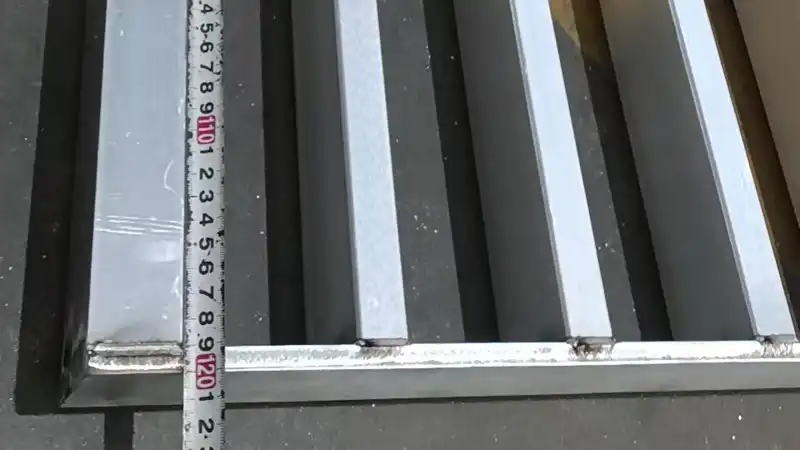
Product information supports the assessment; it does not replace certification of the installed barrier. Ask what any compliance or testing claim covers, which configuration was assessed and whether the supplied components match that configuration.
If you are comparing appearances, our swimming pool fencing ideas can help you narrow the style before developing the detailed specification.
A Practical Checklist Before Installation and Handover
Use this checklist to organise the conversation with your supplier, installer and assessor:
- Confirm the property’s applicable barrier requirements and approval arrangements.
- Agree the complete fence line, including interfaces with existing structures.
- Record final surface levels, slopes, steps and retaining sections.
- Review barrier heights and clear openings across the whole layout.
- Check climbing aids and relevant non-climbable zones.
- Confirm gate hardware, mounting, swing clearance and required latch details.
- Match the delivered panel and component schedule to the agreed drawing.
- Demonstrate automatic gate closing and latching after installation.
- Check registration, CPR signage and the required inspection documents.
- Retain records and agree a routine for maintenance and reassessment after changes.
This checklist helps organise a project. A completed checklist is not a certificate of compliance.
Frequently Asked Questions
How high does a pool fence need to be in NSW?
The NSW Government’s published guidance states at least 1.2 metres from finished ground level and 1.8 metres for a boundary fence used as part of the pool barrier. Confirm the applicable arrangement with the council or certifier, especially for an existing pool or an altered site.
Can aluminium fencing be used around a pool?
Material choice is only one part of the decision. The proposed design, openings, hardware, fixings, installation and surrounding conditions need to satisfy the applicable requirements. Request product details and have the intended installation assessed rather than relying on the material name alone.
Does a compliant panel mean the finished pool fence will pass?
No. A panel’s dimensions or supporting documentation do not establish compliance of the whole site. The completed barrier also includes gates, connections, ground clearances and the surrounding area.
Do portable pools need fencing?
Portable pools can be subject to NSW swimming pool laws. Check the official guidance and council requirements before buying or installing one; the relevant definition considers the depth the pool is capable of holding.
Is pool registration the same as certification?
No. Registration records the pool against the property. Compliance is assessed separately through inspection. Check the register and the relevant certificates rather than assuming one document serves both purposes.
Can JZH Fence certify a pool installation in NSW?
The manufacturing experience described here concerns product specifications and production planning. The site’s required inspection and certification should be arranged with the relevant council or appropriately registered certifier. A supplier’s quotation or drawing is not a site compliance certificate.
Plan the Site First, Then Finalise the Fence Order
Successful pool-fence planning brings together the safety requirements, the site layout and the components being ordered. Start with an assessed design, confirm finished surface levels and coordinate the gate assembly before releasing the order.
If you are preparing a pool-fence enquiry, contact JZH Fence with the layout, panel schedule, gate dimensions, finish preferences and requirements confirmed by your project team. Those details give the manufacturing discussion a clearer starting point and help identify questions before production.
For current regulatory information, refer to the NSW Government’s pool-owner obligations and the Swimming Pools Act 1992. The official guidance was checked for this rewritten edition on 26 October 2026.