
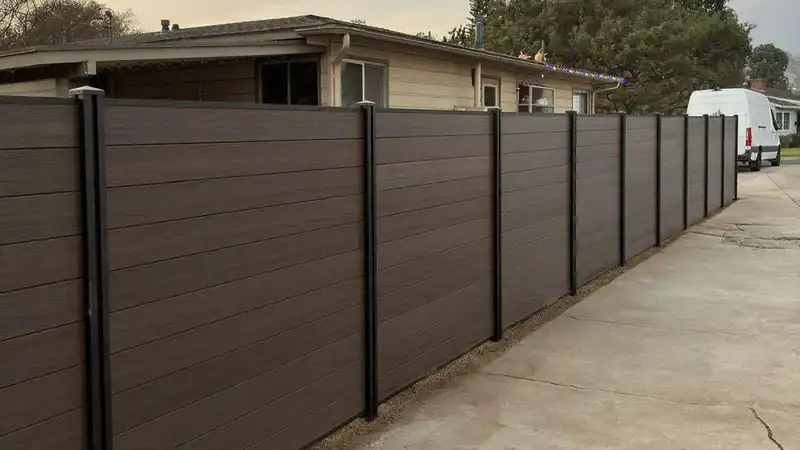
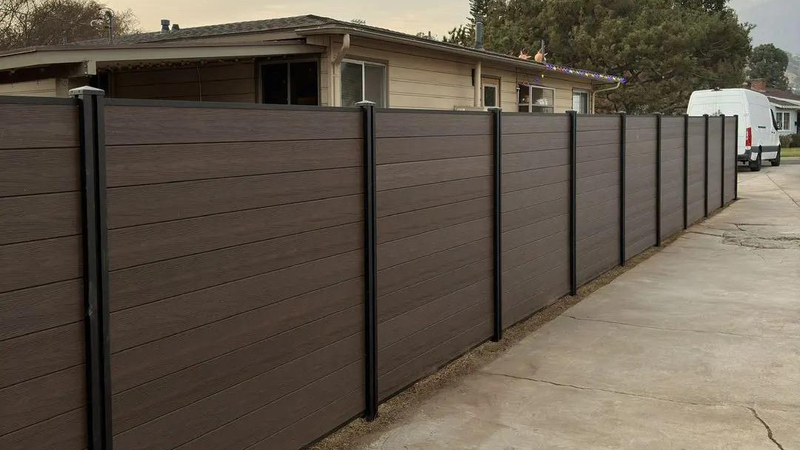
Composite fence panels are complete fencing systems made with WPC boards, aluminum posts, rails, caps, gates, and installation accessories. For B2B buyers, the most important question is not only the board price, but whether the full system can perform well in real outdoor projects.
In this guide, we explain how composite fence panels are made, how first-generation and second-generation WPC differ, how to compare 6-foot and 8-foot systems, and what buyers should check before placing bulk orders.
What Is the Difference Between Composite Fence Panels, Boards, and Posts?
Composite Fence Panels
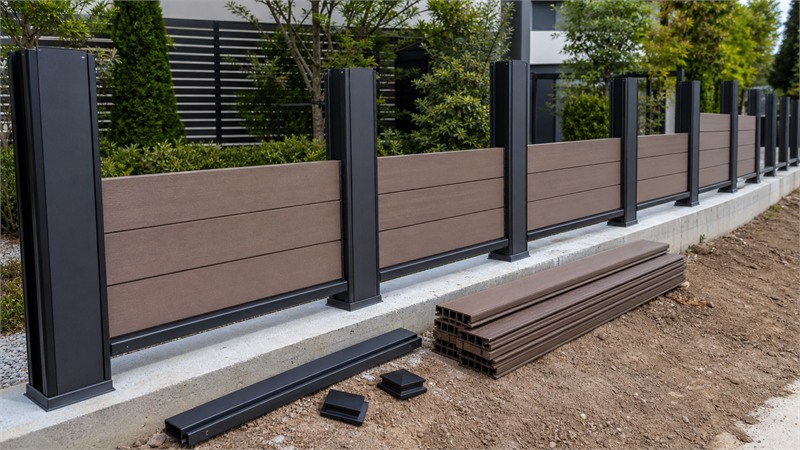
A complete composite fence panel system may include:
- WPC fence boards
- Aluminum posts
- Top and bottom rails
- Post caps
- Finishing trims
- Metal gate frames
- Hinges and locks
- Installation accessories
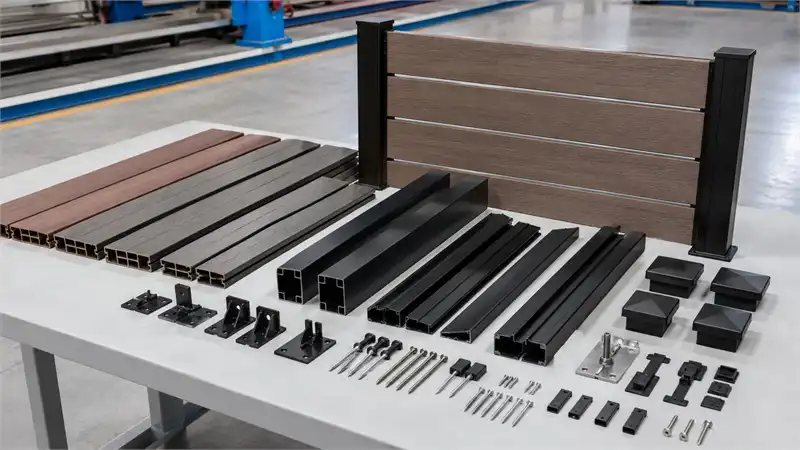
Emphasize that a panel is part of a complete fencing system rather than a single WPC board.
Composite Fence Boards
Composite fence boards are the visible infill components that provide:
- Privacy
- Colour
- Woodgrain appearance
- Partial noise screening
- Protection from direct visibility
Boards can be installed:
- Horizontally
- Vertically
- As tongue-and-groove panels
- As spaced semi-privacy slats
Composite Fence Posts
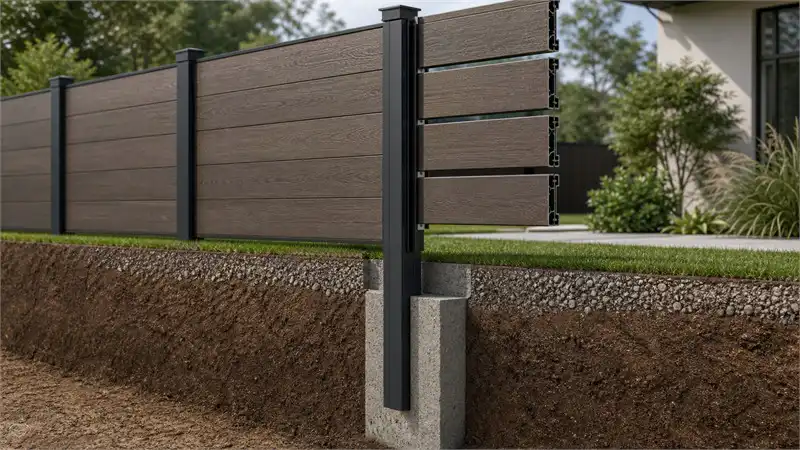
JZH Fence normally uses aluminum posts in new WPC fence systems.
- Aluminum posts are lightweight and corrosion-resistant.
- Post channels allow WPC boards and rails to slot into the system.
- Concrete is normally used for the footing that secures the aluminum post.
- Concrete posts are not the standard post option in JZH Fence’s new WPC fence systems.
How Composite Fencing Panels Are Made
Basic WPC Material Composition
The common components used in WPC fence boards:
- Wood flour or natural fibres
- PE or HDPE
- Colour pigments
- UV stabilisers
- Coupling agents
- Lubricants
- Weather-resistant additives
The composite fence material ratios vary between manufacturers and product generations.
Recommend that B2B buyers request:
- Material data sheets
- Board cross-section drawings
- Surface-layer specifications
- Weathering test information
- Colour samples
- Product samples
The Extrusion Manufacturing Process
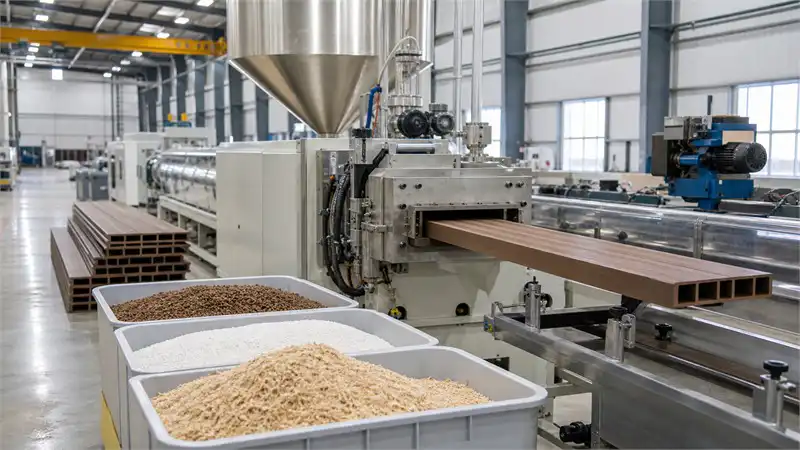
Describe the general production sequence:
- Dry and grind the wood fibres.
- Blend the fibres with PE or HDPE and functional additives.
- Feed the mixture into an extrusion line.
- Form the board profile through a mould.
- Add a co-extruded protective layer when producing second-generation boards.
- Cool and cut the boards to length.
- Apply woodgrain, brushed, or smooth surface textures.
- Inspect dimensions, colour, and surface quality.
Hollow vs Solid Composite Fence Boards
Compare hollow and solid WPC fence boards.
| Comparison | Hollow WPC Boards | Solid WPC Boards |
|---|---|---|
| Weight | Lower | Higher |
| Internal structure | Chambers and reinforcing ribs | Solid profile |
| Transport cost | Usually lower | Usually higher |
| Installation handling | Easier | Heavier |
| Material use | Lower | Higher |
| Selection focus | Wall thickness, rib design, and span | Density, weight, and structural requirements |
A hollow board is not automatically a low-quality board, and a solid board is not automatically the best solution for every project.
Buyers should also evaluate:
- Board wall thickness
- Internal reinforcing ribs
- Board width
- Fence height
- Post spacing
- Rail configuration
- Local wind exposure
First-Generation vs Second-Generation WPC Fence Panels
What Is First-Generation WPC Fencing?
The traditional first-generation WPC fencing in the United States commonly uses PE- or HDPE-based wood-plastic composite boards.
Main benefits include:
- Better resistance to rot than timber
- Resistance to common insect damage
- No regular painting or staining
- Lower maintenance requirements
- Lower initial cost than second-generation co-extruded WPC
First-generation WPC may be suitable for:
- Budget-focused projects
- Temporary screening
- Price-sensitive wholesale programmes
- Trial orders
- Entry-level product ranges
- Projects that prioritize initial price
Limitations of First-Generation WPC
The first-generation boards normally do not have the same complete protective cap as second-generation co-extruded boards.
Potential limitations include:
- More visible colour change after prolonged outdoor exposure
- Lower resistance to common stains
- Lower surface scratch resistance
- Earlier signs of outdoor ageing
- Greater long-term after-sales risk in premium residential markets
The first-generation WPC should not be positioned as the premium long-term option for every application.
What Is Second-Generation Co-Extruded WPC Fencing?
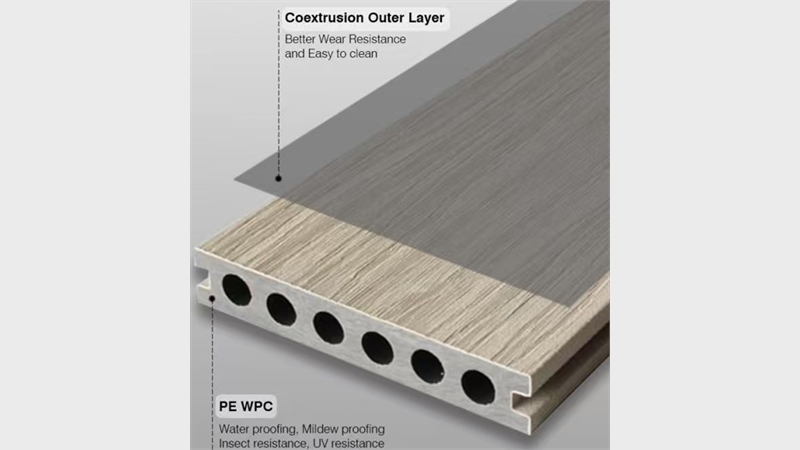
The second-generation products combine a WPC core with an additional co-extruded protective surface.
The product discussed in this article uses hollow co-extruded WPC fence boards.
Typical core composition may include:
- Approximately 60% wood flour or natural fibre
- Approximately 30%–35% HDPE
- Approximately 5%–10% functional additives
The surface layer may contain:
- Modified HDPE or another engineering resin
- UV stabilisers
- Weather-resistant additives
- Colour pigments
- Surface-protection additives
For the relevant JZH Fence product configuration, the co-extruded layer is approximately 0.5–0.8 mm thick, subject to the confirmed product specification.
Main Benefits of Second-Generation WPC
The protective cap helps reduce direct exposure of the WPC core to:
- UV radiation
- Moisture
- Dirt
- Common stains
- Surface abrasion
- Everyday scratches
Second-generation co-extruded WPC is more suitable for buyers who prioritize:
- Long-term appearance
- Colour stability
- Easier cleaning
- Surface protection
- Reduced after-sales risk
- Higher-value residential markets
- Long-term repeat orders
How We Recommend First- or Second-Generation WPC Fencing
In the U.S. WPC fence market, how do we recommend first- or second-generation WPC fencing according to the buyer’s budget, project purpose, and long-term sales plan? Why is first-generation PE- or HDPE-based WPC more suitable for budget-focused or temporary projects, while distributors targeting long-term residential privacy fence sales should consider second-generation hollow co-extruded WPC fence boards?
Our Experience-Based Answer
From our experience with U.S. buyers, we do not automatically recommend the highest-priced WPC fence.
We first ask about the customer’s:
- Budget
- Project purpose
- Target selling price
- Expected service period
- Customer group
- Long-term sales plan
- Repeat-order expectations
For customers with a limited budget, first-generation PE- or HDPE-based WPC can be a practical option.
It offers the main benefits of composite fencing while keeping the initial purchasing cost lower. It is particularly relevant for:
- Temporary screening
- Low-cost projects
- Price-sensitive wholesalers
- Trial orders
- Entry-level product ranges
For customers targeting the U.S. residential privacy fence market, we normally recommend second-generation co-extruded WPC as the stronger long-term product.
Residential customers often expect the fence to maintain an attractive appearance for many years. Distributors also need to consider:
- Customer complaints
- Replacement costs
- Warranty risk
- Product positioning
- Brand reputation
- Repeat purchasing
For these buyers, hollow co-extruded WPC fence panels can provide a stronger market position than a basic first-generation system.
Our objective is not to sell the most expensive product. It is to help the buyer balance:
- Initial investment
- Target selling price
- Market positioning
- Expected service period
- Long-term product performance
- After-sales risk
Product Selection Table
| Buyer Requirement | Recommended Product |
|---|---|
| Limited initial budget | First-generation PE/HDPE-based WPC |
| Temporary screening | First-generation WPC |
| Low-cost project | First-generation WPC |
| Price-sensitive wholesale market | First-generation WPC |
| Trial order for market testing | First-generation WPC |
| U.S. residential privacy fence | Second-generation co-extruded WPC |
| Long-term distributor product line | Second-generation co-extruded WPC |
| Priority on repeat orders | Second-generation co-extruded WPC |
| Priority on colour stability | Second-generation co-extruded WPC |
| Strong UV environment | Second-generation co-extruded WPC |
Australian High-UV WPC Fence Project
The Project Environment
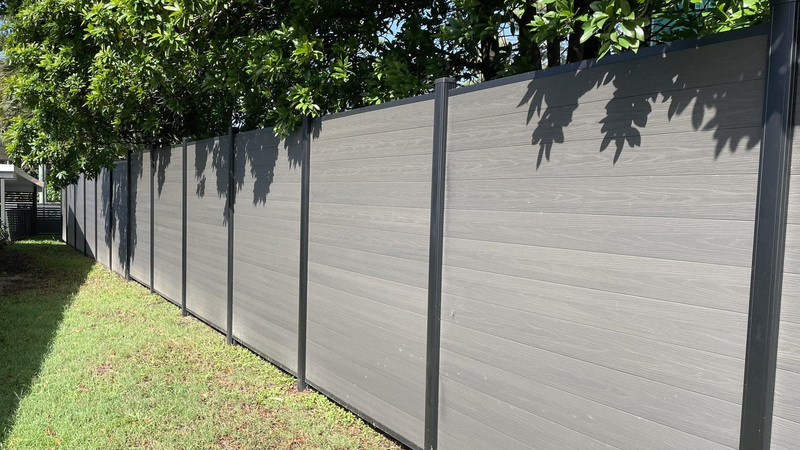
Introduce an Australian WPC fence project installed in an area exposed to:
- Intense sunlight
- Extremely high UV levels
- Prolonged direct outdoor exposure
- High surface temperatures
- Continuous weather changes
Explain that the buyer needed more than basic privacy.
The project required the WPC fence panels to maintain:
- Stable colour
- A clean surface
- Resistance to common stains
- Resistance to everyday scratches
- Long-term outdoor appearance
- Reduced premature ageing
Why Second-Generation Co-Extruded WPC Was Selected
A second-generation co-extruded WPC system was selected because the project placed greater importance on long-term surface performance.
The co-extruded surface layer:
- Covers the WPC core
- Reduces direct UV exposure
- Reduces direct moisture contact
- Creates a denser surface
- Makes common dirt easier to clean
- Provides better protection against everyday scratches
- Helps delay premature surface ageing
Clarify that the protective layer improves resistance but does not make the board completely scratch-proof or permanently colour-free.
Long-Term Project Feedback
Use the following experience-based case paragraph:
In one Australian project exposed to intense sunlight and extremely high UV levels, second-generation co-extruded WPC fence panels were selected for their upgraded surface protection. Based on project feedback and follow-up observation, the panels maintained a stable appearance without obvious fading. The surface also continued to show good resistance to common stains and everyday scratches, with no obvious signs of premature ageing.
What This Project Means for B2B Buyers
The buyers in Australia, the southern United States, and other high-UV markets should ask:
- Is the board first-generation or co-extruded?
- Does the board have a complete protective cap?
- What material is used for the surface layer?
- How thick is the co-extruded layer?
- Are UV stabilisers included?
- Is accelerated weathering test information available?
- Are long-term project photos available?
- Can the supplier provide an approved physical sample?
- How should the surface be cleaned?
- What maintenance practices should be avoided?
Key Benefits of Composite Fencing vs Timber and Metal
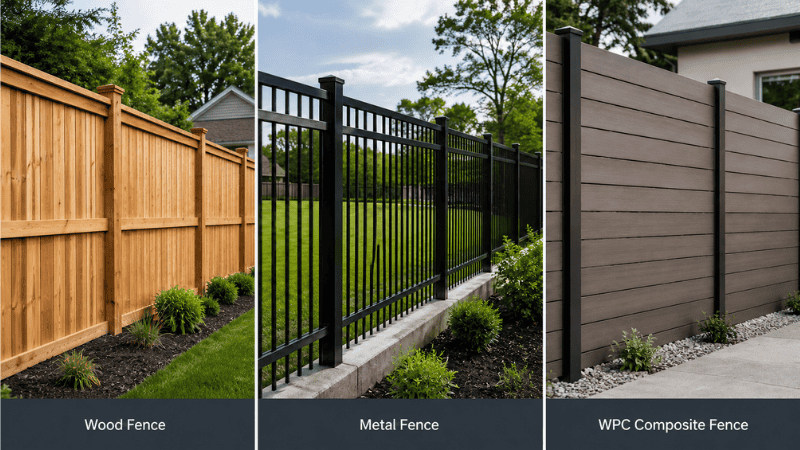
Composite Fence Panels vs Timber Fence
The timber fencing may be affected by:
- Moisture absorption
- Rot
- Insect damage
- Cracking
- Warping
- Splintering
- Uneven colour changes
- Repeated painting and staining
Composite fence panels can offer:
- Lower maintenance
- Better resistance to rot
- Better resistance to insects
- No regular painting
- No regular staining
- Fewer splinters
- More consistent appearance
Composite Fence Panels vs Metal Fencing
The aluminum and steel fencing provide structural strength but open picket or tubular designs do not usually provide full privacy.
A hybrid WPC and aluminum system combines:
- WPC privacy infill
- A wood-like appearance
- Aluminum structural support
- Corrosion-resistant posts
- Modular installation
- Matching gate systems
Composite Fence Panels vs Chain-Link Fencing
The chain-link fencing is suitable for:
- Large boundaries
- Industrial properties
- Sports facilities
- Agricultural areas
- Projects where visibility is acceptable
Composite fencing is more suitable for:
- Residential privacy
- Apartment boundaries
- Commercial screening
- Hotels
- Courtyards
- Equipment screening
- Waste-area screening
Material Comparison Table
| Comparison | Composite Fence | Timber Fence | Metal Fence | Chain Link |
|---|---|---|---|---|
| Privacy | High | High | Depends on design | Low |
| Maintenance | Low | High | Low to medium | Low |
| Resistance to rot | High | Low | Not applicable | Not applicable |
| Surface options | Woodgrain and modern colours | Natural timber | Powder-coated finish | Limited |
| Initial cost | Medium to high | Low to medium | Medium to high | Low |
| Typical use | Privacy and screening | Residential boundaries | Decorative or security | Large perimeters |
Composite Fence Panel Sizes and Design Options
Common Fence Heights
| Fence Height | Typical Application |
|---|---|
| 4 ft / 1.2 m | Front gardens and decorative boundaries |
| 5 ft / 1.5 m | Semi-privacy residential fencing |
| 6 ft / 1.8 m | Common U.S. residential privacy fencing |
| 8 ft / 2.4 m | Higher privacy, commercial screening, and special projects |
Explain that:
- A 6-foot WPC privacy fence is common in the U.S. residential market.
- Some buyers request an 8-foot WPC fence.
- The final permitted height depends on local zoning and HOA approval.
- An 8-foot system requires a new structural review.
- Buyers should not simply add more boards to a standard 6-foot system.
Board Profiles
The available profile options:
- Tongue-and-groove boards
- Full-privacy panels
- Semi-privacy slats
- Horizontal boards
- Vertical boards
- Hollow boards
- Solid boards
- Co-extruded boards
- Woodgrain embossed boards
Colours and Surface Finishes
Popular colours may include:
- Anthracite grey
- Charcoal
- Dark brown
- Walnut
- Teak
- Cedar
- Light coffee
- Red wood
Surface options may include:
- Smooth finish
- Brushed finish
- Traditional woodgrain
- 3D embossed woodgrain
- Co-extruded protective surfaces
Colour Consistency for Repeat Orders
Recommend that distributors:
- Retain an approved physical sample
- Record the product code
- Record the colour code
- Confirm colour before repeat orders
- Inform the supplier when old and new batches will be installed together
- Order spare boards for future replacement
- Review a new sample before a large repeat order
How We Review 6-Foot and 8-Foot WPC Fence Projects
In our U.S. WPC fence projects, customers commonly purchase 6-foot privacy fencing, but some projects require an 8-foot fence. What HOA requirements, site conditions, and structural parameters do we confirm before production? How do we adjust the aluminum posts, rails, gate frames, and footings for an 8-foot WPC fence?
Common U.S. WPC Fence Heights
The 6-foot WPC privacy fencing is the most common height requested by U.S. buyers.
Typical applications include:
- Residential backyards
- Property boundaries
- Townhouses
- HOA-managed communities
- Apartment landscaping
- Poolside privacy areas
Some customers request an 8-foot fence for:
- Higher privacy
- Visual screening
- Noise reduction
- Large residential properties
- Commercial boundaries
- Equipment screening
Confirm Local and HOA Requirements
Before confirming production, ask the buyer to verify:
- Whether the property is managed by an HOA
- Whether approval has already been obtained
- Whether the fence is in the front, side, or rear yard
- The approved fence height
- The approved colour
- The approved board direction
- The approved surface style
- The approved gate location
- The approved gate appearance
The HOA requirements are community-specific and should not be treated as statewide rules.
Why an 8-Foot Fence Requires a New Structural Review
For an 8-foot WPC fence, we do not simply increase the board height while keeping the original aluminum post and rail configuration unchanged.
Increasing the fence height also increases:
- Wind-exposed area
- Lateral load on the posts
- Load on the rails
- Load on the connecting components
- Overturning force on the footing
- Load on gate posts
- Leverage on hinges
- Risk of gate sagging
Why We Normally Use Aluminum Posts
JZH Fence’s new WPC fence systems normally use aluminum posts rather than concrete posts.
Advantages include:
- Lower transport weight
- Good corrosion resistance
- Modular post channels
- Easy integration with WPC boards
- Clean appearance
- Compatibility with powder-coated rails and gates
- Easier international shipping
Concrete is normally used for the footing that secures the aluminum post, rather than as the standard post material.
Structural Points Reviewed Before Quotation
Review the following:
- Aluminum post profile
- Post cross-section
- Post wall thickness
- Above-ground post height
- Underground embedment depth
- Distance between posts
- Top rail strength
- Bottom rail strength
- Internal reinforcement
- Concrete footing width
- Concrete footing depth
- Local wind exposure
- Soil conditions
- Ground slope
- Installation method
Gate Configuration for 6-Foot and 8-Foot WPC Fences
A gate requires a separate structural review because it is a moving component.
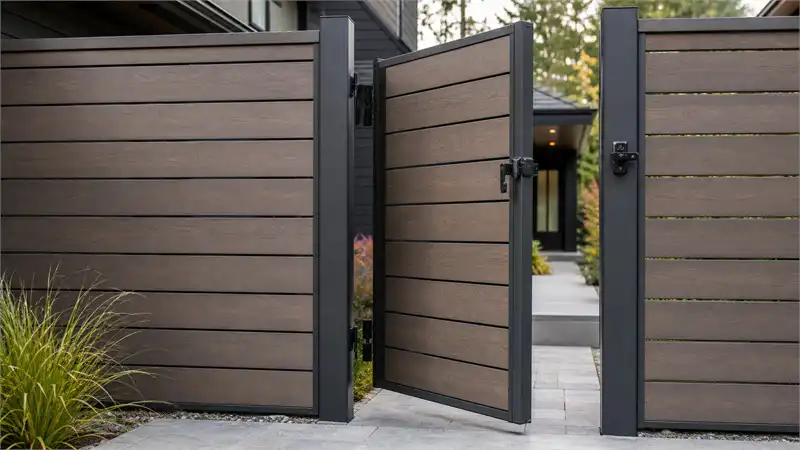
Review:
- Aluminum gate-post profile
- Internal metal gate frame
- Gate-leaf height
- Gate-leaf width
- Hinge capacity
- Lock and latch position
- Opening direction
- Ground clearance
- Wind exposure
- Risk of sagging
Confirm whether the buyer’s requested gate width means:
- Overall gate-leaf width, or
- Required clear opening after installation
Our Experience-Based Answer
From our U.S. enquiry experience, 6-foot WPC privacy fencing is the most common configuration, but some buyers also require 8-foot systems.
Our WPC fence systems normally use aluminum posts. For an 8-foot project, we do not simply add more WPC boards while retaining the same posts, rails, and footings used for a 6-foot system.
As the height increases, the wind-exposed area and structural loads also increase. We therefore review:
- Aluminum post size
- Post wall thickness
- Embedment depth
- Post spacing
- Rail strength
- Internal reinforcement
- Concrete footing dimensions
Gate systems must also be assessed separately.
A taller WPC gate is heavier and creates more leverage on:
- Aluminum gate posts
- Metal gate frames
- Hinges
- Locks
- Mounting hardware
Before production, we confirm whether the requested gate width refers to the gate-leaf dimension or the required clear opening.
In most cases, the customer’s requested 6-foot or 8-foot height does not need to change. The more common adjustments involve strengthening:
- Aluminum posts
- Rails
- Gate frames
- Concrete footings
- Installation accessories
This review helps reduce:
- Fence movement
- Post deflection
- Gate sagging
- Incorrect gate openings
- On-site cutting
- Installation delays
- Replacement-part shipments
Composite Fencing Cost and Lifetime Value
What Affects Composite Fence Panel Cost?
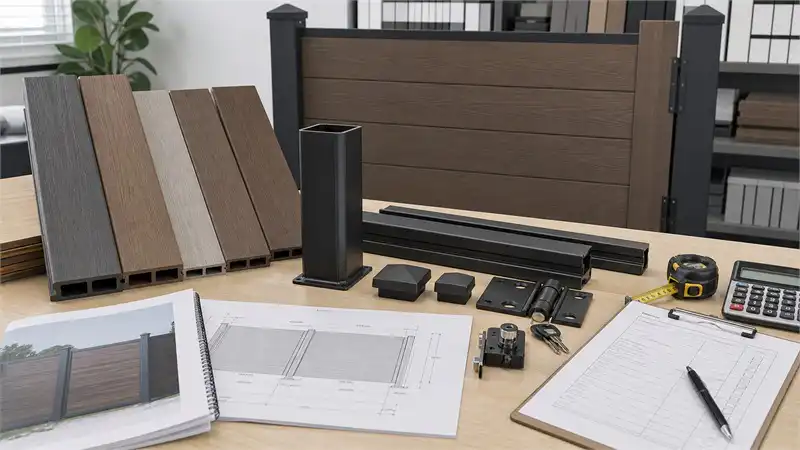
A complete WPC fence system may include:
- Composite fence boards
- Aluminum posts
- Top and bottom rails
- Post caps
- Finishing trims
- Metal gate frames
- Hinges
- Locks
- Mounting accessories
- Concrete footings
- Export packaging
- Freight
- Import duties
- Installation labour
Two suppliers may offer a similar board price but provide different structural specifications.
First-Generation vs Second-Generation Cost
The first-generation WPC normally has:
- A lower initial purchase price
- Fewer production processes
- No complete co-extruded protective cap
- Stronger suitability for budget-focused markets
Second-generation WPC normally has:
- A higher initial price
- An additional co-extrusion process
- Additional surface-protection material
- Greater suitability for premium residential markets
- Better long-term product positioning
Complete-System Cost vs Board Price
Buyers should compare the cost of the complete fencing system, not only the price of each composite board.
Ask buyers to compare:
- Aluminum post dimensions
- Post wall thickness
- Rail quantities
- Gate-frame specifications
- Hinge and lock quality
- Finishing accessories
- Packaging
- Spare components
- Shipping volume
How to Estimate Cost Per Metre or Linear Foot
- Confirm the total fence length.
- Confirm the required fence height.
- Select first- or second-generation WPC.
- Confirm the width of each fence bay.
- Calculate the boards required per bay.
- Calculate the number of aluminum posts.
- Confirm the post specification.
- Add top rails, bottom rails, and trims.
- Add gates and gate hardware.
- Add packaging and freight.
- Add duties and local delivery.
- Add local footing and installation costs.
Installing Composite Fence Panels with Aluminum Posts
Typical Installation Process
- Survey the boundary.
- Confirm the fence line.
- Mark the aluminum post positions.
- Excavate the footing holes.
- Position the aluminum posts.
- Use concrete to secure the posts.
- Check alignment and verticality.
- Install the bottom rails.
- Insert or stack the WPC boards.
- Install the top rails.
- Install the post caps and finishing trims.
- Install the gates and hardware.
- Check the gate clear opening.
- Complete the final inspection.
Thermal Expansion Allowance
The WPC materials expand and contract with temperature changes.
Installation should allow for:
- Board-end expansion gaps
- Movement inside the post channels
- Drainage at the bottom
- Ventilation around the boards
- Replacement access where necessary
Incorrect installation may cause:
- Buckling
- Joint pressure
- Board movement
- Noise
- Difficult board replacement
Common Installation Mistakes
- Post spacing is too wide
- Footings are too shallow
- A 6-foot post system is used for an 8-foot fence
- Gate-post spacing is incorrect
- No thermal expansion gap is provided
- Boards are installed directly against the ground
- Boards are dragged across metal components
- Sharp tools damage the decorative surface
- Post caps or trims are missing
- Gate clear opening is calculated incorrectly
Performance in Real Conditions
UV and Colour Stability
- First-generation WPC provides basic outdoor resistance.
- More visible colour changes may occur after prolonged exposure.
- Second-generation co-extruded WPC provides an additional protective layer.
- Actual colour performance depends on formulation, pigments, UV stabilisers, climate, and maintenance.
Refer briefly to the Australian project:
Our Australian high-UV project demonstrates why buyers should evaluate the co-extruded surface layer when long-term appearance is a priority.
Stain Resistance
The denser co-extruded surface can make common stains easier to remove.
Recommend:
- Clean water
- A soft brush
- Mild detergent
- Routine cleaning
Avoid:
- Highly corrosive chemicals
- Sharp metal cleaning tools
- Aggressive abrasive cleaners
Scratch Resistance
The co-extruded WPC offers better daily surface protection, but it is not completely scratch-proof.
During transport and installation:
- Lift boards instead of dragging them
- Separate boards from metal components
- Protect decorative surfaces
- Keep screws and tools away from exposed faces
- Use suitable packaging
Wind Performance
The wind resistance depends on the complete system, including:
- WPC boards
- Aluminum posts
- Post wall thickness
- Post spacing
- Rails
- Internal reinforcement
- Footings
- Soil conditions
- Installation quality
Avoid describing one universal wind rating unless supported by product-specific testing.
Maintenance
Recommend:
- Periodic water cleaning
- Mild detergent for stains
- Hinge and lock inspection
- Rail and post connection inspection
- Removal of debris at the fence base
- Replacement of damaged accessories when necessary
Sustainability and Environmental Considerations
Recycled Materials
The WPC may use:
- Reclaimed wood flour
- Industrial wood fibres
- Recycled PE
- Recycled HDPE
- Reprocessed production waste
Avoid presenting one recycled-content percentage as a universal figure for every product.
Reduced Maintenance Materials
The composite fencing may reduce the need for:
- Repeated painting
- Timber stains
- Preservatives
- Rot treatments
- Frequent panel replacement
Documents B2B Buyers Should Request
- Material data sheet
- Recycled-content declaration
- EU REACH requirements
- Product test reports
- Surface-layer specification
- Factory inspection documents
- Packaging information
- Installation instructions
Applications of Composite Fence Panels
U.S. Residential Privacy Fencing
Common applications include:
- Backyards
- Residential boundaries
- Townhouses
- HOA-managed communities
- Apartment landscaping
- Poolside privacy areas
- 6-foot privacy fences
- Approved 8-foot privacy fences
For long-term residential distribution, second-generation co-extruded WPC is usually the stronger product option.
Australian High-UV Projects
Suitable applications include:
- High-sunlight residential boundaries
- Open commercial properties
- Coastal and exposed locations
- Long-term outdoor projects
- Projects prioritizing colour and surface stability
Commercial and Multi-Residential Projects
- Apartment complexes
- Hotels
- Schools
- Business parks
- Commercial courtyards
- Equipment screening
- Waste-area screening
- Property-management portfolios
Budget-Focused and Temporary Projects
First-generation WPC may remain suitable for:
- Temporary screening
- Shorter-term projects
- Entry-level wholesale ranges
- Price-sensitive customers
- Trial orders
It should not be presented as having the same long-term surface performance as a properly manufactured co-extruded system.
How JZH Fence Supports B2B Composite Fence Buyers
Product Selection
JZH Fence can help buyers compare:
- First-generation vs second-generation WPC
- Hollow vs solid boards
- 6-foot vs 8-foot systems
- Surface finishes
- Colour options
- Aluminum post options
- Gate configurations
- Target-market positioning
System Engineering
Support may include:
- Aluminum post matching
- Fence-bay layout
- Rail configuration
- Gate design
- Accessory selection
- Material quantity calculation
- Bill of materials preparation
- Installation drawings
OEM and Customisation
Available options may include:
- Custom board dimensions
- Custom colours
- Woodgrain textures
- Aluminum post colours
- Matching gates
- Accessory kits
- OEM packaging
- Distributor branding
Final options depend on the confirmed order quantity and production requirements.
Export and Delivery Support
JZH Fence can support international buyers with:
- Export packaging
- Container-loading planning
- Accessory checklists
- Installation guidance
- Product drawings
- Shipping documentation
- Pre-shipment inspection
Questions to Ask Before Ordering Composite Fence Panels
- Which country and region is the project located in?
- Is the project residential, commercial, or temporary?
- Is the fence 6 feet or 8 feet high?
- Is local zoning or HOA approval required?
- Does the buyer need first-generation or second-generation WPC?
- Is the site exposed to strong UV?
- Is long-term colour stability a priority?
- What aluminum post system will be used?
- What is the required post spacing?
- Is the site exposed to strong wind?
- What are the soil and ground conditions?
- How many gates are required?
- Does the gate size refer to the gate leaf or clear opening?
- Is the buyer prioritizing initial cost or repeat orders?
- Are samples, drawings, and a bill of materials required?
Frequently Asked Questions About Composite Fence Panels
1. What is the difference between first-generation and second-generation WPC fence panels?
First-generation WPC fence panels normally use a PE- or HDPE-based wood-plastic composite structure without a complete co-extruded protective cap. They provide better resistance to rot and insects than timber while keeping the initial purchase cost relatively low.
Second-generation WPC fence panels add a protective co-extruded surface around the composite core. This layer helps improve UV resistance, stain resistance, scratch resistance, and long-term surface appearance.
First-generation WPC is often suitable for budget-focused projects, temporary screening, trial orders, and price-sensitive wholesale markets. Second-generation co-extruded WPC is generally more suitable for long-term residential privacy fencing and distributors building a higher-value product range.
2. Do 8-foot composite fence panels need stronger posts than 6-foot panels?
Yes. An 8-foot WPC privacy fence creates a larger wind-exposed area than a 6-foot fence, increasing the loads placed on the posts, rails, connections, and concrete footings.
You should not simply add more composite boards to a standard 6-foot structure. An 8-foot system normally requires a project-specific review of:
- Aluminum post profile
- Post wall thickness
- Post spacing
- Embedment depth
- Rail strength
- Internal reinforcement
- Concrete footing dimensions
- Local wind and ground conditions
Tall WPC gates should also be reviewed separately because their weight places additional loads on the gate posts, hinges, frame, and hardware.
3. Can composite fence panels be installed between existing concrete posts?
Yes, in some retrofit projects. Existing concrete posts with suitable slots can sometimes be retained by adding compatible U-channels or rail adaptors. The composite fence boards can then be installed between the existing posts without removing the entire foundation system.
Before proceeding, confirm:
- The distance between the concrete posts
- The condition and alignment of the posts
- The width of the existing slots
- The WPC board thickness
- The required expansion allowance
- The compatibility of the rails and adaptors
For new JZH Fence WPC systems, we normally use powder-coated aluminum posts secured in concrete footings rather than using concrete posts as the standard structural component.
4. Do composite fence panels fade or scratch in strong sunlight?
All outdoor materials may experience some surface change after prolonged weather exposure. First-generation WPC boards are generally more likely to show visible fading, staining, or surface ageing over time.
Second-generation co-extruded WPC boards include an additional protective surface layer that helps reduce direct exposure to UV radiation, moisture, stains, and everyday abrasion.
In one Australian project exposed to intense sunlight and high UV levels, the co-extruded panels maintained a stable appearance without obvious fading based on project feedback and follow-up observation. The surface also continued to show good resistance to common stains and everyday scratches.
However, UV-resistant does not mean permanently fade-free, and scratch-resistant does not mean scratch-proof. Performance depends on the material formula, surface cap, colour, installation, climate, handling, and maintenance.
5. What information is needed for an accurate composite fencing quotation?
To prepare an accurate quotation, the supplier needs more than the total fence length.
You should provide:
- Project country and location
- Total fence length
- Required fence height
- Number and size of gates
- Required clear gate openings
- Preferred WPC generation
- Board colour and surface finish
- Required aluminum post system
- Site wind exposure
- Ground or soil conditions
- Installation method
- Delivery address or destination port
The quotation should include the complete WPC fence system, including boards, aluminum posts, rails, trims, gates, hardware, accessories, packaging, and freight—not only the unit price of each composite board.
Conclusion: Choosing the Right Composite Fence Panel System
- Composite fence panels should be evaluated as a complete system.
- First-generation PE- or HDPE-based WPC is suitable for budget-focused and temporary projects.
- Second-generation hollow co-extruded WPC is more suitable for long-term residential sales and high-UV markets.
- The Australian project demonstrates the value of upgraded surface protection under intense UV exposure.
- A 6-foot WPC fence is common in the United States.
- An 8-foot WPC fence requires a new structural review.
- JZH Fence normally uses aluminum posts in new WPC fence systems.
- Concrete is mainly used for the post footings.
- Buyers should compare the complete system cost instead of the board price alone.
JZH Fence supplies aluminum fence, steel fence, garrison fence, WPC fence, Colorbond-style fence, and related gate systems for international wholesalers, contractors, and project buyers. We can help you compare materials, optimize panel size, select coating systems, and prepare a project-based quotation.
Send us your drawing, BOQ, or target fence specification to get a customized quote for your project.