Colorbond steel is designed to resist corrosion, but that does not mean every steel fence will perform the same way in every environment. If you are buying Colorbond-style fencing for resale or a large project, steel grade, metallic coating, surface finish and local exposure conditions all matter.
Coastal salt, moisture, damaged coatings and unsuitable accessories can increase the risk of rust. This guide explains where corrosion starts, what fence wholesalers should check before buying, and how we specify fencing differently for inland and coastal markets.
Trademark note: COLORBOND® is a registered trademark of BlueScope Steel. JZH Fence supplies Colorbond-style steel fencing systems. References to genuine COLORBOND® steel in this article refer to BlueScope products.
Short Answer: Does Colorbond Rust?
Yes, Colorbond and Colorbond-style steel fencing can rust under the wrong conditions, but a correctly specified coated steel fence is designed to provide strong corrosion resistance.
The important point is that not every orange mark means the steel panel itself is failing.
Some rust stains come from external iron contamination, such as grinding dust or metal swarf left on the painted surface. More serious corrosion normally develops when moisture or salt reaches the steel through damaged coatings, exposed edges or unsuitable components.
For wholesalers and distributors, the question should therefore go beyond:
“Does Colorbond rust?”
A better question is:
“Is the corrosion-protection specification suitable for the market where I am going to sell this fence?”
| Situation | Relative Risk | Main Issue |
|---|---|---|
| Normal inland installation | Low | Normal weather exposure |
| Orange surface spots | Low–Medium | Swarf or iron contamination |
| Deep scratches | Medium | Protective layers damaged |
| Constant soil or water contact | Medium–High | Trapped moisture |
| Coastal environment | High | Salt + humidity |
| Incorrect product specification | High | Coating not matched to environment |
How Does Colorbond-Style Steel Resist Rust?
A coated steel fence does not rely on paint alone.
Its corrosion resistance comes from several layers working together. Genuine COLORBOND® steel, for example, uses a five-layer protection system, including the steel base, metallic coating, pretreatment layer, corrosion-inhibitive primer and exterior-grade topcoat.
For Colorbond-style fencing, the specific materials and coating system depend on the product specification agreed with the supplier.
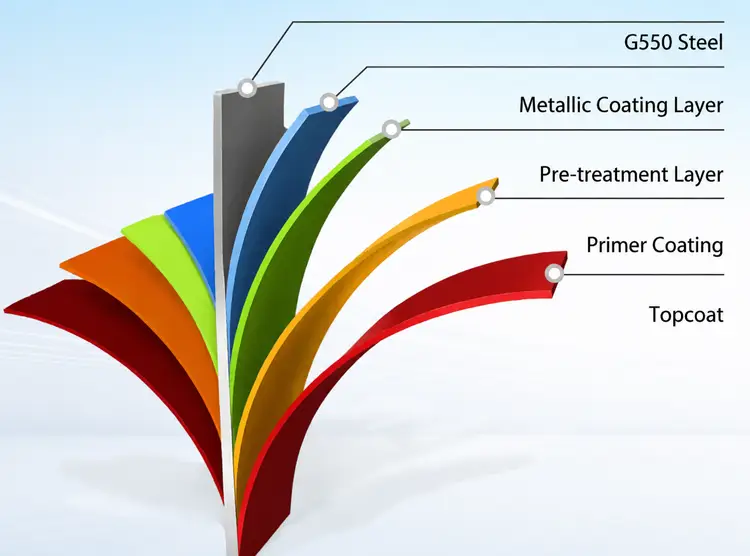
This layered approach is also why two fence panels that look almost identical can perform very differently over time.
For a fence wholesaler, you need to know what is underneath the colour, not simply whether the panel is black, grey or green.
Steel Grade: G300 vs G550
The base steel specification can vary according to the target market and product design.
Based on our current export configurations:
| Market | Typical Steel Grade | Typical Application |
|---|---|---|
| Australia | G550 | Colorbond-style fence sheets |
| North America | G300 | Fence sheet applications |
| United Kingdom | G300 | Fence sheet applications |
For Australian Colorbond-style fence projects, we commonly work with approximately 0.35 mm G550 base steel for the sheet section.
For North American and UK projects, G300 is more commonly used in our current configurations.
This is why comparing suppliers only by panel dimensions can be misleading. You should also confirm the base steel grade and thickness used to manufacture the panel.
ZM vs AZ Coating: What Is the Difference?
The metallic coating is one of the most important parts of corrosion protection.
At JZH Fence, two coating systems may be considered depending on the product and project requirements: ZM and AZ.
ZM60 for Standard Applications
ZM refers to a zinc-aluminium-magnesium metallic coating.
For applicable fence sheet products, our regular configuration may use approximately ZM60, meaning a nominal coating mass of around 60 g/m².
One useful characteristic of zinc-aluminium-magnesium coatings is their ability to provide additional protection around exposed cut edges through corrosion products formed from the coating.
For wholesalers, this can be particularly useful when evaluating sheet products where edges are exposed after forming or fabrication.
The exact ZM specification should still be confirmed for each order rather than assumed across every fence component.
AZ150 for Standard Higher-Corrosion Requirements
For applications requiring stronger corrosion protection, we also use AZ-coated steel.
A common standard project configuration is:
AZ150
For projects with more demanding exposure conditions, we can increase the coating mass according to the project specification.
Typical custom options may reach approximately:
AZ175–275 g/m²
A higher coating number should not, however, be treated as the only indicator of quality.
You still need to consider:
steel grade + metallic coating + surface finish + component design + project environment.
Surface Rust vs Real Corrosion: How Can You Tell the Difference?
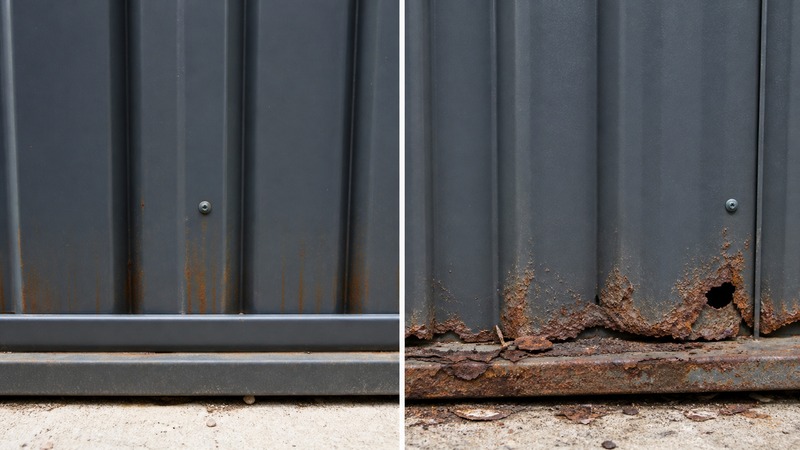
Not every orange spot on a steel fence means that the fence panel is rusting through.
This distinction matters because the solution is completely different.
Surface Rust or Swarf Staining
Surface contamination often appears as:
- Small orange or brown spots
- Speckled stains after rain
- Marks around areas where steel was recently cut or ground
- Rust spots without obvious paint bubbling underneath
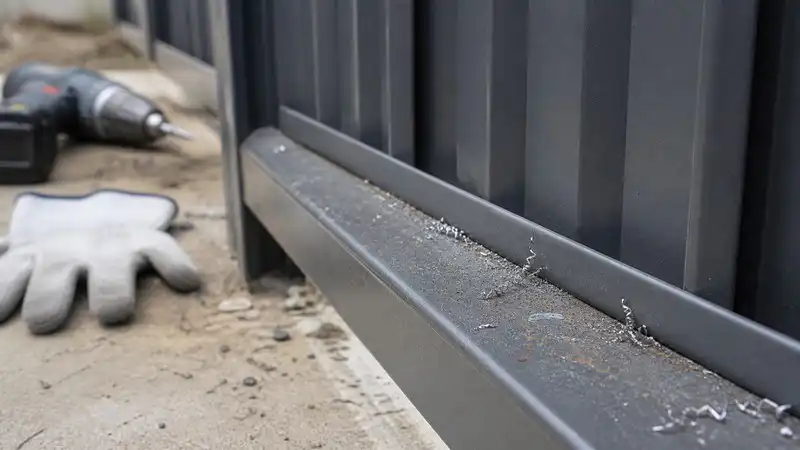
A common source is metal swarf.
When installers cut steel posts, rails or other metal components close to a finished fence, tiny iron particles can land on the coating.
Those particles then rust when exposed to moisture.
The rust may be sitting on the coating, rather than coming from the coated steel panel underneath.
Actual Steel Corrosion
True corrosion is more serious.
Look for:
- Paint bubbling
- Paint lifting or flaking
- Pitting in the metal
- Rust spreading underneath the coating
- Deterioration around exposed edges
- Corrosion affecting posts or structural components
| Sign | Surface Contamination | Actual Corrosion |
|---|---|---|
| Orange speckles | Common | Possible |
| Paint remains intact | Usually | Less likely |
| Paint bubbling | Rare | Common |
| Metal pitting | No | Yes |
| Can often be cleaned | Yes | Usually no |
| Structural impact | No | Possible |
7 Common Causes of Rust on Colorbond-Style Fencing
Understanding where corrosion starts helps both distributors and installers prevent avoidable complaints.
1. Metal Swarf and Grinding Dust
Cutting and grinding steel near finished fence panels creates small metal particles.
If the particles remain on the coating through rain or high humidity, they can quickly oxidise and leave orange stains.
Whenever fabrication is required, metal debris should be removed before it becomes wet.
2. Scratches and Coating Damage
Fence panels can be scratched during:
- Container loading
- Transport
- Unloading
- Site handling
- Installation
A light surface mark may only affect the topcoat.
A deeper scratch can penetrate the protective layers and expose the metallic coating underneath.
For distributors importing container quantities, packaging and loading quality therefore matter almost as much as the coating specification itself.
3. Long-Term Contact With Soil
Keeping the bottom of a steel fence constantly in contact with wet soil, mulch or garden debris increases corrosion risk.
Moisture becomes trapped against the sheet edge instead of drying naturally.
Where a project has uneven ground, ground gaps or minor level differences, a properly selected Colorbond fence plinth can help separate the steel infill section from direct ground contact. However, retaining requirements still need to be evaluated separately according to soil conditions and loads.
Good installation design should minimise persistent wet contact wherever possible.
4. Standing Water
Drainage also matters.
Fence bases installed in areas where water regularly collects remain wet for much longer than fencing in a free-draining area.
For large housing developments, landscape design and fence specification should therefore be considered together.
5. Incompatible Screws and Accessories
A fence is a system, not just a sheet.
You also need to consider:
- Posts
- Rails
- Screws
- Brackets
- Gates
- Other exposed accessories
If the panel has good corrosion protection but another component has a much weaker finish, the weakest component can become the source of an after-sales complaint.
This is particularly important for project and bulk fence buyers, where replacing one unsuitable component across hundreds of fence bays can create considerably more cost than correcting the specification before production.
6. Chemicals and Industrial Pollution
Corrosive exposure is not limited to the ocean.
Agricultural chemicals, fertilisers, industrial fallout, acid rain and other contaminants can also accelerate coating degradation.
A project close to an industrial area may therefore require a different specification from a normal suburban project even if both are far from the coast.
7. Coastal Salt and High Humidity
Salt deposits combined with moisture create one of the most demanding environments for coated steel.
BlueScope’s Technical Bulletin TB35 – Australian Salt Marine Classifications also distinguishes different Australian salt marine environments, reinforcing why actual environmental exposure needs to be considered rather than relying only on a single coastline-distance number.
This is why we ask additional questions before quoting Colorbond-style fencing for coastal markets.
What Should Fence Wholesalers Check Before Buying Colorbond-Style Fencing?
This is one of the most important lessons from our B2B enquiries.
When a wholesaler asks us for Colorbond-style fencing, we do not recommend comparing suppliers only by the price per panel.
A cheaper panel can become expensive if the specification is unsuitable for the distributor’s market and creates replacement claims later.
Before ordering, we recommend confirming at least these four areas.
1. Base Material
Confirm the steel grade and base metal thickness.
2. Corrosion Protection
Confirm whether the material uses ZM, AZ or another coating system, as well as the actual coating mass.
3. Finished Component Dimensions
Do not ask only for sheet thickness.
Ask separately for panel, rail and post specifications.
4. End-Use Environment
Tell the supplier whether your customers are primarily located inland, near the coast, in industrial regions or in other corrosive environments.
Typical Specifications We Currently Work With
| Component | Current Reference Specification |
|---|---|
| Australian fence sheet | G550, approx. 0.35 mm base steel |
| North America / UK sheet | G300 |
| North America / UK pre-coated sheet | approx. 0.5 mm |
| Coated sheet | approx. 0.5–0.55 mm |
| Rail / post base material | 0.8 mm |
| Rail / post after coating | minimum approx. 0.9 mm |
| Standard ZM option | ZM60 |
| Common AZ option | AZ150 |
| Enhanced corrosion option | AZ175–275 g/m², project dependent |
These figures should be confirmed against the final product drawing and purchase order because specifications can vary by product, market and customer requirement.
What Documents Should a Distributor Ask For?
Before placing a container order, we recommend asking the supplier to confirm:
- Steel grade
- Base material thickness
- Metallic coating type
- Coating mass
- Surface coating process
- Rail and post specifications
- Product drawings or datasheets
- Samples where required
- Production photos or videos
- Available testing or inspection documents
- Recommended specification for the final installation environment
The most important takeaway is simple:
Corrosion resistance should be evaluated at system level, not only at panel level.
Does Colorbond-Style Fencing Rust Near the Coast?
Coastal conditions require more attention because airborne salt can remain on steel surfaces and increase the corrosive load.
However, distance from the ocean is only one factor.
Wind direction, breaking surf, rainfall, humidity, industrial pollution, nearby buildings and areas that do not receive regular rain washing can all change the actual exposure level.
For this reason, a supplier should not select a coastal fence specification using a single number alone.
How We Screen Coastal Colorbond-Style Fence Enquiries
When we receive a coastal enquiry, one of the first questions we ask is:
“How far is the project from the coastline?”
For our export fencing enquiries, we currently use 30 km as an internal preliminary screening point.
This is a purchasing and project-review rule used to identify enquiries that require additional corrosion discussion.
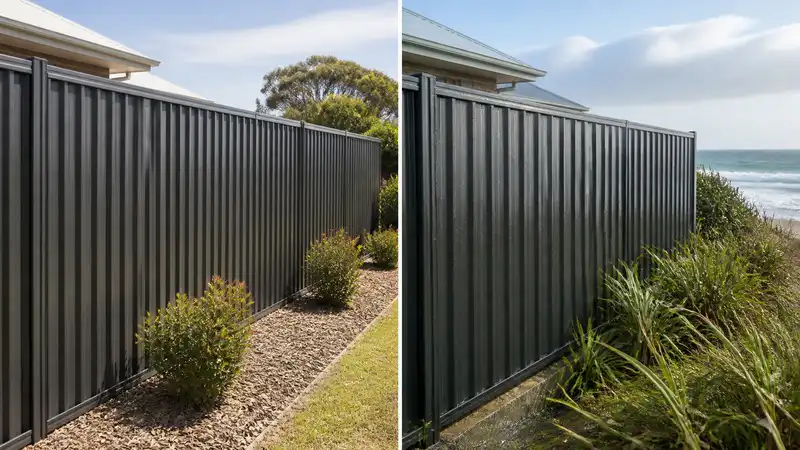
It is not an Australian building standard and it is not BlueScope’s official COLORBOND® distance rule.
For Australian projects, BlueScope’s salt marine environment classification guidance can be used as an additional external reference when assessing actual exposure conditions.
Projects More Than 30 km From the Coast
When a project is more than approximately 30 km inland, we normally start by evaluating standard configurations such as:
ZM60 or AZ150
We then consider the actual location and application before confirming the final specification.
Projects Less Than 30 km From the Coast
When the project is within approximately 30 km of the coastline, we flag it for additional corrosion review.
We ask about:
- Exact location
- Approximate distance from the sea
- Salt exposure
- Humidity
- Industrial pollution
- Expected service environment
- Required project life
The closer or more aggressive the environment, the more likely we are to recommend upgrading the corrosion-protection system.
How We Configure Fencing for Higher-Corrosion Coastal Projects
Increase the Metallic Coating
A standard project may use AZ150.
For a more demanding coastal project, we may recommend:
AZ175 or higher
Depending on the customer’s requirements, customised coating masses of approximately AZ175–275 g/m² may be considered.
The final specification depends on the actual product and exposure environment.
Upgrade the Surface Finish
For high-salt or strongly corrosive projects, we do not want to rely only on a basic pre-coated finish.
One option is an upgraded PVDF coating system.
Another is increasing the metallic coating protection.
In some projects, both approaches may be considered.
Protect Rails and Posts Too
A coastal fence specification is incomplete if only the sheet is upgraded.
Rails and posts are also exposed to:
- Salt
- Condensation
- Rain
- UV
- Pollutants
For high-corrosion environments such as near-coastal or high-acid-rain locations, we may therefore recommend a more protective coating system for the posts and rails as well.
For this reason, B2B buyers should evaluate the complete steel fence system rather than looking only at the infill sheets.
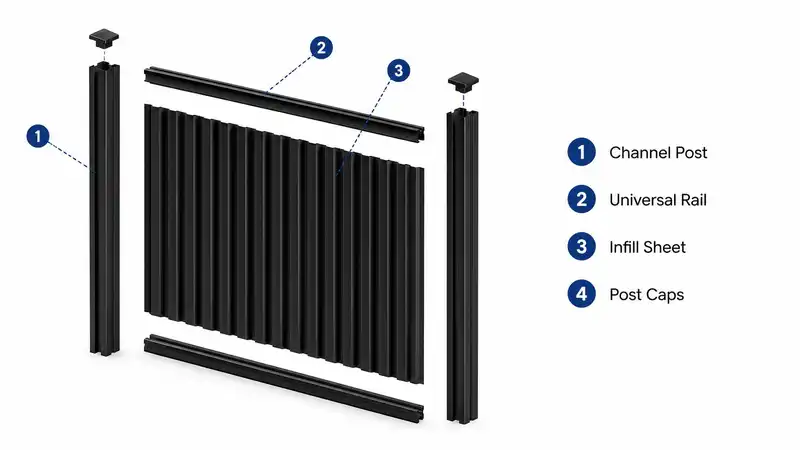
This is why we prefer to discuss a complete fence corrosion-protection package instead of selling an upgraded panel with standard supporting components.
Australian Coastal Distributor Case Study
Here is an anonymous project example that illustrates how this works in practice.
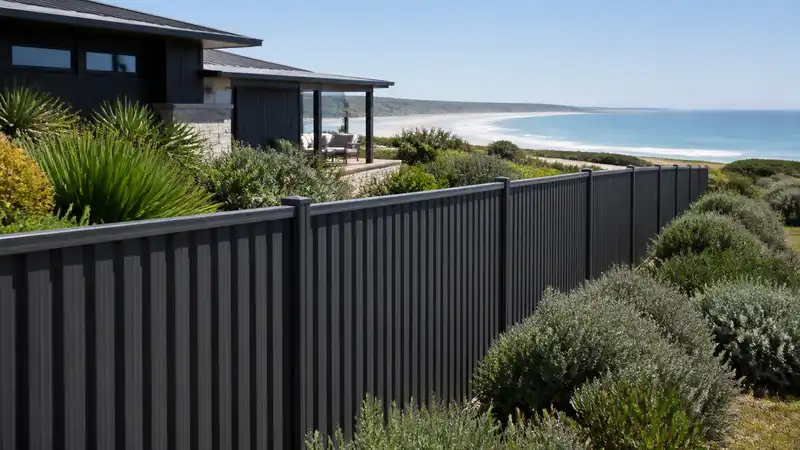
An Australian fence distributor needed Colorbond-style fencing for residential boundary projects in a coastal sales area.
Some of the installations were approximately 15–20 km from the coastline.
The customer was not only concerned about initial purchasing price.
Their bigger concerns were:
- Will customers report rust spots after installation?
- Will exposed sheet edges corrode?
- Will rails or posts deteriorate before the panels?
- Will corrosion create replacement claims?
- Will after-sales costs reduce the margin on the original order?
Because the end-use area was within our coastal screening range, we reviewed the project as a higher-corrosion application rather than automatically supplying a standard inland specification.
Project Configuration
| Item | Selected / Recommended Configuration |
|---|---|
| Fence sheet | G550 steel |
| Sheet thickness | approx. 0.35 mm |
| Metallic coating | AZ175+ |
| Surface finish | PVDF coating |
| Rails / posts | 0.8 mm base steel, ≥0.9 mm after coating |
| Environment | Approx. 15–20 km from coastline |
The main lesson from this project was not simply that “a thicker coating is better.”
It was that the distributor needed a specification matched to the sales environment and long-term after-sales risk.
For a wholesaler, saving a small amount on the original panel price may not be a real saving if the wrong specification later results in:
- Replacement panels
- Additional freight
- Installation labour
- Warranty discussions
- Customer complaints
- Damage to the distributor’s local reputation
That is why our recommendation for B2B buyers is:
Choose corrosion protection according to where the fence will be sold and installed—not only according to the lowest panel price.
How to Prevent Rust on Colorbond-Style Fencing
Good corrosion performance starts before the fence reaches the site.
Before Installation
Choose the material and coating according to the real environment.
For wholesalers, this means giving your supplier enough information about the destination market before ordering.
Also inspect packaging and material condition after arrival, particularly following long-distance sea freight.
During Installation
Avoid unnecessary cutting or grinding next to finished panels.
If cutting is required, remove swarf immediately.
Protect the coating from deep scratches during handling and make sure posts, rails and fasteners are suitable for the same environment as the panels.
After Installation
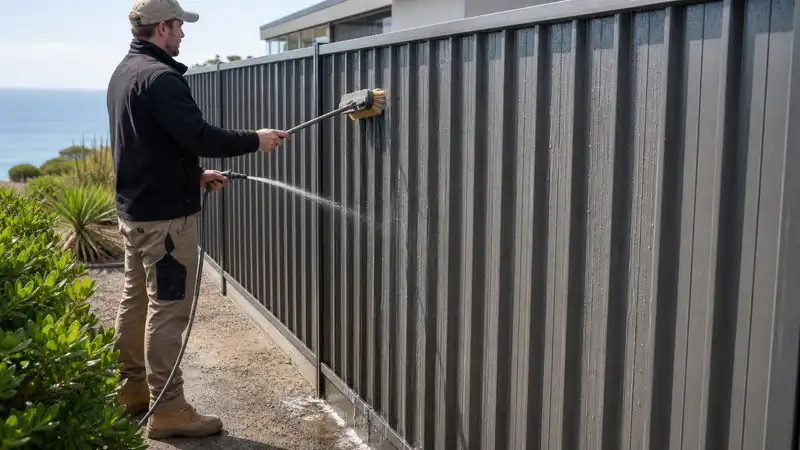
Keep the fence reasonably clean.
BlueScope recommends regular washing of COLORBOND® steel areas that are not naturally cleaned by rain. We recommend washing these unwashed areas with clean fresh water at least every six months, with more frequent cleaning in coastal environments where marine salt spray is present.
Do not allow soil, mulch or debris to remain permanently piled against coated steel.
Also inspect scratches, fixings and component joints periodically so small issues can be identified before they develop into larger corrosion problems.
How Do You Remove Existing Rust Spots?
Start by determining whether you are looking at external contamination or actual corrosion.
For light surface stains:
- Rinse away loose dirt.
- Wash gently with clean water and mild detergent.
- Use a soft sponge or cloth.
- Rinse thoroughly.
- Recheck whether the paint underneath remains intact.
Avoid aggressive steel wool or steel wire brushes because they can damage the finish and introduce additional iron contamination.
If the paint is already blistering, peeling or showing visible pitting underneath, cleaning alone will not solve the problem.
The affected component needs to be assessed for coating damage or replacement.
ZM60 vs AZ150 vs AZ175+: Which Should a Wholesaler Choose?
There is no single coating specification that is automatically best for every order.
| Option | Typical JZH Use | Relative Protection | Typical Decision Logic |
|---|---|---|---|
| ZM60 | Applicable standard sheet products | Standard | Normal environment |
| AZ150 | General corrosion-resistant projects | Good | Standard project specification |
| AZ175+ | Coastal / higher-corrosion projects | Higher | Exposure requires upgrade |
| AZ175–275 | Custom demanding environments | Higher / customised | Project-specific requirement |
The correct choice should be based on:
market + installation environment + fence component + expected corrosion exposure + customer requirement.
For a distributor buying stock, it may also make sense to separate ordinary-market products from upgraded coastal specifications instead of trying to use one configuration for every customer.
Frequently Asked Questions
1. Does Colorbond Steel Eventually Rust?
Any coated steel can corrode if its protective system is damaged or the product is used in an environment beyond its intended specification. Correct material selection and maintenance significantly reduce the risk.
2. Are Orange Spots Always a Sign That the Fence Panel Is Rusting?
No. Orange spots can come from external iron contamination such as grinding dust or metal swarf. Check whether the underlying paint remains intact before assuming structural corrosion.
3. Is AZ150 Enough for Coastal Fencing?
It depends on the actual project environment.
AZ150 may be suitable for many normal applications, while more demanding coastal projects may require a higher coating mass or upgraded surface treatment.
4. What Is the Difference Between ZM60 and AZ150?
They are different metallic coating systems.
ZM contains zinc, aluminium and magnesium, while AZ is an aluminium-zinc based coating system. Selection should depend on the specific fence component and environment rather than simply comparing the coating number.
5. Is G550 Always Better Than G300?
No.
The grade relates to mechanical properties and product design, not simply “better” or “worse.” Our Australian Colorbond-style sheet configurations commonly use G550, while G300 is used in some North American and UK configurations.
Choosing Colorbond-Style Fencing for Your Market
Does Colorbond rust? It can—but the more useful question for a B2B buyer is why corrosion occurs and how the risk can be controlled before the product is ordered.
Steel grade, coating mass, surface finish, component design and environmental exposure all affect long-term performance.
For fence wholesalers and distributors, one of the best ways to reduce future complaints is to provide your supplier with the final market and installation environment before confirming the specification.
JZH Fence supplies Colorbond-style steel fencing systems for distributors, wholesalers and project buyers. We can discuss G300/G550 steel options, ZM and AZ coating configurations, panel thicknesses, posts, rails, accessories and enhanced corrosion-protection options for demanding environments.
If you are sourcing fencing for a coastal or high-corrosion market, send us the destination country, project location, approximate distance from the coastline and required fence specification.
Request a quote to discuss the right Colorbond-style fence configuration for your market.