
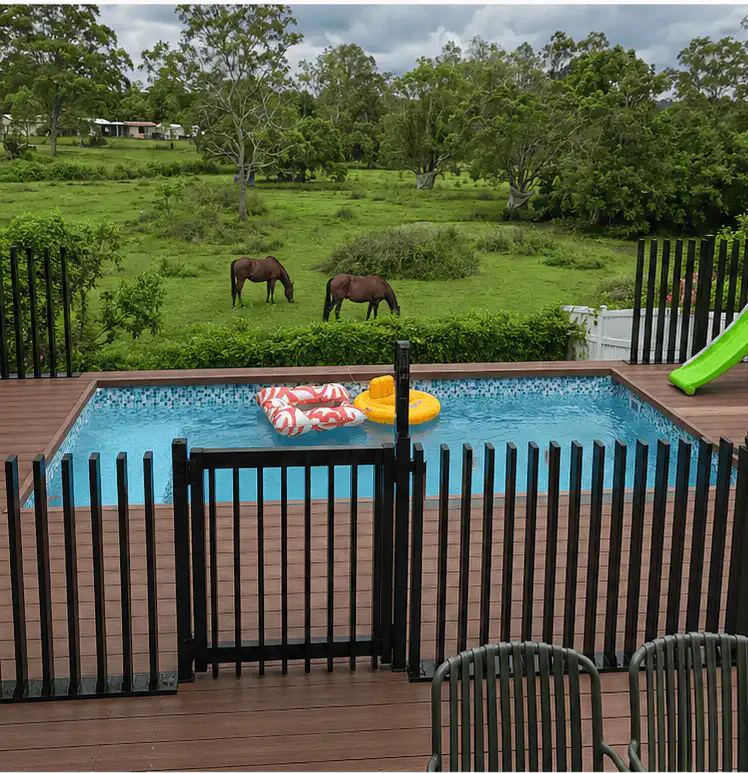
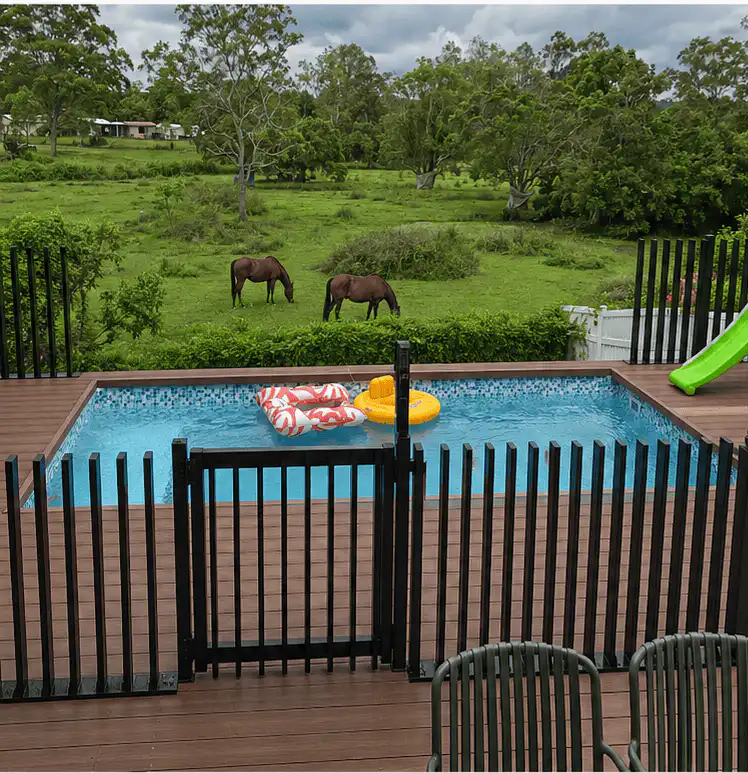
Choosing between different types of pool fencing is about more than appearance. A pool fence needs to meet local safety requirements, fit the installation surface, match the project dimensions, and remain durable in outdoor and poolside environments.
For builders, fencing contractors, distributors, and project buyers, details such as fence height, profile spacing, material thickness, gate hardware, coating, and installation method can matter just as much as the fence style itself.
At JZH Fence, our main pool fencing systems include blade fence, aluminium tubular fence, glass pool fence, and batten fence. Batten fencing can be further configured as barr floating batten fence, frameless batten fence, and Pik round batten panels, giving buyers more flexibility for architectural pool projects.
This guide compares these main pool fencing options and explains how to choose between them based on compliance, installation, specifications, appearance, and project requirements.
Pool Fencing Regulations and Australian Standards
Safety and compliance should always be your first filter when choosing a pool fence.
Australia has detailed requirements for swimming pool barriers. AS 1926.1:2024 – Swimming pool safety – Safety barriers for swimming pools provides requirements covering the design, construction, and performance of pool barriers.
You can review the latest overview from Standards Australia.
However, you should not assume that one specification applies to every project. State regulations, local council requirements, the type of pool, and the barrier location can all affect what is required.
Pool Fence Height
For the Australian pool fencing projects and enquiries we handle, 1.2 m is a commonly requested pool fence height.
For example, current NSW Government guidance states that swimming pool fencing generally needs to be at least 1.2 m high, while boundary fencing forming part of the pool barrier may require different dimensions.
You can check the latest requirements through the NSW Government pool safety guidance.
Before placing an order, confirm:
- Project state or territory
- Local council requirements
- Required fence height
- Pool location
- Whether the fence is a pool barrier or boundary barrier
- Gate dimensions and configuration
Do not simply tell your supplier that you need “a pool fence.”
The more accurately you specify the project conditions, the easier it is to confirm whether the panel dimensions and installation system are suitable.
Gaps and Non-Climbable Zones
Spacing is particularly important for metal pool fencing.
You need to pay attention to:
- Vertical profile spacing
- Ground clearance
- Horizontal rails
- Decorative components
- Furniture or landscaping near the fence
This is particularly relevant when choosing blade fence or batten fence, because different profile widths and spacing arrangements can dramatically change both the appearance and compliance of the finished barrier.
A fence may look suitable for a pool project but still require changes to profile spacing or panel construction before it meets the relevant local requirements.
Self-Closing and Self-Latching Pool Gates
The gate is one of the most important parts of a complete pool fencing system.
Pool gate specifications may involve:
- Self-closing hinges
- Self-latching hardware
- Gate opening direction
- Gate width
- Latch position
- Maximum gaps
- Matching posts
From a procurement perspective, you should confirm the gate specifications at the same time as the fence panels.
Do not treat the gate as an accessory to be decided after production starts.
Key Factors to Consider Before Selecting a Pool Fence
In our enquiries, buyers comparing blade fence, aluminium tubular fence, glass pool fence, and batten fence normally evaluate several factors together.
| Factor | Why It Matters |
|---|---|
| Compliance | Determines whether the fence is suitable for the intended pool application |
| Ease of installation | Influences labour requirements and project progress |
| Specifications, dimensions and thickness | Need to match drawings and structural requirements |
| Appearance | Particularly important for blade and batten pool fencing |
| Visibility | Helps maintain sightlines around the swimming pool |
| Corrosion resistance | Important in wet, chlorinated, and coastal environments |
| Gate configuration | Influences safety and daily use |
| Price | Best compared only after specifications are aligned |
What We See in Actual Pool Fence Enquiries
From our experience, the three most common decision factors are:
- Compliance
- Ease of installation
- Fence specifications, dimensions, and thickness
This is an important distinction for B2B buyers.
Two pool fence quotations may look similar on price, but they may be based on different profile dimensions, material thicknesses, post structures, coatings, or accessories.
Always compare the complete specification rather than only comparing the cost per panel.
Blade Fence for Pool Projects
Blade fence is one of the main pool fencing systems we supply.
It uses narrow vertical aluminium profiles to create a strong architectural appearance while maintaining relatively open sightlines around the swimming pool.
Customers often choose blade fencing because of its:
- Modern appearance
- Clean vertical lines
- Decorative value
- Customisable profile dimensions
- Powder-coated finishes
- Compatibility with modern residential architecture
From our enquiries, customers considering blade fence for pool projects usually place relatively high importance on appearance and decoration.
This makes blade fencing particularly suitable for contemporary houses, villas, apartment projects, hotels, and other projects where the pool fence needs to form part of the overall architectural design.
However, appearance should not be the first specification you confirm.
Before producing a blade pool fence, we normally need to confirm:
- Fence height
- Blade width and depth
- Blade spacing
- Material thickness
- Panel width
- Post size
- Gate size
- Installation surface
- Local compliance requirements
A blade fence designed as a normal residential boundary fence should not automatically be assumed to work as a pool barrier.
The profile configuration needs to match the pool project.
Aluminium Tubular Pool Fence
Aluminium tubular pool fence is a more traditional and highly practical pool fencing solution.
The system normally uses vertical tubular pickets positioned between horizontal rails.
Compared with more architectural fencing styles, aluminium tubular fencing offers a familiar design that is relatively straightforward to manufacture, transport, and install.
Typical advantages include:
- Good visibility
- Lightweight construction
- Corrosion resistance
- Easy handling
- Modular installation
- Powder-coated finishes
- Matching gate systems
From our project experience, aluminium tubular fence is commonly used for both residential swimming pools and commercial swimming pools.
This makes it particularly useful for:
- Residential developments
- Apartment swimming pools
- Commercial properties
- Community pools
- Pool contractors
- Standardised project supply
You can view examples of JZH Fence’s tubular pool fence and garrison fence systems.
One advantage of aluminium tubular fencing is that the design is relatively easy for contractors and distributors to understand.
Once you confirm the required:
- Height
- Panel width
- Vertical picket spacing
- Post size
- Gate configuration
- Surface treatment
the system can be supplied in modular panel sets for relatively efficient site installation.
Glass Pool Fence
Glass pool fence is another major pool fencing category, especially for projects where maintaining an uninterrupted view of the pool is important.
Glass pool fencing works particularly well for:
- Premium residential pools
- Villas
- Hotels
- Resorts
- Apartments
- Rooftop swimming pools
- Architectural developments
The biggest benefit is visibility.
Unlike metal profiles, transparent glass allows you to maintain clear sightlines between the pool and surrounding outdoor areas.
Frameless Glass Pool Fence
Frameless glass pool fencing creates the cleanest visual appearance.
Glass panels are normally supported using components such as:
- Spigots
- Base channels
- Clamps
- Gate hardware
There is very little visible framing.
This allows swimming pools, landscaping, paving, and surrounding architecture to remain visually connected.
Semi-Frameless Glass Pool Fence
Semi-frameless systems use posts between the glass panels.
They create slightly more visible structure but can provide an alternative balance between:
- Appearance
- Structural support
- Installation
- Project budget
What Buyers Should Confirm for Glass Pool Fencing
For a glass pool fence project, you should confirm:
- Glass panel dimensions
- Glass thickness
- Gate dimensions
- Spigot or post system
- Hardware material
- Installation surface
- Local glazing requirements
- Pool barrier requirements
For international projects, glass may sometimes be sourced locally while metal hardware and related components are sourced from a specialist fencing supplier.
This can reduce the logistics risk associated with transporting large quantities of heavy glass internationally.
Batten Fence for Pool Projects
Batten fence is one of the most important pool fencing categories in our current product range.
Compared with conventional tubular fencing, batten fencing delivers a stronger architectural effect.
Vertical aluminium battens can be adjusted in:
- Profile width
- Profile depth
- Spacing
- Panel width
- Height
- Powder-coated colour
This allows contractors and designers to create different levels of openness and different visual styles.
From our current customer enquiries, batten fence is the stronger-selling option among our aluminium pool fencing styles.
Customers commonly choose it because they want to combine:
Compliance + Easy Installation + Suitable Specifications + Modern Appearance
Appearance is particularly important.
Like blade fencing, batten fence is often selected for pool projects where the fence needs to look decorative rather than simply act as a functional barrier.
Our batten pool fencing can be further divided into three main configurations.
Barr Floating Batten Fence
Barr floating batten fence creates a strong vertical architectural appearance while visually reducing the amount of obvious framing around the battens.
The “floating” visual effect makes it suitable for projects where customers want the fence to look lighter and more refined.
It can be considered for:
- Modern residential pools
- Villas
- Hotels
- Apartment projects
- Architectural landscapes
Key specifications still need to be confirmed before production, including:
- Batten size
- Batten spacing
- Panel height
- Panel width
- Post construction
- Material thickness
- Gate configuration
The advantage is not simply appearance.
The dimensions can also be configured around the customer’s project requirements.
Frameless Batten Fence
Frameless batten fence reduces the visual impact of conventional surrounding frames and emphasises the individual vertical battens.
This makes the finished pool fence look cleaner and more integrated with contemporary architecture.
It is particularly useful when the customer wants:
- Minimal visible framing
- Modern straight lines
- Decorative pool boundaries
- Custom batten spacing
- A premium architectural effect
Installation details are particularly important for this type of system.
Before production, the customer and supplier should confirm the post structure and fixing method so that the finished appearance can be achieved without compromising installation stability.
Pik Round Batten Panels
Pik round batten panels use round vertical profiles instead of conventional rectangular battens.
The rounded profile creates a softer visual effect while maintaining the strong vertical rhythm associated with batten fencing.
This design can work particularly well for:
- Modern residential pools
- Hotels
- Resorts
- Commercial pool areas
- Architect-designed projects
Depending on the project, buyers can customise:
- Round profile diameter
- Profile spacing
- Panel width
- Fence height
- Powder-coated colour
- Gate configuration
For pool applications, these specifications should always be checked against the relevant local safety requirements before manufacturing begins.
You can also review JZH Fence’s existing vertical aluminium fencing systems to understand the broader aluminium vertical fence configurations we manufacture.
How Do Customers Choose Between Tubular, Blade and Batten Pool Fencing?
This is one of the most common questions we encounter.
There is no single best answer.
The selection normally depends on what the customer values most.
| Pool Fence | Main Strength | Typical Buyer Priority | Common Application |
|---|---|---|---|
| Aluminium tubular fence | Practical and easy to understand | Compliance and installation | Residential and commercial pools |
| Blade fence | Modern narrow vertical lines | Decoration and appearance | Contemporary pool projects |
| Batten fence | Strong architectural effect | Appearance + customisation | Modern residential and architectural pools |
| Glass pool fence | Maximum visibility | Clear views and premium design | Premium residential, hotel, resort |
Our Experience: Batten Fence Currently Receives Stronger Demand
Among the aluminium pool fencing options we currently sell, batten fence is more popular.
For blade and batten fence projects, customers often place greater importance on the decorative appearance of the fence.
Aluminium tubular pool fencing, on the other hand, remains common for both residential and commercial swimming pools because it provides a more conventional and practical solution.
But regardless of which design a customer prefers, the final decision normally comes back to the same three questions:
- Is it compliant?
- Is it easy to install?
- Do the size, dimensions, and thickness match the project?
These questions should be answered before comparing prices.
An Australian Pool Fence Project Example
One Australian customer we worked with ultimately placed an order after evaluating three factors together.
First, the customer liked the fence style.
Second, the dimensions matched the project requirements.
Third, the system also matched the customer’s compliance requirements.
Once these three points were confirmed, the customer proceeded with the order.
This is representative of what we see in real project sourcing.
Pool fencing is rarely selected successfully based on appearance alone.
For a B2B project, the product needs to bring together:
Style + Dimensions + Compliance
If one of these three elements does not match, the customer may need to change the design or specification.
Pool Fence Installation: What Buyers Often Overlook
Fence panels receive most of the attention during purchasing.
But many installation problems actually come from smaller components or incorrect site information.
Common issues include:
- Incorrect post length
- Incorrect fixing method
- Missing fasteners
- Wrong gate hinges
- Unclear ground conditions
Pool Fence Fasteners and Hardware
In our pool fencing projects, common installation components include:
- Expansion bolts
- Post caps
- Gate hinges
These are small compared with the fence panels, but they can directly affect installation efficiency and long-term operation.
When requesting a quotation, confirm whether your supplier is including:
- Panels
- Posts
- Caps
- Expansion bolts
- Gate frames
- Hinges
- Latches
- Other installation accessories
JZH Fence can provide matching aluminium fence posts, gates, caps, hinges, locks, and installation accessories together with the fence system.
Installing Pool Fencing on Concrete
The pool fencing projects we handle are most commonly installed on concrete surfaces.
In this type of installation, we normally use expansion bolts as part of the fixing system.
The installer needs to confirm:
- Concrete surface
- Post type
- Base arrangement
- Bolt position
- Fence height
- Gate location
Concrete installation is generally more straightforward when the correct post and fixing system have already been confirmed before production.
Installing Pool Fencing on Soil
Installation directly into soil requires a different post specification.
When a pool fence is installed in soil, the post normally needs to be longer.
The additional section of the post provides the required depth below ground for installation and stability.
This is why telling your supplier that you need a 1.2 m pool fence is not enough information to determine the post length.
The supplier also needs to know:
Will the fence be installed on concrete or in soil?
Our Installation Experience
This is one of the questions we recommend confirming before production.
For a typical concrete installation, expansion bolts can be used with the appropriate post fixing system.
For installation in soil, the post normally needs to be extended.
Confirming this before production can reduce the risk of:
- Wrong post lengths
- On-site cutting or modification
- Replacement posts
- Additional international freight
- Installation delays
- Extra labour costs
For B2B orders, the installation surface should therefore be treated as part of the product specification.
Corrosion Resistance and Powder Coating
Pool fencing is constantly exposed to outdoor conditions.
Depending on the project, the fence may face:
- Moisture
- Pool water
- Chlorinated environments
- UV exposure
- Rain
- Coastal salt spray
This makes surface treatment particularly important.
For our aluminium pool fencing projects, we can use high-durability, thicker powder coating when the environment requires stronger protection.
For coastal projects, coating and fastener selection require even more attention.
The complete system should be evaluated, including:
- Aluminium profiles
- Powder coating
- Expansion bolts
- Gate hinges
- Connection points
- Post caps
A high-quality fence panel alone cannot compensate for unsuitable hardware or an incorrect installation system.
Product Dimensions Also Affect Performance
Surface treatment is only one part of the specification.
Customers also need to confirm:
- Fence height
- Panel width
- Profile dimensions
- Material thickness
- Post dimensions
- Spacing
- Gate dimensions
From our experience, customers frequently care about the size, dimensions, and thickness because they affect both project matching and installation.
This is one reason we do not recommend selecting a pool fence only from a product photograph.
For B2B purchasing, drawings and specifications are much more useful.
Warranty and Long-Term Use
For suitable specifications and project conditions, some of our fencing systems can be supplied with 20–25-year warranty coverage, subject to the specific product, surface treatment, installation environment, maintenance conditions, and written warranty terms.
When comparing suppliers, do not compare warranty numbers alone.
Ask what the warranty actually covers, including:
- Fence structure
- Powder coating
- Corrosion
- Hardware
- Installation conditions
- Environmental exclusions
This gives you a much more meaningful comparison.
Which Pool Fence Should You Choose?
The easiest way to choose is to start with your project rather than the product catalogue.
Choose Aluminium Tubular Pool Fence If You Need:
- A practical pool fencing solution
- Residential or commercial use
- High visibility
- Straightforward installation
- A conventional pool fence appearance
Choose Blade Fence If You Need:
- Modern architecture
- Narrow vertical lines
- Decorative appearance
- Custom profile dimensions
- A visually distinctive pool fence
Choose Batten Fence If You Need:
- Strong architectural design
- Flexible profile spacing
- Custom dimensions
- Modern residential or commercial styling
- Multiple design configurations
Then choose between:
- Barr floating batten fence
- Frameless batten fence
- Pik round batten panels
based on the visual effect and structural configuration required.
Choose Glass Pool Fence If You Need:
- Maximum visibility
- Minimal visual obstruction
- Premium pool design
- Integration with high-end landscaping
- Clear sightlines from the house or commercial property
How to Specify a Pool Fence Before Requesting a Quote
Before contacting a pool fencing manufacturer or supplier, prepare the following information.
Step 1: Confirm Compliance Requirements
Provide:
- Country
- State or region
- Applicable pool standard
- Required fence height
- Required profile spacing
- Gate requirements
Step 2: Confirm the Fence Style
Choose from:
- Blade fence
- Aluminium tubular fence
- Glass pool fence
- Barr floating batten fence
- Frameless batten fence
- Pik round batten panels
Step 3: Confirm Product Specifications
Provide:
- Fence height
- Panel width
- Total fence length
- Profile dimensions
- Material thickness
- Post size
- Gate quantity
- Gate dimensions
Step 4: Confirm the Installation Surface
Tell your supplier whether the fence will be installed on:
- Concrete
- Soil
- Deck
- Retaining wall
- Other structures
This is especially important because concrete and soil installations may require different post lengths and fixing methods.
Step 5: Confirm the Surface Treatment and Accessories
Confirm:
- Powder coating
- Colour
- Expansion bolts
- Caps
- Hinges
- Gate hardware
- Installation accessories
This helps your supplier quote a complete pool fencing system rather than only the panels.
Why Source Pool Fencing from JZH Fence?
JZH Fence supplies fencing systems for contractors, distributors, wholesalers, developers, and project buyers in Australia and other international markets.
Our key pool fencing products include:
- Blade fence
- Aluminium tubular pool fence
- Glass pool fence
- Batten fence
- Barr floating batten fence
- Frameless batten fence
- Pik round batten panels
We can also provide matching:
- Posts
- Gates
- Expansion bolts
- Caps
- Hinges
- Installation accessories
For aluminium systems, buyers can review our aluminium fencing solutions and tubular fencing systems.
For project orders, JZH Fence can support:
- Custom panel dimensions
- Custom profile specifications
- Fence heights
- Powder-coated colours
- Matching gates
- Post configurations
- Installation accessories
- OEM / ODM requirements
- Project drawings
Our goal is not simply to supply panels.
We help buyers match the fence system to the required compliance, project dimensions, installation conditions, and architectural design.
FAQs About Types of Pool Fencing
What Are the Main Types of Pool Fencing JZH Fence Supplies?
Our main pool fencing categories are blade fence, aluminium tubular fence, glass pool fence, and batten fence.
Batten fence can be further configured as barr floating batten fence, frameless batten fence, and Pik round batten panels.
Which Pool Fence Is More Popular for Modern Projects?
From our current enquiries, batten fence is the stronger-selling aluminium pool fencing style.
Blade and batten fencing are both commonly chosen when customers place more emphasis on modern appearance and decoration.
What Is the Difference Between Blade Fence and Batten Fence?
Both use vertical aluminium elements.
Blade fence typically creates narrower and sharper vertical lines, while batten fencing provides more flexibility in profile width, depth, and spacing.
Batten fence can also be configured in several structural styles, including floating, frameless, and round-profile panel systems.
For B2B sourcing, it is better to compare the actual technical drawings rather than relying only on product names.
Is Aluminium Tubular Fence Suitable for Swimming Pools?
Yes.
From our project experience, aluminium tubular fence is commonly used for both residential and commercial swimming pools.
It provides good visibility, low maintenance, relatively simple installation, and compatibility with matching pool gates.
What Pool Fence Height Is Common in Australia?
For the Australian pool fencing projects we handle, 1.2 m is a common requested height.
However, the final specification should always be checked against the applicable local pool safety requirements before production.
Can Pool Fencing Be Installed in Soil?
Yes, depending on the project and installation design.
However, posts installed into soil generally need to be longer because part of the post needs to extend below ground.
For concrete installations, we commonly use expansion bolts as part of the fixing system.
Conclusion: Match the Pool Fence to Your Project Requirements
Choosing between different types of pool fencing becomes easier when you follow the right sequence.
Start with:
- Compliance
- Installation conditions
- Fence dimensions and thickness
- Fence style
- Surface treatment
- Hardware and accessories
- Price
If your project needs a practical and widely applicable option, aluminium tubular pool fencing is worth considering.
If architectural appearance is a priority, blade fence or batten fence gives you more design flexibility.
Within batten fencing, you can further choose between barr floating batten fence, frameless batten fence, and Pik round batten panels.
If maintaining clear views of the swimming pool is your priority, glass pool fencing may be the better solution.
If you are sourcing pool fencing for a residential project, commercial pool, distribution business, or contractor programme, contact JZH Fence with your project specifications.
Send us your required fence style, height, panel dimensions, thickness, quantity, gate requirements, installation surface, and destination so we can help you confirm a suitable pool fencing system.